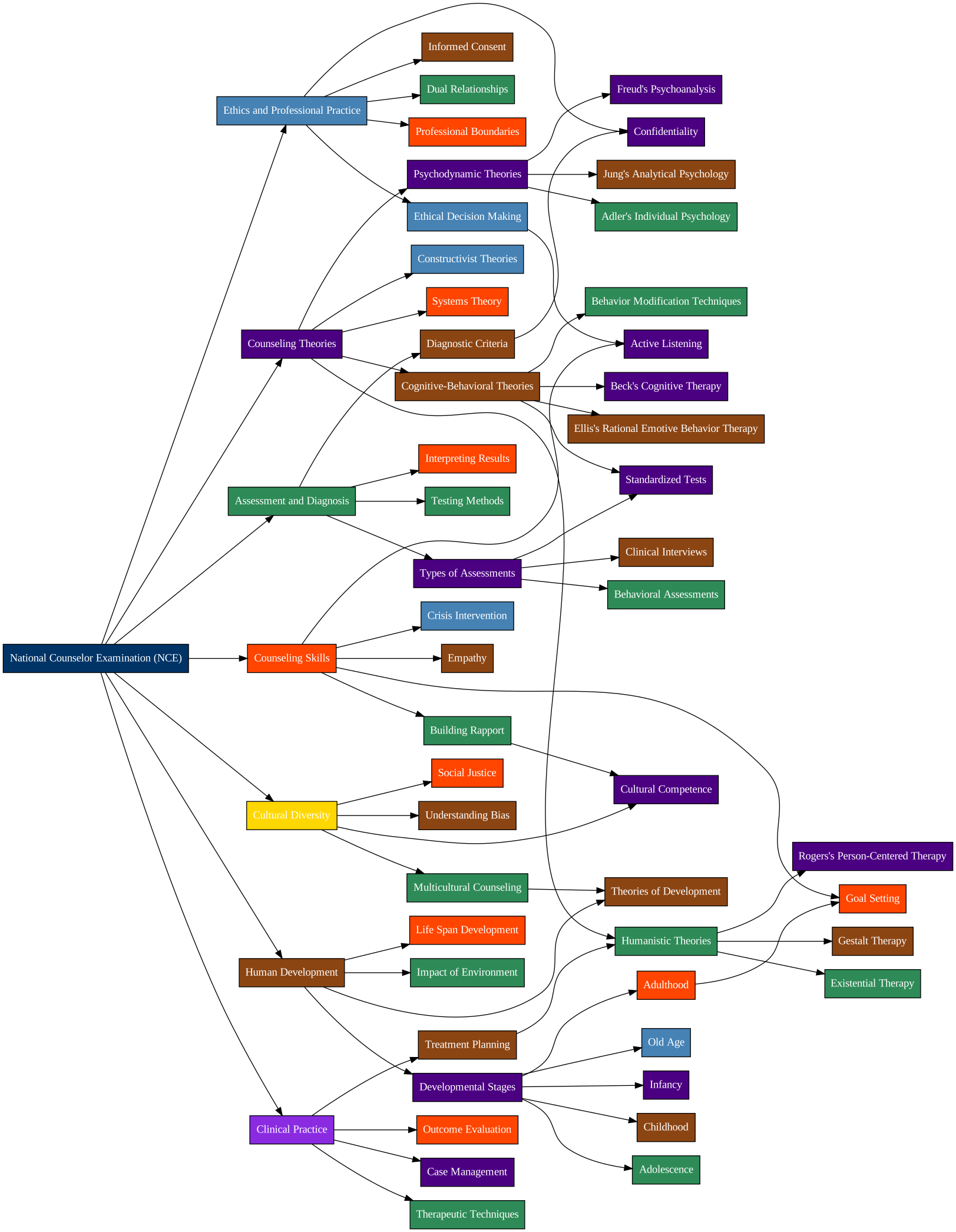
Quiz-summary
0 of 30 questions completed
Questions:
- 1
- 2
- 3
- 4
- 5
- 6
- 7
- 8
- 9
- 10
- 11
- 12
- 13
- 14
- 15
- 16
- 17
- 18
- 19
- 20
- 21
- 22
- 23
- 24
- 25
- 26
- 27
- 28
- 29
- 30
Information
Premium Practice Questions
You have already completed the quiz before. Hence you can not start it again.
Quiz is loading...
You must sign in or sign up to start the quiz.
You have to finish following quiz, to start this quiz:
Results
0 of 30 questions answered correctly
Your time:
Time has elapsed
You have reached 0 of 0 points, (0)
Categories
- Not categorized 0%
- 1
- 2
- 3
- 4
- 5
- 6
- 7
- 8
- 9
- 10
- 11
- 12
- 13
- 14
- 15
- 16
- 17
- 18
- 19
- 20
- 21
- 22
- 23
- 24
- 25
- 26
- 27
- 28
- 29
- 30
- Answered
- Review
-
Question 1 of 30
1. Question
A researcher at the University of Taipei is developing a novel theoretical framework to explain the resilience of metropolitan areas to cascading disruptions. Their model posits that a city’s capacity to absorb, adapt to, and recover from systemic shocks is significantly enhanced by a synergistic interplay between its economic sector heterogeneity and the density of its civic engagement networks. To empirically validate this hypothesis, the researcher needs to design a study that can most effectively demonstrate a causal relationship between these factors and urban resilience, while accounting for the inherent complexities and potential confounding variables present in a dynamic urban environment like Taipei. Which research methodology would best serve to establish this causal link and align with the University of Taipei’s emphasis on robust empirical validation?
Correct
The scenario describes a researcher at the University of Taipei attempting to validate a new theoretical model of urban resilience. The model posits that a city’s ability to withstand and recover from disruptions is directly proportional to the diversity of its economic sectors and the strength of its social capital networks. The researcher collects data on Taipei’s economic diversification index (EDI) and a social cohesion score (SCS) derived from community engagement metrics. The model predicts a positive correlation between these two variables and the city’s resilience index (RI). To test this, the researcher hypothesizes that if the model is accurate, then increasing both EDI and SCS should lead to a statistically significant increase in RI. The core of the question lies in identifying the most appropriate research methodology to establish causality, not just correlation, between these variables, given the complexity of urban systems and the potential for confounding factors. Option A, a longitudinal study with controlled interventions, is the most robust approach. A longitudinal study tracks changes over time, allowing for the observation of how shifts in EDI and SCS precede changes in RI. Controlled interventions, even if simulated or phased, would involve manipulating these variables (e.g., policies promoting economic diversification or community building) in specific districts or sectors and comparing their resilience outcomes against control groups. This design aims to isolate the effect of EDI and SCS on RI by minimizing the influence of external, unmeasured variables. This aligns with the rigorous empirical standards expected in research at the University of Taipei, particularly in fields like urban planning and sociology. Option B, a cross-sectional survey, would only capture a snapshot in time and would be prone to identifying correlations rather than causal relationships. It wouldn’t effectively demonstrate how changes in economic diversity or social capital *lead* to changes in resilience. Option C, a qualitative case study of a single neighborhood, while providing rich detail, would lack the generalizability and statistical power to validate a city-wide theoretical model. It might offer insights into mechanisms but not broad predictive validity. Option D, a meta-analysis of existing literature, is valuable for synthesizing prior research but cannot generate new empirical evidence to test a novel theoretical model directly. It relies on the quality and design of previous studies, which may not have addressed the specific causal pathways proposed by the University of Taipei researcher’s model. Therefore, a longitudinal study with controlled interventions offers the strongest methodological foundation for establishing the causal link hypothesized by the University of Taipei researcher’s model, reflecting the University’s commitment to evidence-based research and rigorous scientific inquiry.
Incorrect
The scenario describes a researcher at the University of Taipei attempting to validate a new theoretical model of urban resilience. The model posits that a city’s ability to withstand and recover from disruptions is directly proportional to the diversity of its economic sectors and the strength of its social capital networks. The researcher collects data on Taipei’s economic diversification index (EDI) and a social cohesion score (SCS) derived from community engagement metrics. The model predicts a positive correlation between these two variables and the city’s resilience index (RI). To test this, the researcher hypothesizes that if the model is accurate, then increasing both EDI and SCS should lead to a statistically significant increase in RI. The core of the question lies in identifying the most appropriate research methodology to establish causality, not just correlation, between these variables, given the complexity of urban systems and the potential for confounding factors. Option A, a longitudinal study with controlled interventions, is the most robust approach. A longitudinal study tracks changes over time, allowing for the observation of how shifts in EDI and SCS precede changes in RI. Controlled interventions, even if simulated or phased, would involve manipulating these variables (e.g., policies promoting economic diversification or community building) in specific districts or sectors and comparing their resilience outcomes against control groups. This design aims to isolate the effect of EDI and SCS on RI by minimizing the influence of external, unmeasured variables. This aligns with the rigorous empirical standards expected in research at the University of Taipei, particularly in fields like urban planning and sociology. Option B, a cross-sectional survey, would only capture a snapshot in time and would be prone to identifying correlations rather than causal relationships. It wouldn’t effectively demonstrate how changes in economic diversity or social capital *lead* to changes in resilience. Option C, a qualitative case study of a single neighborhood, while providing rich detail, would lack the generalizability and statistical power to validate a city-wide theoretical model. It might offer insights into mechanisms but not broad predictive validity. Option D, a meta-analysis of existing literature, is valuable for synthesizing prior research but cannot generate new empirical evidence to test a novel theoretical model directly. It relies on the quality and design of previous studies, which may not have addressed the specific causal pathways proposed by the University of Taipei researcher’s model. Therefore, a longitudinal study with controlled interventions offers the strongest methodological foundation for establishing the causal link hypothesized by the University of Taipei researcher’s model, reflecting the University’s commitment to evidence-based research and rigorous scientific inquiry.
-
Question 2 of 30
2. Question
Consider the University of Taipei’s commitment to fostering a harmonious blend of tradition and modernity in its urban planning initiatives. A proposal is on the table to construct a new high-speed rail station adjacent to a historically significant district in Taipei, renowned for its well-preserved traditional shophouses, active artisanal workshops, and vibrant community life. What strategic approach would best facilitate the integration of this major transportation hub while respecting and enhancing the unique cultural identity and social fabric of the existing neighborhood?
Correct
The core of this question lies in understanding the principles of cultural preservation and adaptation within urban development, a key consideration for a city like Taipei. The scenario presents a conflict between modern infrastructure needs and the preservation of historical urban fabric. The University of Taipei, with its focus on urban studies and cultural heritage, would expect students to analyze this conflict through a lens that balances progress with the safeguarding of intangible and tangible cultural assets. The question asks to identify the most appropriate strategy for integrating a new high-speed rail station into an existing district characterized by traditional shophouses and artisanal workshops. Option a) proposes a strategy that emphasizes adaptive reuse of existing structures, integration of traditional architectural elements into new designs, and the creation of public spaces that foster community interaction and showcase local crafts. This approach directly addresses the need to preserve the district’s cultural identity while accommodating modern infrastructure. It aligns with principles of sustainable urban development and heritage conservation, which are often central to academic discourse at institutions like the University of Taipei. This strategy acknowledges that urban development is not merely about functionality but also about maintaining the social and cultural continuity of a place. It promotes a symbiotic relationship between the new development and the existing heritage, rather than a purely utilitarian or destructive one. Option b) suggests a purely functional approach focused on maximizing efficiency and minimizing disruption, which could lead to the demolition of historical structures. This would disregard the cultural significance of the district. Option c) advocates for a complete segregation of the new development from the old, creating a distinct modern zone. While this might preserve the old district, it fails to integrate the new infrastructure meaningfully and misses an opportunity for synergistic development. Option d) proposes a superficial aesthetic overlay without addressing the underlying structural and functional integration of the new station with the existing urban fabric, potentially leading to a disjointed and inauthentic outcome. Therefore, the strategy that best balances the demands of modern infrastructure with the preservation and integration of cultural heritage, reflecting a nuanced understanding of urban planning and cultural stewardship, is the one that prioritizes adaptive reuse, design integration, and community engagement.
Incorrect
The core of this question lies in understanding the principles of cultural preservation and adaptation within urban development, a key consideration for a city like Taipei. The scenario presents a conflict between modern infrastructure needs and the preservation of historical urban fabric. The University of Taipei, with its focus on urban studies and cultural heritage, would expect students to analyze this conflict through a lens that balances progress with the safeguarding of intangible and tangible cultural assets. The question asks to identify the most appropriate strategy for integrating a new high-speed rail station into an existing district characterized by traditional shophouses and artisanal workshops. Option a) proposes a strategy that emphasizes adaptive reuse of existing structures, integration of traditional architectural elements into new designs, and the creation of public spaces that foster community interaction and showcase local crafts. This approach directly addresses the need to preserve the district’s cultural identity while accommodating modern infrastructure. It aligns with principles of sustainable urban development and heritage conservation, which are often central to academic discourse at institutions like the University of Taipei. This strategy acknowledges that urban development is not merely about functionality but also about maintaining the social and cultural continuity of a place. It promotes a symbiotic relationship between the new development and the existing heritage, rather than a purely utilitarian or destructive one. Option b) suggests a purely functional approach focused on maximizing efficiency and minimizing disruption, which could lead to the demolition of historical structures. This would disregard the cultural significance of the district. Option c) advocates for a complete segregation of the new development from the old, creating a distinct modern zone. While this might preserve the old district, it fails to integrate the new infrastructure meaningfully and misses an opportunity for synergistic development. Option d) proposes a superficial aesthetic overlay without addressing the underlying structural and functional integration of the new station with the existing urban fabric, potentially leading to a disjointed and inauthentic outcome. Therefore, the strategy that best balances the demands of modern infrastructure with the preservation and integration of cultural heritage, reflecting a nuanced understanding of urban planning and cultural stewardship, is the one that prioritizes adaptive reuse, design integration, and community engagement.
-
Question 3 of 30
3. Question
A researcher at the University of Taipei, investigating urban mobility trends, has gathered anonymized user data from a widely used local social media application. The platform’s user agreement permits data aggregation for research but mandates explicit individual consent for any secondary analysis beyond the initial scope of data provision. During their analysis, the researcher identifies a statistically significant correlation between certain aggregated user behavioral patterns and a potential, albeit unconfirmed, public health risk. This correlation, if further investigated and validated, could inform targeted public health interventions. What is the most ethically responsible and academically rigorous course of action for the researcher to pursue at the University of Taipei, considering both the potential for public good and the established data usage protocols?
Correct
The core of this question lies in understanding the ethical considerations of data utilization in academic research, particularly within the context of a university like the University of Taipei, which emphasizes responsible innovation and societal impact. The scenario presents a researcher at the University of Taipei who has collected anonymized user data from a popular local social media platform to study urban mobility patterns. The platform’s terms of service, while allowing data aggregation for research, also stipulate that individual user consent is paramount for any secondary analysis beyond the initial purpose of data collection. The researcher, however, discovers a correlation between specific user behaviors captured in the anonymized data and a potential public health risk, which could be mitigated by targeted public awareness campaigns. To address this, the researcher must navigate the ethical imperative to potentially prevent harm against the principle of respecting user privacy and the terms of service. Simply publishing the findings without further action risks not only violating the platform’s agreement but also potentially causing undue alarm or misinterpretation if the correlation is not fully validated or if the data, despite anonymization, could be re-identified. Conversely, withholding the information means foregoing an opportunity to address a potential public health issue. The most ethically sound approach, aligning with the University of Taipei’s commitment to scholarly integrity and social responsibility, involves seeking appropriate ethical review and, if possible, obtaining broader consent or informing the data provider of the emergent public health concern. This allows for a structured and transparent process to determine the best course of action, balancing the potential benefits of intervention with the risks to individual privacy and data governance. Specifically, the researcher should consult the University of Taipei’s Institutional Review Board (IRB) or equivalent ethics committee. This body can provide guidance on how to proceed, which might include attempting to re-contact users for specific consent for this new research purpose, working with the platform to issue a general advisory without revealing individual data, or conducting further, more targeted research under strict ethical protocols. The key is to avoid unilateral action that bypasses established ethical review processes and data usage agreements. Therefore, the most appropriate first step is to engage with the university’s ethical oversight mechanisms.
Incorrect
The core of this question lies in understanding the ethical considerations of data utilization in academic research, particularly within the context of a university like the University of Taipei, which emphasizes responsible innovation and societal impact. The scenario presents a researcher at the University of Taipei who has collected anonymized user data from a popular local social media platform to study urban mobility patterns. The platform’s terms of service, while allowing data aggregation for research, also stipulate that individual user consent is paramount for any secondary analysis beyond the initial purpose of data collection. The researcher, however, discovers a correlation between specific user behaviors captured in the anonymized data and a potential public health risk, which could be mitigated by targeted public awareness campaigns. To address this, the researcher must navigate the ethical imperative to potentially prevent harm against the principle of respecting user privacy and the terms of service. Simply publishing the findings without further action risks not only violating the platform’s agreement but also potentially causing undue alarm or misinterpretation if the correlation is not fully validated or if the data, despite anonymization, could be re-identified. Conversely, withholding the information means foregoing an opportunity to address a potential public health issue. The most ethically sound approach, aligning with the University of Taipei’s commitment to scholarly integrity and social responsibility, involves seeking appropriate ethical review and, if possible, obtaining broader consent or informing the data provider of the emergent public health concern. This allows for a structured and transparent process to determine the best course of action, balancing the potential benefits of intervention with the risks to individual privacy and data governance. Specifically, the researcher should consult the University of Taipei’s Institutional Review Board (IRB) or equivalent ethics committee. This body can provide guidance on how to proceed, which might include attempting to re-contact users for specific consent for this new research purpose, working with the platform to issue a general advisory without revealing individual data, or conducting further, more targeted research under strict ethical protocols. The key is to avoid unilateral action that bypasses established ethical review processes and data usage agreements. Therefore, the most appropriate first step is to engage with the university’s ethical oversight mechanisms.
-
Question 4 of 30
4. Question
A research team at the University of Taipei is investigating the multifaceted impact of urban green infrastructure on resident psychological well-being and community cohesion. Their methodology involves in-depth interviews with residents regarding their perceptions of local parks and public spaces, alongside the administration of validated questionnaires measuring self-reported stress levels and frequency of social interactions within these spaces. What analytical framework best facilitates the integration of these distinct qualitative and quantitative data streams to produce a holistic and nuanced understanding of the research question, as expected in advanced social science research at the University of Taipei?
Correct
The scenario describes a research project at the University of Taipei aiming to understand the impact of urban green spaces on citizen well-being. The project involves collecting qualitative data through interviews and focus groups, and quantitative data through surveys measuring perceived stress and social interaction frequency. The core challenge lies in synthesizing these diverse data types to draw robust conclusions. Qualitative data, rich in context and nuance, can reveal *why* certain green spaces are more beneficial, identifying themes like accessibility, perceived safety, and aesthetic qualities. Quantitative data provides measurable indicators of well-being, allowing for statistical analysis of correlations between green space exposure and reported stress levels or social engagement. To effectively integrate these, a mixed-methods approach is essential. Specifically, a convergent parallel design, where qualitative and quantitative data are collected and analyzed concurrently and then merged during interpretation, is most suitable. This allows for triangulation, where findings from one method can corroborate or challenge findings from the other. For instance, if surveys indicate a correlation between park proximity and lower stress, interviews could explore the specific park features or activities that contribute to this effect. Conversely, if interviews highlight the importance of community events in a particular park, quantitative data could be analyzed to see if participation in such events correlates with higher reported social interaction. The goal is not simply to present both sets of findings side-by-side, but to create a more comprehensive understanding by identifying convergences, divergences, and elaborations between the qualitative narratives and quantitative trends. This approach aligns with the University of Taipei’s emphasis on interdisciplinary research and holistic understanding of societal issues.
Incorrect
The scenario describes a research project at the University of Taipei aiming to understand the impact of urban green spaces on citizen well-being. The project involves collecting qualitative data through interviews and focus groups, and quantitative data through surveys measuring perceived stress and social interaction frequency. The core challenge lies in synthesizing these diverse data types to draw robust conclusions. Qualitative data, rich in context and nuance, can reveal *why* certain green spaces are more beneficial, identifying themes like accessibility, perceived safety, and aesthetic qualities. Quantitative data provides measurable indicators of well-being, allowing for statistical analysis of correlations between green space exposure and reported stress levels or social engagement. To effectively integrate these, a mixed-methods approach is essential. Specifically, a convergent parallel design, where qualitative and quantitative data are collected and analyzed concurrently and then merged during interpretation, is most suitable. This allows for triangulation, where findings from one method can corroborate or challenge findings from the other. For instance, if surveys indicate a correlation between park proximity and lower stress, interviews could explore the specific park features or activities that contribute to this effect. Conversely, if interviews highlight the importance of community events in a particular park, quantitative data could be analyzed to see if participation in such events correlates with higher reported social interaction. The goal is not simply to present both sets of findings side-by-side, but to create a more comprehensive understanding by identifying convergences, divergences, and elaborations between the qualitative narratives and quantitative trends. This approach aligns with the University of Taipei’s emphasis on interdisciplinary research and holistic understanding of societal issues.
-
Question 5 of 30
5. Question
Consider a research project at the University of Taipei investigating the impact of urban soundscapes on cognitive function. The principal investigator, Dr. Anya Sharma, has designed an experiment involving participants listening to various ambient city noises while performing memory tasks. During the pilot phase, a small subset of participants reported experiencing mild anxiety and disorientation, which were not explicitly detailed in the initial consent forms. Dr. Sharma, believing these effects to be transient and unrelated to the core cognitive measures, decides to proceed with the main study without amending the consent forms or informing the Institutional Review Board (IRB) of this potential psychological distress. What is the most ethically sound course of action for Dr. Sharma to take immediately upon realizing this oversight?
Correct
The core of this question lies in understanding the foundational principles of ethical research conduct, particularly as they apply to interdisciplinary studies, a hallmark of the University of Taipei’s academic environment. The scenario presents a conflict between the desire for novel findings and the imperative to protect human participants. The principle of informed consent is paramount. This involves clearly communicating the nature of the research, potential risks and benefits, and the participant’s right to withdraw at any time, without coercion. In this case, the researcher’s omission of the potential for psychological distress, even if not definitively proven, violates this principle. The subsequent decision to proceed without explicit consent for this specific risk, and then to withhold the information from the review board, constitutes a severe breach of research integrity and ethical guidelines. The most appropriate action, therefore, is to immediately halt the data collection, inform the review board of the oversight and the potential risk, and re-seek informed consent from participants, clearly outlining the previously omitted information. This upholds the primacy of participant welfare and transparency, which are non-negotiable in academic research at institutions like the University of Taipei. The other options, while seemingly addressing the issue, fall short of the rigorous ethical standards. Continuing data collection without proper consent, even with the intention to disclose later, is unethical. Reporting the issue only after data analysis risks compromising the integrity of the findings and the participants’ trust. Attempting to retroactively justify the omission to the review board without first rectifying the consent process is also a violation of ethical protocols.
Incorrect
The core of this question lies in understanding the foundational principles of ethical research conduct, particularly as they apply to interdisciplinary studies, a hallmark of the University of Taipei’s academic environment. The scenario presents a conflict between the desire for novel findings and the imperative to protect human participants. The principle of informed consent is paramount. This involves clearly communicating the nature of the research, potential risks and benefits, and the participant’s right to withdraw at any time, without coercion. In this case, the researcher’s omission of the potential for psychological distress, even if not definitively proven, violates this principle. The subsequent decision to proceed without explicit consent for this specific risk, and then to withhold the information from the review board, constitutes a severe breach of research integrity and ethical guidelines. The most appropriate action, therefore, is to immediately halt the data collection, inform the review board of the oversight and the potential risk, and re-seek informed consent from participants, clearly outlining the previously omitted information. This upholds the primacy of participant welfare and transparency, which are non-negotiable in academic research at institutions like the University of Taipei. The other options, while seemingly addressing the issue, fall short of the rigorous ethical standards. Continuing data collection without proper consent, even with the intention to disclose later, is unethical. Reporting the issue only after data analysis risks compromising the integrity of the findings and the participants’ trust. Attempting to retroactively justify the omission to the review board without first rectifying the consent process is also a violation of ethical protocols.
-
Question 6 of 30
6. Question
Consider a scenario at the University of Taipei where a new international student, accustomed to high-context communication norms, is attending a seminar led by a professor who primarily utilizes low-context communication. During the Q&A session, the student hesitates to ask a clarifying question about a complex theoretical concept, instead offering a series of tentative, indirect statements that hint at their confusion. The professor, accustomed to direct inquiries, initially interprets these statements as a lack of engagement or understanding of the material. Which pedagogical approach would best facilitate effective communication and support the student’s learning in this situation, reflecting the University of Taipei’s emphasis on global inclusivity?
Correct
The core of this question lies in understanding the principles of effective intercultural communication within an academic setting, specifically at an institution like the University of Taipei, which values global perspectives and diverse student bodies. The scenario presents a common challenge: a student from a high-context communication culture interacting with a professor from a low-context culture. In high-context cultures, meaning is often conveyed implicitly through nonverbal cues, shared understanding, and the relationship between communicators. Conversely, low-context cultures rely more on explicit verbal messages. The student’s indirect approach to questioning, which might be perceived as hesitant or unclear by a low-context communicator, stems from a desire to maintain politeness and avoid direct confrontation, which are valued in their cultural background. The professor’s initial reaction, interpreting this as a lack of preparation or engagement, highlights a potential misunderstanding rooted in differing communication norms. To bridge this gap and foster a productive academic dialogue, the professor should adopt strategies that acknowledge and accommodate these differences. This involves actively seeking clarification without judgment, providing explicit prompts for the student to elaborate, and demonstrating patience. Creating a safe space for the student to express their thoughts, even if indirectly at first, is crucial. The professor could also subtly introduce more direct communication styles by modeling them or by explicitly stating expectations for clarity in academic discourse, but in a supportive manner. The correct approach, therefore, is to employ active listening and empathetic inquiry, focusing on understanding the underlying intent behind the student’s communication rather than solely on the literal words used. This aligns with the University of Taipei’s commitment to fostering an inclusive and supportive learning environment where all students can thrive, regardless of their cultural communication background. It requires the professor to be culturally sensitive and adapt their own communication style to facilitate understanding, rather than expecting the student to immediately conform to a different cultural norm. This proactive and adaptive strategy ensures that the student feels valued and understood, ultimately promoting their academic success and integration into the university community.
Incorrect
The core of this question lies in understanding the principles of effective intercultural communication within an academic setting, specifically at an institution like the University of Taipei, which values global perspectives and diverse student bodies. The scenario presents a common challenge: a student from a high-context communication culture interacting with a professor from a low-context culture. In high-context cultures, meaning is often conveyed implicitly through nonverbal cues, shared understanding, and the relationship between communicators. Conversely, low-context cultures rely more on explicit verbal messages. The student’s indirect approach to questioning, which might be perceived as hesitant or unclear by a low-context communicator, stems from a desire to maintain politeness and avoid direct confrontation, which are valued in their cultural background. The professor’s initial reaction, interpreting this as a lack of preparation or engagement, highlights a potential misunderstanding rooted in differing communication norms. To bridge this gap and foster a productive academic dialogue, the professor should adopt strategies that acknowledge and accommodate these differences. This involves actively seeking clarification without judgment, providing explicit prompts for the student to elaborate, and demonstrating patience. Creating a safe space for the student to express their thoughts, even if indirectly at first, is crucial. The professor could also subtly introduce more direct communication styles by modeling them or by explicitly stating expectations for clarity in academic discourse, but in a supportive manner. The correct approach, therefore, is to employ active listening and empathetic inquiry, focusing on understanding the underlying intent behind the student’s communication rather than solely on the literal words used. This aligns with the University of Taipei’s commitment to fostering an inclusive and supportive learning environment where all students can thrive, regardless of their cultural communication background. It requires the professor to be culturally sensitive and adapt their own communication style to facilitate understanding, rather than expecting the student to immediately conform to a different cultural norm. This proactive and adaptive strategy ensures that the student feels valued and understood, ultimately promoting their academic success and integration into the university community.
-
Question 7 of 30
7. Question
A researcher at the University of Taipei is conducting a phenomenological study to understand the multifaceted challenges and triumphs experienced by international students navigating the cultural and academic landscape of Taipei. After conducting a series of in-depth, semi-structured interviews, the researcher is faced with a substantial volume of transcribed conversations. To begin the process of extracting meaningful insights from these rich narratives, what is the most critical and foundational interpretive step the researcher must undertake before proceeding to more structured analytical techniques?
Correct
The core of this question lies in understanding the foundational principles of qualitative research methodology as applied in social sciences, particularly relevant to the interdisciplinary approach often fostered at the University of Taipei. The scenario describes a researcher aiming to explore the lived experiences of international students adapting to Taipei’s cultural milieu. This necessitates a methodology that prioritizes in-depth understanding of individual perspectives and the nuances of social interaction. The process of thematic analysis, a cornerstone of qualitative data interpretation, involves several key stages: familiarization with the data, generating initial codes, searching for themes, reviewing themes, defining and naming themes, and finally, producing the report. The question asks about the *initial* step in interpreting the collected interview transcripts. Familiarization with the data is the absolute first step. This involves immersing oneself in the raw data – reading and re-reading the transcripts, listening to audio recordings, and making initial notes. This stage is crucial for developing a holistic understanding of the content and identifying potential patterns or areas of interest before any formal coding begins. Without this deep engagement, the subsequent steps of coding and theme development would be superficial and potentially misdirected. Generating initial codes comes after familiarization. Searching for themes involves grouping codes into potential themes. Reviewing themes refines these groupings. Defining and naming themes solidifies the analytical framework. Producing the report is the final output. Therefore, the most appropriate initial interpretive step for the described research is thorough familiarization.
Incorrect
The core of this question lies in understanding the foundational principles of qualitative research methodology as applied in social sciences, particularly relevant to the interdisciplinary approach often fostered at the University of Taipei. The scenario describes a researcher aiming to explore the lived experiences of international students adapting to Taipei’s cultural milieu. This necessitates a methodology that prioritizes in-depth understanding of individual perspectives and the nuances of social interaction. The process of thematic analysis, a cornerstone of qualitative data interpretation, involves several key stages: familiarization with the data, generating initial codes, searching for themes, reviewing themes, defining and naming themes, and finally, producing the report. The question asks about the *initial* step in interpreting the collected interview transcripts. Familiarization with the data is the absolute first step. This involves immersing oneself in the raw data – reading and re-reading the transcripts, listening to audio recordings, and making initial notes. This stage is crucial for developing a holistic understanding of the content and identifying potential patterns or areas of interest before any formal coding begins. Without this deep engagement, the subsequent steps of coding and theme development would be superficial and potentially misdirected. Generating initial codes comes after familiarization. Searching for themes involves grouping codes into potential themes. Reviewing themes refines these groupings. Defining and naming themes solidifies the analytical framework. Producing the report is the final output. Therefore, the most appropriate initial interpretive step for the described research is thorough familiarization.
-
Question 8 of 30
8. Question
A research team at the University of Taipei is conducting a longitudinal study on student academic progression, collecting detailed records of course performance, extracurricular involvement, and demographic information. After anonymizing the collected data, the lead researcher proposes sharing this dataset with an external educational analytics company, which claims it will use the information to develop predictive models for student success. However, the anonymization process, while robust, cannot guarantee absolute re-identification prevention if combined with other external data sources. What is the most ethically imperative action for the research team to take before sharing the data with the external company?
Correct
The core of this question lies in understanding the ethical considerations of data privacy and informed consent within the context of academic research, particularly at an institution like the University of Taipei, which emphasizes responsible scholarship. When a research project involves collecting sensitive personal information from participants, such as their academic performance records and demographic data, the researcher has a paramount duty to ensure that this data is handled with the utmost care and transparency. The principle of informed consent requires that participants are fully apprised of how their data will be used, who will have access to it, and the potential risks and benefits associated with their participation. This includes clearly stating the purpose of the research, the duration for which the data will be stored, and the measures taken to anonymize or de-identify the data to protect their privacy. In this scenario, the researcher’s decision to share anonymized but potentially re-identifiable data with a third-party analytics firm without explicit consent from the participants, even if the firm claims to use it for “improving educational tools,” violates fundamental ethical guidelines. Anonymization, while a crucial step, is not always foolproof. If the anonymized dataset, when combined with other publicly available information, could still lead to the identification of individuals, then further safeguards or explicit consent for such sharing are necessary. The University of Taipei’s commitment to academic integrity and ethical research practices would necessitate that researchers prioritize participant privacy and adhere strictly to consent agreements. Therefore, the most ethically sound action is to obtain explicit consent from the participants for the sharing of their data with the third-party firm, even in its anonymized form, before proceeding. This upholds the trust placed in the researcher and the institution.
Incorrect
The core of this question lies in understanding the ethical considerations of data privacy and informed consent within the context of academic research, particularly at an institution like the University of Taipei, which emphasizes responsible scholarship. When a research project involves collecting sensitive personal information from participants, such as their academic performance records and demographic data, the researcher has a paramount duty to ensure that this data is handled with the utmost care and transparency. The principle of informed consent requires that participants are fully apprised of how their data will be used, who will have access to it, and the potential risks and benefits associated with their participation. This includes clearly stating the purpose of the research, the duration for which the data will be stored, and the measures taken to anonymize or de-identify the data to protect their privacy. In this scenario, the researcher’s decision to share anonymized but potentially re-identifiable data with a third-party analytics firm without explicit consent from the participants, even if the firm claims to use it for “improving educational tools,” violates fundamental ethical guidelines. Anonymization, while a crucial step, is not always foolproof. If the anonymized dataset, when combined with other publicly available information, could still lead to the identification of individuals, then further safeguards or explicit consent for such sharing are necessary. The University of Taipei’s commitment to academic integrity and ethical research practices would necessitate that researchers prioritize participant privacy and adhere strictly to consent agreements. Therefore, the most ethically sound action is to obtain explicit consent from the participants for the sharing of their data with the third-party firm, even in its anonymized form, before proceeding. This upholds the trust placed in the researcher and the institution.
-
Question 9 of 30
9. Question
Consider a scenario at the University of Taipei where Ms. Chen, an international student from Vietnam, is collaborating on a research project with a Taiwanese peer. Ms. Chen feels her contributions are being overlooked due to perceived indirectness in her communication style, which her peer interprets as a lack of engagement. Conversely, her peer’s direct feedback, while intended to be constructive, sometimes feels abrupt to Ms. Chen. Which of the following approaches would best facilitate effective collaboration and mutual understanding within the University of Taipei’s diverse academic community?
Correct
The core of this question lies in understanding the principles of effective cross-cultural communication within an academic setting, specifically as it pertains to the University of Taipei’s commitment to fostering a global learning environment. The University of Taipei emphasizes a pedagogical approach that values diverse perspectives and encourages nuanced dialogue. When an international student, such as Ms. Chen from Vietnam, encounters a communication barrier with a local peer regarding a collaborative project, the most effective strategy involves actively seeking to understand the underlying cultural assumptions influencing their interaction. This goes beyond simply rephrasing; it requires an empathetic inquiry into potential differences in communication styles, directness, or even non-verbal cues. For instance, a direct request for clarification might be perceived differently across cultures. Therefore, a strategy that encourages open dialogue about these differences, perhaps by asking open-ended questions about preferred communication methods or expectations for collaboration, is paramount. This approach aligns with the University of Taipei’s dedication to cultivating intercultural competence, ensuring that all students feel supported and can contribute fully to their academic endeavors. It moves beyond superficial adjustments to address the root causes of misunderstanding, promoting deeper integration and mutual respect within the student body.
Incorrect
The core of this question lies in understanding the principles of effective cross-cultural communication within an academic setting, specifically as it pertains to the University of Taipei’s commitment to fostering a global learning environment. The University of Taipei emphasizes a pedagogical approach that values diverse perspectives and encourages nuanced dialogue. When an international student, such as Ms. Chen from Vietnam, encounters a communication barrier with a local peer regarding a collaborative project, the most effective strategy involves actively seeking to understand the underlying cultural assumptions influencing their interaction. This goes beyond simply rephrasing; it requires an empathetic inquiry into potential differences in communication styles, directness, or even non-verbal cues. For instance, a direct request for clarification might be perceived differently across cultures. Therefore, a strategy that encourages open dialogue about these differences, perhaps by asking open-ended questions about preferred communication methods or expectations for collaboration, is paramount. This approach aligns with the University of Taipei’s dedication to cultivating intercultural competence, ensuring that all students feel supported and can contribute fully to their academic endeavors. It moves beyond superficial adjustments to address the root causes of misunderstanding, promoting deeper integration and mutual respect within the student body.
-
Question 10 of 30
10. Question
A student undertaking fieldwork for a University of Taipei Entrance Exam anthropology course encounters a traditional ceremony in a remote mountain village that involves practices and beliefs significantly divergent from their own upbringing. The student’s initial reaction is one of discomfort and a tendency to evaluate the observed behaviors through the lens of their familiar societal norms. What fundamental anthropological principle should guide the student’s analytical framework to ensure a nuanced and respectful understanding of the community’s cultural expressions?
Correct
The core of this question lies in understanding the concept of **cultural relativism** versus **ethnocentrism** within the context of anthropological study, a foundational element for students at the University of Taipei Entrance Exam. Cultural relativism posits that a person’s beliefs, values, and practices should be understood based on that person’s own culture, rather than judged against the criteria of another. Ethnocentrism, conversely, is the tendency to view one’s own culture as superior and to judge other cultures by its standards. Consider the scenario: A student from the University of Taipei Entrance Exam is studying indigenous Taiwanese communities. They observe a ritual involving the consumption of a specific fermented food, which, by their own cultural norms, might be considered unpalatable or even unsanitary. If the student immediately dismisses the ritual as “primitive” or “disgusting” based on their own dietary preferences and hygiene standards, they are exhibiting **ethnocentrism**. This approach hinders objective understanding and can lead to biased interpretations and disrespectful engagement. In contrast, adopting a **cultural relativist** perspective would involve seeking to understand the ritual within its own cultural context. This means exploring the historical, social, spiritual, and ecological reasons behind the practice. Why is this food consumed? What is its significance in their cosmology or social structure? What are the traditional methods of preparation and preservation that ensure its safety within their environment? This approach prioritizes empathy, open-mindedness, and a commitment to understanding diversity without imposing external judgments. It aligns with the University of Taipei Entrance Exam’s emphasis on interdisciplinary understanding and respect for diverse perspectives. Therefore, the most appropriate approach for a student at the University of Taipei Entrance Exam, aiming for genuine anthropological insight and ethical engagement, is to suspend personal judgment and strive for contextual understanding, which is the essence of cultural relativism.
Incorrect
The core of this question lies in understanding the concept of **cultural relativism** versus **ethnocentrism** within the context of anthropological study, a foundational element for students at the University of Taipei Entrance Exam. Cultural relativism posits that a person’s beliefs, values, and practices should be understood based on that person’s own culture, rather than judged against the criteria of another. Ethnocentrism, conversely, is the tendency to view one’s own culture as superior and to judge other cultures by its standards. Consider the scenario: A student from the University of Taipei Entrance Exam is studying indigenous Taiwanese communities. They observe a ritual involving the consumption of a specific fermented food, which, by their own cultural norms, might be considered unpalatable or even unsanitary. If the student immediately dismisses the ritual as “primitive” or “disgusting” based on their own dietary preferences and hygiene standards, they are exhibiting **ethnocentrism**. This approach hinders objective understanding and can lead to biased interpretations and disrespectful engagement. In contrast, adopting a **cultural relativist** perspective would involve seeking to understand the ritual within its own cultural context. This means exploring the historical, social, spiritual, and ecological reasons behind the practice. Why is this food consumed? What is its significance in their cosmology or social structure? What are the traditional methods of preparation and preservation that ensure its safety within their environment? This approach prioritizes empathy, open-mindedness, and a commitment to understanding diversity without imposing external judgments. It aligns with the University of Taipei Entrance Exam’s emphasis on interdisciplinary understanding and respect for diverse perspectives. Therefore, the most appropriate approach for a student at the University of Taipei Entrance Exam, aiming for genuine anthropological insight and ethical engagement, is to suspend personal judgment and strive for contextual understanding, which is the essence of cultural relativism.
-
Question 11 of 30
11. Question
Consider a researcher at the University of Taipei undertaking a project to analyze public sentiment regarding new transportation infrastructure proposals within the city. The researcher plans to utilize publicly accessible social media posts that have been anonymized. However, the analysis involves correlating sentiment trends with specific, localized discussions about these proposals, potentially allowing for the inference of individual or group opinions based on the granularity of the data and the context of the discussions. Which of the following approaches best upholds the ethical principles of research integrity and participant privacy as espoused by the University of Taipei’s academic standards?
Correct
The core of this question lies in understanding the ethical implications of data utilization in academic research, particularly within the context of the University of Taipei’s commitment to responsible scholarship. The scenario presents a researcher using publicly available, anonymized social media data for sentiment analysis related to urban development policies in Taipei. The ethical principle at play is informed consent and the potential for re-identification, even with anonymized data. While the data is stated as anonymized, the detailed nature of the analysis (e.g., correlating sentiment with specific policy discussions) could inadvertently lead to the identification of individuals or small groups, especially if combined with other publicly available information. This raises concerns about privacy and the potential for misuse of perceived opinions. Therefore, the most ethically sound approach, aligning with principles of academic integrity and data privacy, is to proactively seek explicit consent from participants whose data might be indirectly identifiable or to ensure the anonymization process is robust enough to prevent any possibility of re-identification, even if it means limiting the scope of the analysis. The University of Taipei emphasizes a rigorous ethical framework for all research, ensuring that the pursuit of knowledge does not compromise individual rights or societal trust. This includes a deep understanding of data governance and the evolving landscape of digital ethics. The other options, while seemingly practical, fail to address the fundamental ethical concern of consent and potential re-identification. Simply relying on the “publicly available” nature of the data overlooks the nuanced ethical obligations researchers have, especially when dealing with human subjects’ data, even in its aggregated form. The university’s ethos encourages a proactive, rather than reactive, approach to ethical considerations in research.
Incorrect
The core of this question lies in understanding the ethical implications of data utilization in academic research, particularly within the context of the University of Taipei’s commitment to responsible scholarship. The scenario presents a researcher using publicly available, anonymized social media data for sentiment analysis related to urban development policies in Taipei. The ethical principle at play is informed consent and the potential for re-identification, even with anonymized data. While the data is stated as anonymized, the detailed nature of the analysis (e.g., correlating sentiment with specific policy discussions) could inadvertently lead to the identification of individuals or small groups, especially if combined with other publicly available information. This raises concerns about privacy and the potential for misuse of perceived opinions. Therefore, the most ethically sound approach, aligning with principles of academic integrity and data privacy, is to proactively seek explicit consent from participants whose data might be indirectly identifiable or to ensure the anonymization process is robust enough to prevent any possibility of re-identification, even if it means limiting the scope of the analysis. The University of Taipei emphasizes a rigorous ethical framework for all research, ensuring that the pursuit of knowledge does not compromise individual rights or societal trust. This includes a deep understanding of data governance and the evolving landscape of digital ethics. The other options, while seemingly practical, fail to address the fundamental ethical concern of consent and potential re-identification. Simply relying on the “publicly available” nature of the data overlooks the nuanced ethical obligations researchers have, especially when dealing with human subjects’ data, even in its aggregated form. The university’s ethos encourages a proactive, rather than reactive, approach to ethical considerations in research.
-
Question 12 of 30
12. Question
During a collaborative project meeting at the University of Taipei, a student from a different cultural background exhibits communication behaviors that are perceived as unusually reserved and indirect by their Taiwanese peers. This leads to a subtle but noticeable tension, as the local students interpret the reserved behavior as a lack of engagement or even disinterest, while the visiting student feels their contributions are being misunderstood due to differing norms of expressing enthusiasm and agreement. Which approach best facilitates productive collaboration and mutual understanding in this situation, reflecting the University of Taipei’s emphasis on global citizenship and intercultural competence?
Correct
The core of this question lies in understanding the principles of effective cross-cultural communication within an academic setting, specifically at an institution like the University of Taipei, which values global perspectives and diverse student bodies. The scenario describes a student encountering a communication barrier due to differing non-verbal cues. The most effective strategy to overcome this involves active listening and seeking clarification, rather than assuming intent or relying on stereotypes. To arrive at the correct answer, consider the following: 1. **Identify the core problem:** A misunderstanding arises from differing interpretations of non-verbal communication (e.g., eye contact, personal space, gestures). 2. **Evaluate potential responses:** * **Ignoring the difference:** This is ineffective as it allows the misunderstanding to persist. * **Assuming negative intent:** This can lead to prejudice and further communication breakdown, contradicting the University of Taipei’s inclusive environment. * **Directly confronting the other person about their “rudeness”:** This is confrontational and unlikely to foster understanding, potentially escalating the issue. * **Actively seeking to understand the other person’s perspective and clarifying one’s own:** This approach prioritizes empathy, open dialogue, and mutual respect, which are foundational to successful cross-cultural interactions. It involves asking clarifying questions and explaining one’s own communication style. Therefore, the most appropriate and academically sound approach, aligning with the University of Taipei’s commitment to fostering a globally aware and respectful learning community, is to engage in a process of clarification and mutual understanding. This involves demonstrating patience, employing active listening skills, and politely inquiring about the other person’s communication norms or intentions, while also explaining one’s own. This strategy aims to bridge the cultural gap by fostering a shared understanding of communication styles.
Incorrect
The core of this question lies in understanding the principles of effective cross-cultural communication within an academic setting, specifically at an institution like the University of Taipei, which values global perspectives and diverse student bodies. The scenario describes a student encountering a communication barrier due to differing non-verbal cues. The most effective strategy to overcome this involves active listening and seeking clarification, rather than assuming intent or relying on stereotypes. To arrive at the correct answer, consider the following: 1. **Identify the core problem:** A misunderstanding arises from differing interpretations of non-verbal communication (e.g., eye contact, personal space, gestures). 2. **Evaluate potential responses:** * **Ignoring the difference:** This is ineffective as it allows the misunderstanding to persist. * **Assuming negative intent:** This can lead to prejudice and further communication breakdown, contradicting the University of Taipei’s inclusive environment. * **Directly confronting the other person about their “rudeness”:** This is confrontational and unlikely to foster understanding, potentially escalating the issue. * **Actively seeking to understand the other person’s perspective and clarifying one’s own:** This approach prioritizes empathy, open dialogue, and mutual respect, which are foundational to successful cross-cultural interactions. It involves asking clarifying questions and explaining one’s own communication style. Therefore, the most appropriate and academically sound approach, aligning with the University of Taipei’s commitment to fostering a globally aware and respectful learning community, is to engage in a process of clarification and mutual understanding. This involves demonstrating patience, employing active listening skills, and politely inquiring about the other person’s communication norms or intentions, while also explaining one’s own. This strategy aims to bridge the cultural gap by fostering a shared understanding of communication styles.
-
Question 13 of 30
13. Question
Consider a scenario at the University of Taipei where a visiting scholar, accustomed to a communication style that prioritizes indirectness and the preservation of interpersonal harmony, is asked by a faculty member for their candid assessment of a collaborative research proposal. The scholar responds with broad, generally positive affirmations but offers no specific points for revision or enhancement. Which approach would best facilitate a productive and culturally sensitive academic exchange, reflecting the University of Taipei’s commitment to global scholarship?
Correct
The core of this question lies in understanding the principles of effective cross-cultural communication within an academic setting, specifically as it pertains to the University of Taipei’s commitment to fostering a globalized learning environment. The University of Taipei emphasizes a nuanced approach to intercultural dialogue, recognizing that direct translation or literal interpretation of communication styles can lead to misunderstandings. Instead, it promotes an understanding of underlying cultural values and communication norms. Consider the scenario of a student from a high-context communication culture interacting with a professor at the University of Taipei, who may operate within a more explicit, low-context communication framework. In a high-context culture, meaning is often conveyed through nonverbal cues, shared understanding, and implicit messages. Direct disagreement or criticism might be considered impolite. In contrast, a low-context culture tends to rely on explicit verbal communication, where messages are clear, direct, and unambiguous. When a student from a high-context background is asked for feedback on a project and responds with general positive remarks without specific suggestions for improvement, it is crucial to interpret this not as a lack of critical engagement, but as a culturally influenced method of expressing feedback. The student might be avoiding direct criticism to maintain harmony or because they assume the professor will infer areas for improvement. Therefore, the most effective response from the professor, aligning with the University of Taipei’s educational philosophy, would be to encourage further elaboration by asking open-ended questions that prompt more detailed articulation of thoughts. This approach respects the student’s communication style while gently guiding them towards more explicit expression, thereby facilitating a deeper understanding and more productive academic exchange. This is not about forcing a change in the student’s cultural communication patterns, but about building bridges of understanding. The professor’s role is to facilitate learning and dialogue, which includes navigating diverse communication norms.
Incorrect
The core of this question lies in understanding the principles of effective cross-cultural communication within an academic setting, specifically as it pertains to the University of Taipei’s commitment to fostering a globalized learning environment. The University of Taipei emphasizes a nuanced approach to intercultural dialogue, recognizing that direct translation or literal interpretation of communication styles can lead to misunderstandings. Instead, it promotes an understanding of underlying cultural values and communication norms. Consider the scenario of a student from a high-context communication culture interacting with a professor at the University of Taipei, who may operate within a more explicit, low-context communication framework. In a high-context culture, meaning is often conveyed through nonverbal cues, shared understanding, and implicit messages. Direct disagreement or criticism might be considered impolite. In contrast, a low-context culture tends to rely on explicit verbal communication, where messages are clear, direct, and unambiguous. When a student from a high-context background is asked for feedback on a project and responds with general positive remarks without specific suggestions for improvement, it is crucial to interpret this not as a lack of critical engagement, but as a culturally influenced method of expressing feedback. The student might be avoiding direct criticism to maintain harmony or because they assume the professor will infer areas for improvement. Therefore, the most effective response from the professor, aligning with the University of Taipei’s educational philosophy, would be to encourage further elaboration by asking open-ended questions that prompt more detailed articulation of thoughts. This approach respects the student’s communication style while gently guiding them towards more explicit expression, thereby facilitating a deeper understanding and more productive academic exchange. This is not about forcing a change in the student’s cultural communication patterns, but about building bridges of understanding. The professor’s role is to facilitate learning and dialogue, which includes navigating diverse communication norms.
-
Question 14 of 30
14. Question
Consider a researcher at the University of Taipei conducting in-depth interviews for a study on the socio-economic impact of emerging technology adoption in local small businesses. One participant, a proprietor of a unique artisanal bakery in the Wanhua District, explicitly states during the consent process that they wish for their identity to be completely concealed in any resulting publications. Following the interviews, the researcher removes the participant’s name and the bakery’s specific name. However, the researcher retains detailed descriptions of the bakery’s unique product offerings, its specific location within a well-known alleyway known for its traditional crafts, and the participant’s role as a third-generation owner managing a business that has recently integrated AI-powered inventory management. Which of the following actions by the researcher most directly compromises the participant’s informed consent regarding their identity?
Correct
The core of this question lies in understanding the ethical considerations of data privacy and informed consent within the context of academic research, particularly at an institution like the University of Taipei which emphasizes rigorous scholarly practice. The scenario presents a researcher collecting qualitative data through interviews. The ethical principle of informed consent requires participants to be fully aware of the research’s purpose, their rights, and how their data will be used, and to voluntarily agree to participate. When a participant explicitly requests that their identity not be revealed in any published work, this constitutes a specific condition of their consent. The researcher’s subsequent decision to anonymize the data by removing direct identifiers (names, specific locations) but still retaining potentially identifiable contextual details (e.g., unique professional roles within a specific Taipei district, detailed descriptions of a niche local business) without re-confirming consent for this modified level of anonymity, or without ensuring the context itself cannot lead to identification, breaches the participant’s explicit request. This is because true anonymity means that even the researcher cannot link the data back to the individual, and the context should not allow for deductive identification by a third party familiar with the research setting. Therefore, the researcher’s action of retaining potentially identifying contextual information, even after removing direct identifiers, without further explicit consent for this level of “anonymization,” violates the participant’s original, specific request for non-disclosure of identity. This is a critical aspect of maintaining research integrity and participant trust, paramount in academic environments that value ethical conduct. The University of Taipei’s commitment to responsible research necessitates adherence to such principles, ensuring that participant rights are not inadvertently compromised through overly broad or insufficient anonymization techniques that still allow for potential identification. The researcher must ensure that the level of anonymization is sufficient to prevent re-identification, especially when a participant has explicitly requested it.
Incorrect
The core of this question lies in understanding the ethical considerations of data privacy and informed consent within the context of academic research, particularly at an institution like the University of Taipei which emphasizes rigorous scholarly practice. The scenario presents a researcher collecting qualitative data through interviews. The ethical principle of informed consent requires participants to be fully aware of the research’s purpose, their rights, and how their data will be used, and to voluntarily agree to participate. When a participant explicitly requests that their identity not be revealed in any published work, this constitutes a specific condition of their consent. The researcher’s subsequent decision to anonymize the data by removing direct identifiers (names, specific locations) but still retaining potentially identifiable contextual details (e.g., unique professional roles within a specific Taipei district, detailed descriptions of a niche local business) without re-confirming consent for this modified level of anonymity, or without ensuring the context itself cannot lead to identification, breaches the participant’s explicit request. This is because true anonymity means that even the researcher cannot link the data back to the individual, and the context should not allow for deductive identification by a third party familiar with the research setting. Therefore, the researcher’s action of retaining potentially identifying contextual information, even after removing direct identifiers, without further explicit consent for this level of “anonymization,” violates the participant’s original, specific request for non-disclosure of identity. This is a critical aspect of maintaining research integrity and participant trust, paramount in academic environments that value ethical conduct. The University of Taipei’s commitment to responsible research necessitates adherence to such principles, ensuring that participant rights are not inadvertently compromised through overly broad or insufficient anonymization techniques that still allow for potential identification. The researcher must ensure that the level of anonymization is sufficient to prevent re-identification, especially when a participant has explicitly requested it.
-
Question 15 of 30
15. Question
Consider the University of Taipei’s strategic goal to enhance its global academic standing and foster interdisciplinary research collaborations. Which of the following pedagogical and research integration strategies would most effectively promote a nuanced understanding of diverse knowledge systems and mitigate potential biases inherent in Western-centric academic paradigms, thereby aligning with the university’s commitment to inclusive scholarship?
Correct
The core of this question lies in understanding the principles of **cultural relativism** versus **ethnocentrism** as applied to the development of academic discourse and research methodologies within a globalized university context like the University of Taipei. Cultural relativism posits that a person’s beliefs, values, and practices should be understood based on that person’s own culture, rather than be judged against the criteria of another. Ethnocentrism, conversely, is the evaluation of other cultures according to preconceptions originating in the standards and customs of one’s own culture. In the context of the University of Taipei, which fosters international collaboration and diverse perspectives, an approach that prioritizes understanding and integrating various cultural frameworks in research and teaching is crucial. This aligns with the university’s commitment to global scholarship and interdisciplinary learning. A purely ethnocentric approach, where one’s own cultural norms are assumed to be universally superior or the only valid standard, would hinder genuine cross-cultural understanding and limit the scope of academic inquiry. Therefore, the most effective strategy for fostering a truly inclusive and globally-minded academic environment at the University of Taipei involves actively seeking to understand and incorporate diverse cultural perspectives, recognizing that different societies may have developed unique and valid ways of knowing and problem-solving. This requires a conscious effort to move beyond one’s own cultural biases and to engage with knowledge systems from a position of intellectual humility and openness. This approach not only enriches the learning experience but also strengthens the university’s position as a leader in international academic exchange and innovation.
Incorrect
The core of this question lies in understanding the principles of **cultural relativism** versus **ethnocentrism** as applied to the development of academic discourse and research methodologies within a globalized university context like the University of Taipei. Cultural relativism posits that a person’s beliefs, values, and practices should be understood based on that person’s own culture, rather than be judged against the criteria of another. Ethnocentrism, conversely, is the evaluation of other cultures according to preconceptions originating in the standards and customs of one’s own culture. In the context of the University of Taipei, which fosters international collaboration and diverse perspectives, an approach that prioritizes understanding and integrating various cultural frameworks in research and teaching is crucial. This aligns with the university’s commitment to global scholarship and interdisciplinary learning. A purely ethnocentric approach, where one’s own cultural norms are assumed to be universally superior or the only valid standard, would hinder genuine cross-cultural understanding and limit the scope of academic inquiry. Therefore, the most effective strategy for fostering a truly inclusive and globally-minded academic environment at the University of Taipei involves actively seeking to understand and incorporate diverse cultural perspectives, recognizing that different societies may have developed unique and valid ways of knowing and problem-solving. This requires a conscious effort to move beyond one’s own cultural biases and to engage with knowledge systems from a position of intellectual humility and openness. This approach not only enriches the learning experience but also strengthens the university’s position as a leader in international academic exchange and innovation.
-
Question 16 of 30
16. Question
Considering the University of Taipei’s emphasis on interdisciplinary approaches to urban challenges, which strategic framework would most effectively address the complex interplay of rapid technological advancement, preservation of historical districts, and the need for equitable access to green spaces within Taipei’s metropolitan area?
Correct
The core of this question lies in understanding the principles of sustainable urban development and how they are applied in the context of Taipei’s unique geographical and socio-economic landscape. The University of Taipei, with its focus on urban studies and regional planning, emphasizes a holistic approach to city management. The question probes the candidate’s ability to synthesize knowledge about environmental preservation, economic viability, and social equity within an urban setting. To arrive at the correct answer, one must consider the multifaceted nature of sustainable urban development. This involves not just technological solutions but also policy frameworks, community engagement, and long-term planning. The University of Taipei’s curriculum often highlights the importance of integrating traditional cultural heritage with modern infrastructure, a key aspect of its identity. Therefore, a strategy that balances economic growth with the preservation of cultural identity and ecological integrity, while actively involving local communities in decision-making, represents the most comprehensive and aligned approach. This aligns with the university’s commitment to fostering responsible urban stewardship.
Incorrect
The core of this question lies in understanding the principles of sustainable urban development and how they are applied in the context of Taipei’s unique geographical and socio-economic landscape. The University of Taipei, with its focus on urban studies and regional planning, emphasizes a holistic approach to city management. The question probes the candidate’s ability to synthesize knowledge about environmental preservation, economic viability, and social equity within an urban setting. To arrive at the correct answer, one must consider the multifaceted nature of sustainable urban development. This involves not just technological solutions but also policy frameworks, community engagement, and long-term planning. The University of Taipei’s curriculum often highlights the importance of integrating traditional cultural heritage with modern infrastructure, a key aspect of its identity. Therefore, a strategy that balances economic growth with the preservation of cultural identity and ecological integrity, while actively involving local communities in decision-making, represents the most comprehensive and aligned approach. This aligns with the university’s commitment to fostering responsible urban stewardship.
-
Question 17 of 30
17. Question
Consider the historic Dadaocheng district in Taipei, a vibrant area known for its traditional architecture and bustling commerce. A proposal emerges to revitalize the area, aiming to attract new businesses and residents while preserving its unique cultural identity. Which strategic approach would best align with the University of Taipei’s commitment to fostering sustainable urban development that honors historical integrity?
Correct
The question probes the understanding of how cultural heritage preservation intersects with urban development, specifically within the context of Taipei. The University of Taipei, with its focus on urban studies and cultural preservation, would expect candidates to grasp the nuanced balance required. The scenario describes a common challenge: a historic district facing modernization pressures. The core issue is identifying the most appropriate guiding principle for development that respects the past while enabling future growth. The calculation is conceptual, not numerical. We are evaluating the *degree* of adherence to heritage principles. 1. **Identify the core conflict:** Modernization vs. Heritage Preservation. 2. **Analyze the proposed solutions:** * **Option 1 (Focus on strict preservation):** This would likely stifle economic development and limit necessary urban upgrades, potentially leading to neglect of the historic structures themselves due to lack of resources. * **Option 2 (Focus on complete modernization):** This would erase the historical character, defeating the purpose of preservation and potentially alienating residents who value the district’s heritage. * **Option 3 (Adaptive reuse with strict guidelines):** This approach seeks to integrate new development by repurposing existing structures or building in a style that complements the historical context. It allows for economic viability and infrastructure improvement while maintaining the essence of the heritage district. This aligns with principles of sustainable urbanism and cultural continuity, which are key considerations in cities like Taipei that are actively managing their historical assets. * **Option 4 (Minimal intervention with limited public access):** While preserving the physical structures, this approach might isolate the heritage site, preventing community engagement and economic benefit, thus failing to integrate it into the living city. Therefore, the approach that best balances preservation with necessary urban evolution, fostering both cultural continuity and economic vitality, is adaptive reuse guided by stringent heritage protection protocols. This demonstrates a sophisticated understanding of heritage management as a dynamic process, not a static one, and its crucial role in the identity and sustainability of urban environments like Taipei.
Incorrect
The question probes the understanding of how cultural heritage preservation intersects with urban development, specifically within the context of Taipei. The University of Taipei, with its focus on urban studies and cultural preservation, would expect candidates to grasp the nuanced balance required. The scenario describes a common challenge: a historic district facing modernization pressures. The core issue is identifying the most appropriate guiding principle for development that respects the past while enabling future growth. The calculation is conceptual, not numerical. We are evaluating the *degree* of adherence to heritage principles. 1. **Identify the core conflict:** Modernization vs. Heritage Preservation. 2. **Analyze the proposed solutions:** * **Option 1 (Focus on strict preservation):** This would likely stifle economic development and limit necessary urban upgrades, potentially leading to neglect of the historic structures themselves due to lack of resources. * **Option 2 (Focus on complete modernization):** This would erase the historical character, defeating the purpose of preservation and potentially alienating residents who value the district’s heritage. * **Option 3 (Adaptive reuse with strict guidelines):** This approach seeks to integrate new development by repurposing existing structures or building in a style that complements the historical context. It allows for economic viability and infrastructure improvement while maintaining the essence of the heritage district. This aligns with principles of sustainable urbanism and cultural continuity, which are key considerations in cities like Taipei that are actively managing their historical assets. * **Option 4 (Minimal intervention with limited public access):** While preserving the physical structures, this approach might isolate the heritage site, preventing community engagement and economic benefit, thus failing to integrate it into the living city. Therefore, the approach that best balances preservation with necessary urban evolution, fostering both cultural continuity and economic vitality, is adaptive reuse guided by stringent heritage protection protocols. This demonstrates a sophisticated understanding of heritage management as a dynamic process, not a static one, and its crucial role in the identity and sustainability of urban environments like Taipei.
-
Question 18 of 30
18. Question
Consider a scenario where Dr. Chen, a researcher at the University of Taipei, has made a significant breakthrough in material science, identifying a novel application for a compound previously deemed inert. This research was partially funded by a private technology firm that holds patents on related materials and has expressed a desire for exclusive rights to exploit Dr. Chen’s findings before public disclosure. Dr. Chen is committed to the University of Taipei’s ethos of advancing knowledge for the public good. What is the most ethically appropriate course of action for Dr. Chen to ensure adherence to academic integrity and the University’s scholarly principles?
Correct
The core of this question lies in understanding the principles of ethical research conduct and academic integrity, particularly as they apply to the University of Taipei’s commitment to scholarly excellence and societal contribution. The scenario presents a researcher, Dr. Chen, who has discovered a novel application for a previously overlooked material. However, the discovery was made during a project funded by a private corporation with specific, undisclosed commercial interests in the material’s development. Dr. Chen’s obligation is to the advancement of knowledge and the public good, which are paramount in academic institutions like the University of Taipei. The ethical dilemma arises from the potential conflict between the funding source’s proprietary interests and the academic imperative to disseminate findings openly and transparently. If Dr. Chen were to withhold or delay publication of the research due to the corporation’s demands for exclusive rights or market control, it would violate the principle of open science and potentially hinder further academic inquiry. Furthermore, failing to disclose the full extent of the funding agreement and its potential influence on the research direction could be seen as a breach of academic integrity. Therefore, the most ethically sound approach, aligning with the University of Taipei’s values, is to acknowledge the funding source while ensuring that the research findings are published in a peer-reviewed journal without undue restriction. This allows for scientific scrutiny, contributes to the broader academic discourse, and upholds the researcher’s responsibility to the scientific community and the public. The corporation’s commercial interests can be pursued through separate licensing agreements or patent applications that do not impede the academic publication of the fundamental research. This approach balances the need for research funding with the non-negotiable principles of academic freedom and the pursuit of knowledge for the benefit of society.
Incorrect
The core of this question lies in understanding the principles of ethical research conduct and academic integrity, particularly as they apply to the University of Taipei’s commitment to scholarly excellence and societal contribution. The scenario presents a researcher, Dr. Chen, who has discovered a novel application for a previously overlooked material. However, the discovery was made during a project funded by a private corporation with specific, undisclosed commercial interests in the material’s development. Dr. Chen’s obligation is to the advancement of knowledge and the public good, which are paramount in academic institutions like the University of Taipei. The ethical dilemma arises from the potential conflict between the funding source’s proprietary interests and the academic imperative to disseminate findings openly and transparently. If Dr. Chen were to withhold or delay publication of the research due to the corporation’s demands for exclusive rights or market control, it would violate the principle of open science and potentially hinder further academic inquiry. Furthermore, failing to disclose the full extent of the funding agreement and its potential influence on the research direction could be seen as a breach of academic integrity. Therefore, the most ethically sound approach, aligning with the University of Taipei’s values, is to acknowledge the funding source while ensuring that the research findings are published in a peer-reviewed journal without undue restriction. This allows for scientific scrutiny, contributes to the broader academic discourse, and upholds the researcher’s responsibility to the scientific community and the public. The corporation’s commercial interests can be pursued through separate licensing agreements or patent applications that do not impede the academic publication of the fundamental research. This approach balances the need for research funding with the non-negotiable principles of academic freedom and the pursuit of knowledge for the benefit of society.
-
Question 19 of 30
19. Question
When engaging with faculty at the University of Taipei, a student from a predominantly high-context communication background encounters a professor whose communication style appears more direct and explicit. To ensure productive academic dialogue and demonstrate cultural intelligence, which approach would best align with the University of Taipei’s emphasis on nuanced intercultural understanding?
Correct
The core of this question lies in understanding the principles of effective cross-cultural communication within an academic setting, specifically as it pertains to the University of Taipei’s commitment to fostering a global perspective. The University of Taipei emphasizes a nuanced approach to intercultural dialogue, recognizing that direct translation or superficial adaptation of communication styles can lead to misunderstandings. Instead, it promotes a deeper engagement with cultural contexts, encouraging students to develop empathy and adapt their communication strategies based on an understanding of underlying values and social norms. Consider the scenario of a student from a high-context communication culture interacting with a professor in a low-context academic environment. A high-context culture often relies on implicit cues, non-verbal communication, and shared understanding, whereas a low-context culture prioritizes explicit, direct, and unambiguous verbal communication. Simply adopting a more direct communication style without understanding the underlying reasons for the professor’s potentially less direct approach (which might stem from a different cultural norm of politeness or deference) would be a superficial adaptation. The most effective strategy, aligning with the University of Taipei’s educational philosophy, involves a conscious effort to understand the professor’s communication preferences and the cultural underpinnings of those preferences. This means actively seeking clarification, observing communication patterns, and demonstrating a willingness to adjust one’s own approach while remaining authentic. It’s about building a bridge of understanding rather than merely mimicking surface-level behaviors. This approach fosters genuine connection and facilitates effective academic exchange, reflecting the university’s dedication to cultivating globally competent individuals who can navigate diverse intellectual landscapes with sensitivity and skill.
Incorrect
The core of this question lies in understanding the principles of effective cross-cultural communication within an academic setting, specifically as it pertains to the University of Taipei’s commitment to fostering a global perspective. The University of Taipei emphasizes a nuanced approach to intercultural dialogue, recognizing that direct translation or superficial adaptation of communication styles can lead to misunderstandings. Instead, it promotes a deeper engagement with cultural contexts, encouraging students to develop empathy and adapt their communication strategies based on an understanding of underlying values and social norms. Consider the scenario of a student from a high-context communication culture interacting with a professor in a low-context academic environment. A high-context culture often relies on implicit cues, non-verbal communication, and shared understanding, whereas a low-context culture prioritizes explicit, direct, and unambiguous verbal communication. Simply adopting a more direct communication style without understanding the underlying reasons for the professor’s potentially less direct approach (which might stem from a different cultural norm of politeness or deference) would be a superficial adaptation. The most effective strategy, aligning with the University of Taipei’s educational philosophy, involves a conscious effort to understand the professor’s communication preferences and the cultural underpinnings of those preferences. This means actively seeking clarification, observing communication patterns, and demonstrating a willingness to adjust one’s own approach while remaining authentic. It’s about building a bridge of understanding rather than merely mimicking surface-level behaviors. This approach fosters genuine connection and facilitates effective academic exchange, reflecting the university’s dedication to cultivating globally competent individuals who can navigate diverse intellectual landscapes with sensitivity and skill.
-
Question 20 of 30
20. Question
A visiting scholar from a nation with a highly individualistic societal structure is observing the communal decision-making processes within a rural Taiwanese village for a research project funded by the University of Taipei. The scholar initially struggles to reconcile the village’s consensus-driven approach, which prioritizes group harmony and collective agreement, with their own cultural background where individual opinions and direct debate are paramount. This initial dissonance leads the scholar to perceive the village’s methods as slow and potentially indecisive. To conduct a truly insightful and academically rigorous study that aligns with the University of Taipei’s ethos of global scholarship, which analytical framework should the scholar prioritize when interpreting the observed behaviors?
Correct
The core of this question lies in understanding the principles of **cultural relativism** versus **ethnocentrism** within the context of anthropological and sociological study, particularly as it relates to the University of Taipei’s emphasis on global understanding and diverse perspectives. Cultural relativism posits that a person’s beliefs, values, and practices should be understood based on that person’s own culture, rather than be judged against the criteria of another. Ethnocentrism, conversely, involves judging other cultures based on the standards and customs of one’s own culture, often leading to a belief in the superiority of one’s own culture. Consider a hypothetical scenario where a student at the University of Taipei is conducting ethnographic research on traditional Taiwanese tea ceremonies. This student, raised in a Westernized environment, initially finds the intricate, ritualistic nature of the ceremony to be inefficient and overly formal compared to their own casual beverage consumption habits. This initial reaction, where the student implicitly judges the Taiwanese practice against their own cultural norms, exemplifies ethnocentrism. To conduct effective and respectful research, as expected in academic disciplines at the University of Taipei, the student must shift their perspective. By adopting a stance of cultural relativism, the student would seek to understand the historical, social, and spiritual significance of each gesture, utensil, and element within the tea ceremony itself, appreciating its inherent value and meaning within its own cultural context. This involves suspending judgment and striving for an objective understanding of the practice as it is performed and understood by its practitioners. Therefore, the most appropriate approach for the student to adopt to ensure unbiased and insightful research is to embrace cultural relativism, allowing for a deeper and more meaningful engagement with the subject matter. This aligns with the University of Taipei’s commitment to fostering interdisciplinary understanding and respecting diverse cultural expressions.
Incorrect
The core of this question lies in understanding the principles of **cultural relativism** versus **ethnocentrism** within the context of anthropological and sociological study, particularly as it relates to the University of Taipei’s emphasis on global understanding and diverse perspectives. Cultural relativism posits that a person’s beliefs, values, and practices should be understood based on that person’s own culture, rather than be judged against the criteria of another. Ethnocentrism, conversely, involves judging other cultures based on the standards and customs of one’s own culture, often leading to a belief in the superiority of one’s own culture. Consider a hypothetical scenario where a student at the University of Taipei is conducting ethnographic research on traditional Taiwanese tea ceremonies. This student, raised in a Westernized environment, initially finds the intricate, ritualistic nature of the ceremony to be inefficient and overly formal compared to their own casual beverage consumption habits. This initial reaction, where the student implicitly judges the Taiwanese practice against their own cultural norms, exemplifies ethnocentrism. To conduct effective and respectful research, as expected in academic disciplines at the University of Taipei, the student must shift their perspective. By adopting a stance of cultural relativism, the student would seek to understand the historical, social, and spiritual significance of each gesture, utensil, and element within the tea ceremony itself, appreciating its inherent value and meaning within its own cultural context. This involves suspending judgment and striving for an objective understanding of the practice as it is performed and understood by its practitioners. Therefore, the most appropriate approach for the student to adopt to ensure unbiased and insightful research is to embrace cultural relativism, allowing for a deeper and more meaningful engagement with the subject matter. This aligns with the University of Taipei’s commitment to fostering interdisciplinary understanding and respecting diverse cultural expressions.
-
Question 21 of 30
21. Question
Considering the University of Taipei’s commitment to preserving Taiwan’s rich cultural tapestry and fostering community-driven development, analyze the following scenario: A significant urban renewal project is planned for Taipei’s historic Dadaocheng district, an area renowned for its traditional crafts, vibrant street life, and historical significance. The project aims to modernize infrastructure and attract new businesses while respecting the district’s unique heritage. Which approach would be most critical in ensuring that the renewal genuinely safeguards and enhances the intangible cultural heritage of Dadaocheng, reflecting the University of Taipei’s academic values?
Correct
The core of this question lies in understanding the interplay between cultural preservation, economic development, and community engagement, particularly within the context of Taipei’s unique urban landscape and the University of Taipei’s commitment to fostering local heritage. The scenario presents a common challenge: balancing modernization with the safeguarding of historical assets. The proposed urban renewal project for the Dadaocheng district, a historically significant area in Taipei, necessitates careful consideration of its intangible cultural heritage. The question asks to identify the *most* critical factor for ensuring the long-term viability and authenticity of the district’s cultural identity during this renewal. Let’s analyze the options in relation to the University of Taipei’s potential role and its emphasis on community-centric research and development: * **Option A: Active participation and co-creation of the renewal plan by local residents and cultural practitioners.** This option directly addresses the principle of community ownership and empowerment, which is fundamental to preserving intangible heritage. Local knowledge and lived experiences are invaluable in identifying what elements are truly representative of the district’s cultural fabric and how they can be integrated into a modern context without being diluted or commodified. The University of Taipei, with its focus on social sciences and humanities, would likely champion such an approach, fostering collaborative research and community-based projects. This ensures that the renewal is not merely an external imposition but a process driven by and for the community it serves, aligning with the university’s ethos of contributing to societal well-being and cultural continuity. * **Option B: Prioritizing the economic benefits derived from increased tourism.** While economic revitalization is often a goal of urban renewal, an overemphasis on tourism can lead to the commercialization and superficialization of culture, potentially eroding its authenticity. This approach might favor easily marketable aspects over the nuanced, everyday practices that constitute genuine heritage. * **Option C: Strict enforcement of architectural preservation guidelines for all historical structures.** While architectural preservation is important, intangible cultural heritage encompasses more than just buildings. It includes traditions, skills, social practices, and performing arts. Focusing solely on physical structures might neglect the living aspects of culture that are vital for its continuation. * **Option D: Securing substantial government funding for the project’s initial phase.** Funding is crucial, but its allocation and the project’s direction are more critical. Without community buy-in and a culturally sensitive approach, even ample funding can lead to a renewal that fails to preserve the essence of Dadaocheng’s heritage. Therefore, the most critical factor is the active involvement of the community, as it ensures that the renewal process is culturally sensitive, inclusive, and sustainable, reflecting the University of Taipei’s commitment to interdisciplinary approaches that benefit society.
Incorrect
The core of this question lies in understanding the interplay between cultural preservation, economic development, and community engagement, particularly within the context of Taipei’s unique urban landscape and the University of Taipei’s commitment to fostering local heritage. The scenario presents a common challenge: balancing modernization with the safeguarding of historical assets. The proposed urban renewal project for the Dadaocheng district, a historically significant area in Taipei, necessitates careful consideration of its intangible cultural heritage. The question asks to identify the *most* critical factor for ensuring the long-term viability and authenticity of the district’s cultural identity during this renewal. Let’s analyze the options in relation to the University of Taipei’s potential role and its emphasis on community-centric research and development: * **Option A: Active participation and co-creation of the renewal plan by local residents and cultural practitioners.** This option directly addresses the principle of community ownership and empowerment, which is fundamental to preserving intangible heritage. Local knowledge and lived experiences are invaluable in identifying what elements are truly representative of the district’s cultural fabric and how they can be integrated into a modern context without being diluted or commodified. The University of Taipei, with its focus on social sciences and humanities, would likely champion such an approach, fostering collaborative research and community-based projects. This ensures that the renewal is not merely an external imposition but a process driven by and for the community it serves, aligning with the university’s ethos of contributing to societal well-being and cultural continuity. * **Option B: Prioritizing the economic benefits derived from increased tourism.** While economic revitalization is often a goal of urban renewal, an overemphasis on tourism can lead to the commercialization and superficialization of culture, potentially eroding its authenticity. This approach might favor easily marketable aspects over the nuanced, everyday practices that constitute genuine heritage. * **Option C: Strict enforcement of architectural preservation guidelines for all historical structures.** While architectural preservation is important, intangible cultural heritage encompasses more than just buildings. It includes traditions, skills, social practices, and performing arts. Focusing solely on physical structures might neglect the living aspects of culture that are vital for its continuation. * **Option D: Securing substantial government funding for the project’s initial phase.** Funding is crucial, but its allocation and the project’s direction are more critical. Without community buy-in and a culturally sensitive approach, even ample funding can lead to a renewal that fails to preserve the essence of Dadaocheng’s heritage. Therefore, the most critical factor is the active involvement of the community, as it ensures that the renewal process is culturally sensitive, inclusive, and sustainable, reflecting the University of Taipei’s commitment to interdisciplinary approaches that benefit society.
-
Question 22 of 30
22. Question
A researcher at the University of Taipei, aiming to enhance pedagogical approaches by analyzing student performance trends, has obtained a dataset containing anonymized academic records. While the data has undergone a robust anonymization process, the researcher is contemplating a secondary analysis that might involve correlating performance metrics with broader demographic indicators that, while not directly identifying individuals, could potentially reveal group-level vulnerabilities. Which of the following actions best reflects the University of Taipei’s commitment to ethical research practices and the responsible stewardship of student information?
Correct
The core of this question lies in understanding the ethical implications of data utilization within a research context, specifically as it pertains to the University of Taipei’s commitment to academic integrity and responsible scholarship. The scenario presents a researcher at the University of Taipei who has access to anonymized student performance data. The ethical dilemma arises from the potential for this data, even when anonymized, to be indirectly linked back to individuals or to reveal patterns that could be used to disadvantage specific student groups. The principle of “beneficence” in research ethics dictates that researchers should strive to maximize benefits and minimize harm. While using data to improve educational strategies is a beneficial goal, the potential for unintended negative consequences or breaches of privacy, even with anonymized data, necessitates a cautious approach. The University of Taipei’s academic environment emphasizes a strong ethical framework that prioritizes participant well-being and data security. Option A, which suggests that the researcher should first consult with the University of Taipei’s Institutional Review Board (IRB) or ethics committee, directly addresses this by ensuring that the proposed use of data aligns with established ethical guidelines and institutional policies. The IRB’s role is precisely to review research protocols involving human subjects or their data to ensure ethical conduct and protect participants’ rights. This proactive step is crucial for any research conducted under the auspices of the university. Option B, focusing solely on the anonymization process, is insufficient because anonymization is not always foolproof and can be compromised through re-identification techniques, especially when combined with other publicly available information. Option C, which proposes immediate analysis without further ethical consideration, directly violates the principle of minimizing harm and could lead to the misuse of data. Option D, suggesting that the data is inherently safe due to anonymization, underestimates the complexities of data privacy and the potential for unforeseen ethical breaches, which the University of Taipei’s rigorous academic standards aim to prevent. Therefore, seeking ethical approval is the most responsible and aligned action with the University of Taipei’s values.
Incorrect
The core of this question lies in understanding the ethical implications of data utilization within a research context, specifically as it pertains to the University of Taipei’s commitment to academic integrity and responsible scholarship. The scenario presents a researcher at the University of Taipei who has access to anonymized student performance data. The ethical dilemma arises from the potential for this data, even when anonymized, to be indirectly linked back to individuals or to reveal patterns that could be used to disadvantage specific student groups. The principle of “beneficence” in research ethics dictates that researchers should strive to maximize benefits and minimize harm. While using data to improve educational strategies is a beneficial goal, the potential for unintended negative consequences or breaches of privacy, even with anonymized data, necessitates a cautious approach. The University of Taipei’s academic environment emphasizes a strong ethical framework that prioritizes participant well-being and data security. Option A, which suggests that the researcher should first consult with the University of Taipei’s Institutional Review Board (IRB) or ethics committee, directly addresses this by ensuring that the proposed use of data aligns with established ethical guidelines and institutional policies. The IRB’s role is precisely to review research protocols involving human subjects or their data to ensure ethical conduct and protect participants’ rights. This proactive step is crucial for any research conducted under the auspices of the university. Option B, focusing solely on the anonymization process, is insufficient because anonymization is not always foolproof and can be compromised through re-identification techniques, especially when combined with other publicly available information. Option C, which proposes immediate analysis without further ethical consideration, directly violates the principle of minimizing harm and could lead to the misuse of data. Option D, suggesting that the data is inherently safe due to anonymization, underestimates the complexities of data privacy and the potential for unforeseen ethical breaches, which the University of Taipei’s rigorous academic standards aim to prevent. Therefore, seeking ethical approval is the most responsible and aligned action with the University of Taipei’s values.
-
Question 23 of 30
23. Question
A research team at the University of Taipei is investigating the multifaceted impact of urban green spaces on the psychological well-being of city residents. Their methodology involves conducting in-depth interviews and focus groups to capture lived experiences and perceptions of these spaces, alongside administering surveys that quantify levels of perceived stress and the frequency of social interactions within these environments. To what extent does the proposed research design necessitate a methodological framework capable of synthesizing both subjective experiential data and objective behavioral metrics to achieve a comprehensive understanding of the phenomenon?
Correct
The scenario describes a research project at the University of Taipei aiming to understand the impact of urban green spaces on citizen well-being. The project involves collecting qualitative data through interviews and focus groups, and quantitative data through surveys measuring perceived stress and social interaction frequency. The core challenge is to synthesize these disparate data types into a cohesive understanding of the relationship between green space accessibility and psychological outcomes. This requires a methodology that can integrate subjective experiences (qualitative) with measurable indicators (quantitative). Mixed-methods research, specifically a convergent parallel design or an explanatory sequential design, is best suited for this purpose. A convergent parallel design would involve collecting and analyzing qualitative and quantitative data concurrently, then merging the results during interpretation. An explanatory sequential design would involve collecting quantitative data first, followed by qualitative data to help explain the quantitative findings. Given the goal of understanding the *impact* and the need to capture both the *experience* and the *measurable effects*, a design that allows for triangulation and deeper exploration of quantitative trends through qualitative insights is paramount. The question asks for the most appropriate methodological approach for integrating these data types to achieve the project’s goals. * **Option 1 (Correct):** A mixed-methods approach, specifically one that emphasizes the integration of qualitative narratives with quantitative metrics to provide a holistic understanding of well-being influenced by urban green spaces. This directly addresses the need to combine subjective experiences with objective measurements. * **Option 2 (Incorrect):** A purely qualitative approach would miss the quantifiable aspects of stress and social interaction, limiting the ability to establish correlations or measure the magnitude of effects. * **Option 3 (Incorrect):** A purely quantitative approach would fail to capture the nuanced subjective experiences and contextual factors that qualitative data can reveal, potentially leading to an incomplete or superficial understanding of well-being. * **Option 4 (Incorrect):** A meta-analysis is a statistical technique used to combine results from multiple independent studies, not a primary research methodology for collecting and integrating new data within a single project. Therefore, a mixed-methods approach is the most fitting strategy for the University of Taipei’s research project.
Incorrect
The scenario describes a research project at the University of Taipei aiming to understand the impact of urban green spaces on citizen well-being. The project involves collecting qualitative data through interviews and focus groups, and quantitative data through surveys measuring perceived stress and social interaction frequency. The core challenge is to synthesize these disparate data types into a cohesive understanding of the relationship between green space accessibility and psychological outcomes. This requires a methodology that can integrate subjective experiences (qualitative) with measurable indicators (quantitative). Mixed-methods research, specifically a convergent parallel design or an explanatory sequential design, is best suited for this purpose. A convergent parallel design would involve collecting and analyzing qualitative and quantitative data concurrently, then merging the results during interpretation. An explanatory sequential design would involve collecting quantitative data first, followed by qualitative data to help explain the quantitative findings. Given the goal of understanding the *impact* and the need to capture both the *experience* and the *measurable effects*, a design that allows for triangulation and deeper exploration of quantitative trends through qualitative insights is paramount. The question asks for the most appropriate methodological approach for integrating these data types to achieve the project’s goals. * **Option 1 (Correct):** A mixed-methods approach, specifically one that emphasizes the integration of qualitative narratives with quantitative metrics to provide a holistic understanding of well-being influenced by urban green spaces. This directly addresses the need to combine subjective experiences with objective measurements. * **Option 2 (Incorrect):** A purely qualitative approach would miss the quantifiable aspects of stress and social interaction, limiting the ability to establish correlations or measure the magnitude of effects. * **Option 3 (Incorrect):** A purely quantitative approach would fail to capture the nuanced subjective experiences and contextual factors that qualitative data can reveal, potentially leading to an incomplete or superficial understanding of well-being. * **Option 4 (Incorrect):** A meta-analysis is a statistical technique used to combine results from multiple independent studies, not a primary research methodology for collecting and integrating new data within a single project. Therefore, a mixed-methods approach is the most fitting strategy for the University of Taipei’s research project.
-
Question 24 of 30
24. Question
A research team at the University of Taipei is conducting a study on the impact of extracurricular activities on student well-being, collecting detailed survey data that includes students’ personal reflections on their academic challenges and social interactions. While the data has been rigorously anonymized by removing direct identifiers like names and student IDs, the research team is considering sharing the complete anonymized dataset with a consortium of international universities for comparative analysis. What is the most ethically defensible course of action for the University of Taipei research team to ensure participant privacy and research integrity?
Correct
The core of this question lies in understanding the ethical considerations of data privacy and research integrity within the context of a university setting, specifically the University of Taipei. When a research project at the University of Taipei involves collecting sensitive personal information from participants, such as their academic performance records and personal reflections on learning experiences, the primary ethical obligation is to ensure the confidentiality and anonymity of this data. This means implementing robust measures to prevent any unauthorized access or disclosure of identifiable information. The principle of informed consent is paramount, requiring participants to be fully aware of how their data will be used, stored, and protected, and to voluntarily agree to participate. Furthermore, researchers must adhere to institutional review board (IRB) guidelines and relevant data protection regulations. The scenario presented highlights a potential breach of trust if the data, even if anonymized, is shared in a way that could inadvertently lead to re-identification or if the original consent did not cover such broad dissemination. Therefore, the most ethically sound approach is to restrict the sharing of the raw, albeit anonymized, dataset to only those directly involved in the research and to ensure that any published findings do not contain details that could compromise participant privacy. This aligns with the University of Taipei’s commitment to fostering a responsible and ethical research environment, where the well-being and rights of participants are prioritized above all else. The goal is to balance the pursuit of knowledge with the protection of individuals, ensuring that academic advancement does not come at the cost of personal privacy or trust.
Incorrect
The core of this question lies in understanding the ethical considerations of data privacy and research integrity within the context of a university setting, specifically the University of Taipei. When a research project at the University of Taipei involves collecting sensitive personal information from participants, such as their academic performance records and personal reflections on learning experiences, the primary ethical obligation is to ensure the confidentiality and anonymity of this data. This means implementing robust measures to prevent any unauthorized access or disclosure of identifiable information. The principle of informed consent is paramount, requiring participants to be fully aware of how their data will be used, stored, and protected, and to voluntarily agree to participate. Furthermore, researchers must adhere to institutional review board (IRB) guidelines and relevant data protection regulations. The scenario presented highlights a potential breach of trust if the data, even if anonymized, is shared in a way that could inadvertently lead to re-identification or if the original consent did not cover such broad dissemination. Therefore, the most ethically sound approach is to restrict the sharing of the raw, albeit anonymized, dataset to only those directly involved in the research and to ensure that any published findings do not contain details that could compromise participant privacy. This aligns with the University of Taipei’s commitment to fostering a responsible and ethical research environment, where the well-being and rights of participants are prioritized above all else. The goal is to balance the pursuit of knowledge with the protection of individuals, ensuring that academic advancement does not come at the cost of personal privacy or trust.
-
Question 25 of 30
25. Question
Consider a scenario at the University of Taipei where a new student, Chen, finds himself in a multidisciplinary project group. He notices significant friction arising from differing approaches to task delegation and feedback within the team. Chen, accustomed to a more direct communication style, feels his contributions are being overlooked, while other members seem hesitant to offer constructive criticism openly. To foster a more productive and inclusive team dynamic, which of the following strategies would best align with the University of Taipei’s emphasis on collaborative learning and global competency?
Correct
The core of this question lies in understanding the principles of effective intercultural communication within an academic setting, specifically as it pertains to the University of Taipei’s commitment to fostering a global perspective. The scenario presents a student, Chen, who is struggling to integrate into a project group due to differing communication styles. The University of Taipei emphasizes collaborative learning and the development of cross-cultural competencies. Therefore, the most effective approach for Chen to address this challenge would involve proactive, open, and respectful engagement with his group members. This includes seeking to understand their perspectives, clearly articulating his own needs, and jointly establishing communication norms. This aligns with the university’s educational philosophy of promoting mutual understanding and effective teamwork in a diverse environment. Option (a) directly addresses these aspects by suggesting a multi-pronged strategy of seeking clarification, expressing needs, and proposing collaborative solutions. Option (b) is less effective because while directness is important, it might be perceived as confrontational without the preceding steps of understanding and empathy. Option (c) is too passive; simply observing without active engagement is unlikely to resolve the underlying communication barriers. Option (d) focuses on external intervention, which should be a last resort and doesn’t empower the student to develop their own intercultural communication skills, a key learning outcome at the University of Taipei. The University of Taipei’s curriculum often integrates modules on global citizenship and interpersonal skills, making the proactive and empathetic approach outlined in option (a) the most congruent with its academic goals.
Incorrect
The core of this question lies in understanding the principles of effective intercultural communication within an academic setting, specifically as it pertains to the University of Taipei’s commitment to fostering a global perspective. The scenario presents a student, Chen, who is struggling to integrate into a project group due to differing communication styles. The University of Taipei emphasizes collaborative learning and the development of cross-cultural competencies. Therefore, the most effective approach for Chen to address this challenge would involve proactive, open, and respectful engagement with his group members. This includes seeking to understand their perspectives, clearly articulating his own needs, and jointly establishing communication norms. This aligns with the university’s educational philosophy of promoting mutual understanding and effective teamwork in a diverse environment. Option (a) directly addresses these aspects by suggesting a multi-pronged strategy of seeking clarification, expressing needs, and proposing collaborative solutions. Option (b) is less effective because while directness is important, it might be perceived as confrontational without the preceding steps of understanding and empathy. Option (c) is too passive; simply observing without active engagement is unlikely to resolve the underlying communication barriers. Option (d) focuses on external intervention, which should be a last resort and doesn’t empower the student to develop their own intercultural communication skills, a key learning outcome at the University of Taipei. The University of Taipei’s curriculum often integrates modules on global citizenship and interpersonal skills, making the proactive and empathetic approach outlined in option (a) the most congruent with its academic goals.
-
Question 26 of 30
26. Question
Consider a scenario at the University of Taipei where a postgraduate student, whose cultural background typically emphasizes indirect communication and preserving interpersonal harmony, is asked by their supervisor to provide critical feedback on a research proposal. The student offers observations that are polite and subtly suggest areas for refinement, relying heavily on implicit cues and shared understanding. The supervisor, accustomed to a more direct and explicit communication style, interprets these comments as lacking substantive critique. Which of the following strategies would be most effective for the student to employ in future interactions to ensure their feedback is understood and valued within the University of Taipei’s academic discourse?
Correct
The core of this question lies in understanding the principles of effective cross-cultural communication within an academic setting, specifically at an institution like the University of Taipei, which values global perspectives and diverse student bodies. The scenario presents a common challenge: a student from a high-context communication culture interacting with a professor from a low-context culture. High-context cultures often rely on implicit cues, nonverbal communication, and shared understanding, while low-context cultures prioritize directness, explicit verbal messages, and clarity. When a student from a high-context background, such as certain East Asian cultures, is asked for feedback on a project by a professor at the University of Taipei, who may implicitly expect direct, critical input, a misunderstanding can arise. The student might offer polite, indirect suggestions, focusing on maintaining harmony and avoiding direct criticism, which is typical in their cultural communication style. The professor, accustomed to a more explicit approach, might interpret this as a lack of engagement or critical thought. To bridge this gap, the student needs to adapt their communication strategy. This involves consciously incorporating more direct language, clearly articulating specific areas for improvement, and providing concrete examples, even if it feels less natural. This doesn’t mean abandoning their cultural communication style entirely, but rather supplementing it with elements that are more readily understood in a low-context academic environment. The goal is to ensure the message is received as intended, fostering productive dialogue and demonstrating a commitment to academic rigor. This adaptation is crucial for academic success and for building strong relationships within the University of Taipei’s internationalized learning community. Therefore, the most effective approach is to consciously adopt more explicit and direct verbal feedback, providing specific examples to clarify points, thereby minimizing potential misinterpretations rooted in differing communication norms.
Incorrect
The core of this question lies in understanding the principles of effective cross-cultural communication within an academic setting, specifically at an institution like the University of Taipei, which values global perspectives and diverse student bodies. The scenario presents a common challenge: a student from a high-context communication culture interacting with a professor from a low-context culture. High-context cultures often rely on implicit cues, nonverbal communication, and shared understanding, while low-context cultures prioritize directness, explicit verbal messages, and clarity. When a student from a high-context background, such as certain East Asian cultures, is asked for feedback on a project by a professor at the University of Taipei, who may implicitly expect direct, critical input, a misunderstanding can arise. The student might offer polite, indirect suggestions, focusing on maintaining harmony and avoiding direct criticism, which is typical in their cultural communication style. The professor, accustomed to a more explicit approach, might interpret this as a lack of engagement or critical thought. To bridge this gap, the student needs to adapt their communication strategy. This involves consciously incorporating more direct language, clearly articulating specific areas for improvement, and providing concrete examples, even if it feels less natural. This doesn’t mean abandoning their cultural communication style entirely, but rather supplementing it with elements that are more readily understood in a low-context academic environment. The goal is to ensure the message is received as intended, fostering productive dialogue and demonstrating a commitment to academic rigor. This adaptation is crucial for academic success and for building strong relationships within the University of Taipei’s internationalized learning community. Therefore, the most effective approach is to consciously adopt more explicit and direct verbal feedback, providing specific examples to clarify points, thereby minimizing potential misinterpretations rooted in differing communication norms.
-
Question 27 of 30
27. Question
A graduate student at the University of Taipei, hailing from a nation where indirect communication and reliance on shared context are paramount, is struggling to grasp a nuanced aspect of their dissertation’s quantitative analysis. During a scheduled meeting, the student attempts to convey their confusion to the professor by alluding to potential complexities in the data interpretation and subtly questioning the suitability of a particular statistical model, hoping the professor will infer the specific areas of difficulty. The professor, accustomed to a more direct and explicit communication style prevalent in many Western academic traditions, perceives the student’s approach as hesitant and lacking in clarity, leading to a perceived lack of engagement with the research problem. Which of the following strategies would best facilitate mutual understanding and academic progress in this cross-cultural interaction at the University of Taipei?
Correct
The core of this question lies in understanding the principles of effective cross-cultural communication within an academic setting, specifically at an institution like the University of Taipei, which values global perspectives and diverse student bodies. The scenario presents a common challenge: a student from a high-context communication culture interacting with a professor from a low-context culture. High-context cultures often rely on implicit cues, nonverbal communication, and shared understanding, while low-context cultures prioritize directness, explicit verbal messages, and clarity. In this situation, the student’s indirect approach to seeking clarification on a complex research methodology, characterized by subtle hints and a reliance on the professor’s intuitive understanding, is typical of a high-context communication style. The professor, accustomed to a low-context style, interprets this as a lack of preparedness or a failure to articulate the core issue directly. The most effective strategy for the student, therefore, is to adapt their communication to be more explicit and direct, without abandoning their cultural politeness. This involves clearly stating the specific points of confusion regarding the research methodology, using precise language, and perhaps even framing the questions in a way that invites direct feedback. For instance, instead of hinting at difficulties, the student could say, “Professor, I am encountering a specific challenge in applying the statistical model to the dataset. Could you clarify the precise steps for handling outliers in this particular context?” This demonstrates a willingness to engage directly with the material while still maintaining respect. The other options represent less effective or even counterproductive approaches. Simply repeating the same indirect communication style will likely lead to continued misunderstanding. Becoming overly assertive or demanding might be perceived as disrespectful in either cultural context. Focusing solely on nonverbal cues ignores the professor’s likely preference for explicit verbal information. Therefore, the optimal solution is a measured shift towards more direct and explicit verbal communication, a key skill for navigating diverse academic environments at the University of Taipei.
Incorrect
The core of this question lies in understanding the principles of effective cross-cultural communication within an academic setting, specifically at an institution like the University of Taipei, which values global perspectives and diverse student bodies. The scenario presents a common challenge: a student from a high-context communication culture interacting with a professor from a low-context culture. High-context cultures often rely on implicit cues, nonverbal communication, and shared understanding, while low-context cultures prioritize directness, explicit verbal messages, and clarity. In this situation, the student’s indirect approach to seeking clarification on a complex research methodology, characterized by subtle hints and a reliance on the professor’s intuitive understanding, is typical of a high-context communication style. The professor, accustomed to a low-context style, interprets this as a lack of preparedness or a failure to articulate the core issue directly. The most effective strategy for the student, therefore, is to adapt their communication to be more explicit and direct, without abandoning their cultural politeness. This involves clearly stating the specific points of confusion regarding the research methodology, using precise language, and perhaps even framing the questions in a way that invites direct feedback. For instance, instead of hinting at difficulties, the student could say, “Professor, I am encountering a specific challenge in applying the statistical model to the dataset. Could you clarify the precise steps for handling outliers in this particular context?” This demonstrates a willingness to engage directly with the material while still maintaining respect. The other options represent less effective or even counterproductive approaches. Simply repeating the same indirect communication style will likely lead to continued misunderstanding. Becoming overly assertive or demanding might be perceived as disrespectful in either cultural context. Focusing solely on nonverbal cues ignores the professor’s likely preference for explicit verbal information. Therefore, the optimal solution is a measured shift towards more direct and explicit verbal communication, a key skill for navigating diverse academic environments at the University of Taipei.
-
Question 28 of 30
28. Question
A visiting scholar from a Western nation, while conducting field research on indigenous agricultural techniques in Taiwan, observes a community’s intricate system of communal land sharing and reciprocal labor exchange. This system, while efficient within its local context and deeply rooted in historical kinship ties, appears to deviate from the individualistic property ownership models prevalent in the scholar’s home country. Which epistemological and methodological stance would best enable the scholar to accurately document and analyze these practices without imposing external biases, thereby aligning with the University of Taipei’s commitment to nuanced cross-cultural understanding and rigorous social science inquiry?
Correct
The core of this question lies in understanding the principles of **cultural relativism** versus **ethnocentrism** within the context of anthropological study, a foundational concept for many social science programs at the University of Taipei. Cultural relativism posits that a person’s beliefs, values, and practices should be understood based on that person’s own culture, rather than judged against the criteria of another. Ethnocentrism, conversely, is the tendency to view one’s own culture as superior and to judge other cultures by its standards. Consider a scenario where a student at the University of Taipei, specializing in East Asian studies, encounters traditional practices in a rural Taiwanese community that differ significantly from urban norms. If the student approaches these practices with an open mind, seeking to understand their meaning and function within the community’s specific historical and social context, they are employing cultural relativism. This involves suspending judgment and recognizing that what might seem unusual or even illogical from an outsider’s perspective has its own internal logic and purpose for the people who practice it. For instance, understanding the significance of ancestral veneration rituals, even if they differ from the student’s own familial customs, requires this relativistic approach. Conversely, if the student were to dismiss these practices as “backward” or “irrational” simply because they do not align with their own upbringing or the dominant urban Taiwanese culture, they would be exhibiting ethnocentrism. This would hinder their ability to conduct meaningful ethnographic research and to foster genuine cross-cultural understanding, which are paramount in the interdisciplinary environment of the University of Taipei. Therefore, the most appropriate approach for a student aiming for deep, respectful, and academically rigorous engagement with diverse cultures is to adopt a stance of cultural relativism, prioritizing contextual understanding over judgmental comparison.
Incorrect
The core of this question lies in understanding the principles of **cultural relativism** versus **ethnocentrism** within the context of anthropological study, a foundational concept for many social science programs at the University of Taipei. Cultural relativism posits that a person’s beliefs, values, and practices should be understood based on that person’s own culture, rather than judged against the criteria of another. Ethnocentrism, conversely, is the tendency to view one’s own culture as superior and to judge other cultures by its standards. Consider a scenario where a student at the University of Taipei, specializing in East Asian studies, encounters traditional practices in a rural Taiwanese community that differ significantly from urban norms. If the student approaches these practices with an open mind, seeking to understand their meaning and function within the community’s specific historical and social context, they are employing cultural relativism. This involves suspending judgment and recognizing that what might seem unusual or even illogical from an outsider’s perspective has its own internal logic and purpose for the people who practice it. For instance, understanding the significance of ancestral veneration rituals, even if they differ from the student’s own familial customs, requires this relativistic approach. Conversely, if the student were to dismiss these practices as “backward” or “irrational” simply because they do not align with their own upbringing or the dominant urban Taiwanese culture, they would be exhibiting ethnocentrism. This would hinder their ability to conduct meaningful ethnographic research and to foster genuine cross-cultural understanding, which are paramount in the interdisciplinary environment of the University of Taipei. Therefore, the most appropriate approach for a student aiming for deep, respectful, and academically rigorous engagement with diverse cultures is to adopt a stance of cultural relativism, prioritizing contextual understanding over judgmental comparison.
-
Question 29 of 30
29. Question
A newly arrived international student at the University of Taipei, hailing from a Southeast Asian nation with strong collectivist values and a high-context communication style, is struggling to articulate their understanding of a complex research methodology presented in a seminar. During a one-on-one feedback session, the student nods and offers brief, agreeable responses to the professor’s critiques, but avoids asking clarifying questions or offering alternative interpretations, seemingly hesitant to challenge the professor’s authority or disrupt the perceived academic harmony. Which of the following approaches best reflects the University of Taipei’s commitment to fostering an inclusive and globally-minded learning environment by effectively addressing this intercultural communication dynamic?
Correct
The core of this question lies in understanding the principles of **intercultural communication competence** as applied to the specific context of a Taiwanese university aiming for global engagement, such as the University of Taipei. The scenario describes a new international student from a collectivist, high-context culture encountering a professor who prioritizes direct, low-context communication. The student’s hesitation to directly question the professor’s feedback, stemming from a desire to maintain harmony and avoid perceived disrespect, is a classic manifestation of cultural differences in communication styles. To effectively navigate this situation and foster a positive learning environment, the professor needs to adopt strategies that bridge this cultural gap. The most effective approach involves **active listening, empathetic understanding, and adapting communication methods to be more inclusive**. This means the professor should not simply expect the student to immediately adopt Western directness but rather create opportunities for the student to express their concerns in a way that feels comfortable. This could involve asking open-ended questions that encourage elaboration, providing written feedback alongside verbal discussions, or even explicitly stating that questions and seeking clarification are valued and expected in the academic setting. The incorrect options represent less effective or potentially counterproductive responses. Simply reiterating the importance of directness without acknowledging the student’s cultural background can lead to further misunderstanding and alienation. Focusing solely on the student’s perceived lack of assertiveness ignores the underlying cultural norms that shape their behavior. Furthermore, assuming the student is intentionally being evasive or uncooperative overlooks the fundamental principles of intercultural communication, which emphasize understanding behavior within its cultural context. Therefore, the most appropriate strategy for the professor at the University of Taipei, committed to fostering a diverse and inclusive academic community, is to proactively facilitate understanding and adapt their own communication style to accommodate the student’s cultural background, thereby promoting genuine learning and integration.
Incorrect
The core of this question lies in understanding the principles of **intercultural communication competence** as applied to the specific context of a Taiwanese university aiming for global engagement, such as the University of Taipei. The scenario describes a new international student from a collectivist, high-context culture encountering a professor who prioritizes direct, low-context communication. The student’s hesitation to directly question the professor’s feedback, stemming from a desire to maintain harmony and avoid perceived disrespect, is a classic manifestation of cultural differences in communication styles. To effectively navigate this situation and foster a positive learning environment, the professor needs to adopt strategies that bridge this cultural gap. The most effective approach involves **active listening, empathetic understanding, and adapting communication methods to be more inclusive**. This means the professor should not simply expect the student to immediately adopt Western directness but rather create opportunities for the student to express their concerns in a way that feels comfortable. This could involve asking open-ended questions that encourage elaboration, providing written feedback alongside verbal discussions, or even explicitly stating that questions and seeking clarification are valued and expected in the academic setting. The incorrect options represent less effective or potentially counterproductive responses. Simply reiterating the importance of directness without acknowledging the student’s cultural background can lead to further misunderstanding and alienation. Focusing solely on the student’s perceived lack of assertiveness ignores the underlying cultural norms that shape their behavior. Furthermore, assuming the student is intentionally being evasive or uncooperative overlooks the fundamental principles of intercultural communication, which emphasize understanding behavior within its cultural context. Therefore, the most appropriate strategy for the professor at the University of Taipei, committed to fostering a diverse and inclusive academic community, is to proactively facilitate understanding and adapt their own communication style to accommodate the student’s cultural background, thereby promoting genuine learning and integration.
-
Question 30 of 30
30. Question
Considering the University of Taipei’s emphasis on innovative urban planning and its strategic location within a dynamic East Asian metropolis, which of the following approaches most effectively encapsulates the multifaceted requirements for achieving long-term sustainable development in a city facing rapid urbanization and environmental pressures?
Correct
The core of this question lies in understanding the principles of sustainable urban development and how they are applied in a specific cultural and geographical context like Taipei. The University of Taipei, with its focus on urban studies and regional development, would expect candidates to grasp the interconnectedness of environmental, social, and economic factors in city planning. The question probes the candidate’s ability to synthesize these elements and identify the most comprehensive approach. A truly sustainable urban development strategy for a densely populated and economically vibrant city like Taipei must address multiple facets simultaneously. It cannot solely focus on technological solutions, nor can it prioritize economic growth at the expense of environmental integrity or social equity. Instead, it requires an integrated approach that balances these competing demands. Option A, focusing on a holistic framework that integrates ecological preservation, equitable social development, and robust economic viability, represents this balanced approach. This aligns with the University of Taipei’s emphasis on interdisciplinary studies and its commitment to fostering responsible urban stewardship. Such a framework acknowledges that environmental degradation can undermine economic prosperity and social well-being, and conversely, that social inequalities can exacerbate environmental problems. For instance, promoting green infrastructure (ecological preservation) can create jobs and improve public health (social development), leading to a more resilient and attractive city for investment (economic viability). This interconnectedness is a key tenet of modern urban planning and a critical area of study at the University of Taipei. Option B, while important, is too narrow. Technological innovation is a tool, not an end in itself, and without social and economic considerations, it may not lead to equitable or sustainable outcomes. Option C, prioritizing economic growth above all else, is antithetical to sustainable development principles, as it often leads to environmental exploitation and social disparities. Option D, while addressing community engagement, lacks the broader systemic integration of environmental and economic considerations necessary for comprehensive urban sustainability. Therefore, the integrated framework is the most fitting answer for a candidate seeking to demonstrate a nuanced understanding of sustainable urbanism in the context of a major Asian metropolis.
Incorrect
The core of this question lies in understanding the principles of sustainable urban development and how they are applied in a specific cultural and geographical context like Taipei. The University of Taipei, with its focus on urban studies and regional development, would expect candidates to grasp the interconnectedness of environmental, social, and economic factors in city planning. The question probes the candidate’s ability to synthesize these elements and identify the most comprehensive approach. A truly sustainable urban development strategy for a densely populated and economically vibrant city like Taipei must address multiple facets simultaneously. It cannot solely focus on technological solutions, nor can it prioritize economic growth at the expense of environmental integrity or social equity. Instead, it requires an integrated approach that balances these competing demands. Option A, focusing on a holistic framework that integrates ecological preservation, equitable social development, and robust economic viability, represents this balanced approach. This aligns with the University of Taipei’s emphasis on interdisciplinary studies and its commitment to fostering responsible urban stewardship. Such a framework acknowledges that environmental degradation can undermine economic prosperity and social well-being, and conversely, that social inequalities can exacerbate environmental problems. For instance, promoting green infrastructure (ecological preservation) can create jobs and improve public health (social development), leading to a more resilient and attractive city for investment (economic viability). This interconnectedness is a key tenet of modern urban planning and a critical area of study at the University of Taipei. Option B, while important, is too narrow. Technological innovation is a tool, not an end in itself, and without social and economic considerations, it may not lead to equitable or sustainable outcomes. Option C, prioritizing economic growth above all else, is antithetical to sustainable development principles, as it often leads to environmental exploitation and social disparities. Option D, while addressing community engagement, lacks the broader systemic integration of environmental and economic considerations necessary for comprehensive urban sustainability. Therefore, the integrated framework is the most fitting answer for a candidate seeking to demonstrate a nuanced understanding of sustainable urbanism in the context of a major Asian metropolis.