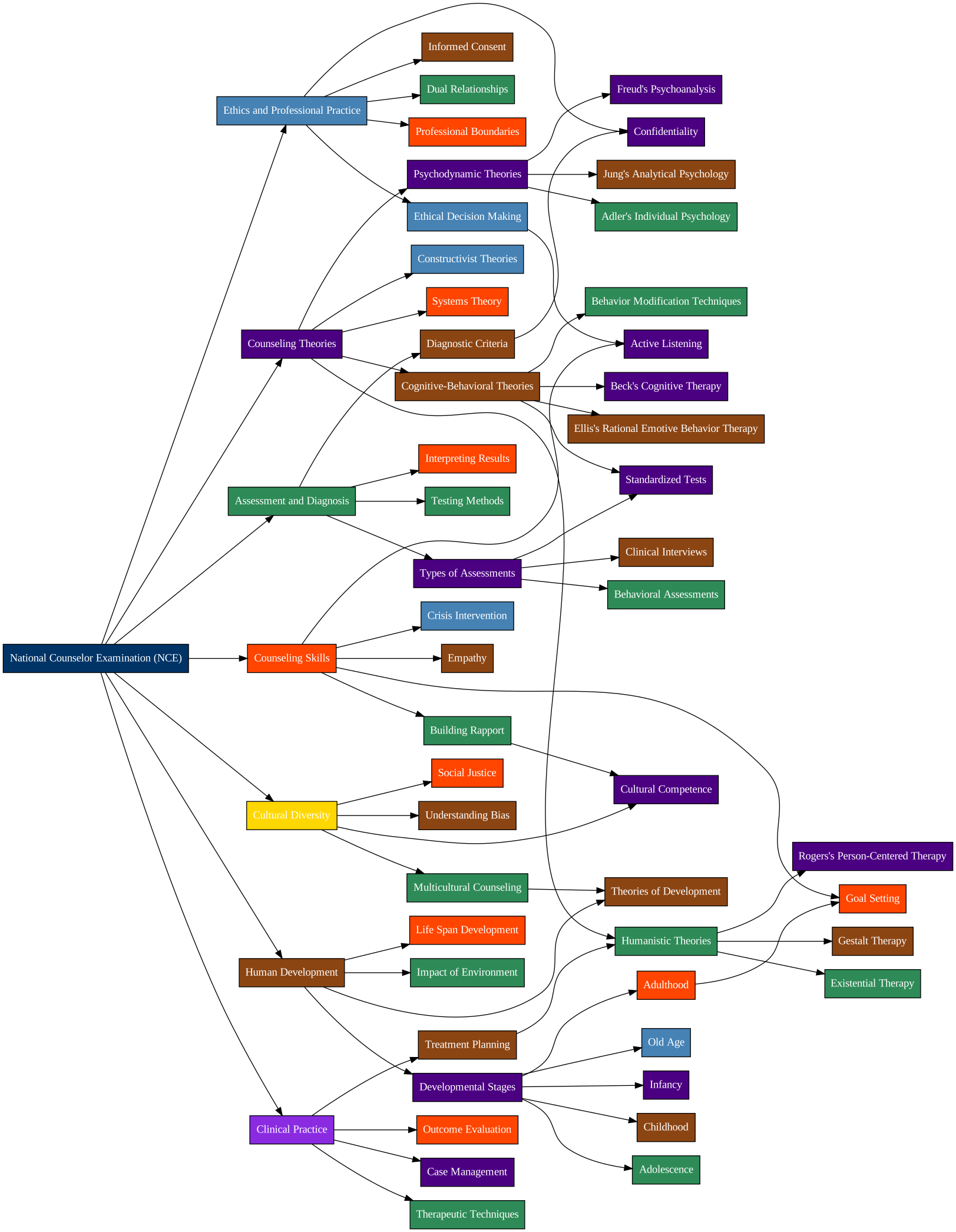
Quiz-summary
0 of 30 questions completed
Questions:
- 1
- 2
- 3
- 4
- 5
- 6
- 7
- 8
- 9
- 10
- 11
- 12
- 13
- 14
- 15
- 16
- 17
- 18
- 19
- 20
- 21
- 22
- 23
- 24
- 25
- 26
- 27
- 28
- 29
- 30
Information
Premium Practice Questions
You have already completed the quiz before. Hence you can not start it again.
Quiz is loading...
You must sign in or sign up to start the quiz.
You have to finish following quiz, to start this quiz:
Results
0 of 30 questions answered correctly
Your time:
Time has elapsed
You have reached 0 of 0 points, (0)
Categories
- Not categorized 0%
- 1
- 2
- 3
- 4
- 5
- 6
- 7
- 8
- 9
- 10
- 11
- 12
- 13
- 14
- 15
- 16
- 17
- 18
- 19
- 20
- 21
- 22
- 23
- 24
- 25
- 26
- 27
- 28
- 29
- 30
- Answered
- Review
-
Question 1 of 30
1. Question
Consider a scenario where San Diego State University is hosting a public forum to discuss the potential impacts of a new regional infrastructure project. Which of the following formats would most effectively facilitate a nuanced and productive exchange of ideas among students, faculty, community members, and project stakeholders, fostering a deeper understanding of the project’s multifaceted implications?
Correct
The question probes the understanding of the foundational principles of effective public discourse and community engagement, particularly relevant to a university setting like San Diego State University, which emphasizes civic responsibility and diverse perspectives. The core concept being tested is the ability to identify the most conducive environment for constructive dialogue. A scenario involving a moderated panel discussion with clear guidelines for respectful interaction, diverse representation of viewpoints, and a focus on evidence-based arguments would foster the most productive exchange. This approach directly addresses the need for structured yet open communication, allowing for the exploration of complex issues without devolving into unproductive conflict. The emphasis on “evidence-based arguments” aligns with academic rigor, while “respectful interaction” and “diverse representation” reflect the values of inclusivity and critical inquiry inherent in higher education. The goal is to facilitate a deeper understanding of multifaceted issues, which is a hallmark of a strong academic program.
Incorrect
The question probes the understanding of the foundational principles of effective public discourse and community engagement, particularly relevant to a university setting like San Diego State University, which emphasizes civic responsibility and diverse perspectives. The core concept being tested is the ability to identify the most conducive environment for constructive dialogue. A scenario involving a moderated panel discussion with clear guidelines for respectful interaction, diverse representation of viewpoints, and a focus on evidence-based arguments would foster the most productive exchange. This approach directly addresses the need for structured yet open communication, allowing for the exploration of complex issues without devolving into unproductive conflict. The emphasis on “evidence-based arguments” aligns with academic rigor, while “respectful interaction” and “diverse representation” reflect the values of inclusivity and critical inquiry inherent in higher education. The goal is to facilitate a deeper understanding of multifaceted issues, which is a hallmark of a strong academic program.
-
Question 2 of 30
2. Question
When considering the strategic development of academic programs at San Diego State University to foster robust interdisciplinary research and learning, which of the following approaches is most likely to yield significant and sustained cross-departmental collaboration, moving beyond superficial departmental interactions?
Correct
The question probes the understanding of how interdisciplinary collaboration, a hallmark of modern research and education, can be effectively fostered within a university setting like San Diego State University (SDSU). SDSU emphasizes a holistic approach to learning and problem-solving, encouraging students and faculty to bridge traditional academic boundaries. To cultivate genuine interdisciplinary synergy, the focus must be on creating structured opportunities for interaction and shared intellectual pursuit, rather than relying on serendipitous encounters or superficial administrative directives. Consider the core components of fostering interdisciplinary work: shared research goals, common methodological training, and platforms for cross-pollination of ideas. Simply co-locating departments or offering joint seminars without a unifying project or a shared intellectual challenge is unlikely to yield deep collaboration. The most effective approach involves establishing a framework where diverse perspectives are not just tolerated but actively sought and integrated to address complex problems. This requires intentional design of programs, research centers, or project incubators that necessitate contributions from multiple fields. For instance, a university initiative focused on sustainable urban development might bring together environmental scientists, urban planners, sociologists, and economists. The success of such an initiative hinges on creating a shared understanding of the problem and a common language for discussing solutions, which is best achieved through collaborative project design and execution. Therefore, the most impactful strategy involves creating dedicated, project-driven environments that necessitate the integration of knowledge and methodologies from disparate disciplines.
Incorrect
The question probes the understanding of how interdisciplinary collaboration, a hallmark of modern research and education, can be effectively fostered within a university setting like San Diego State University (SDSU). SDSU emphasizes a holistic approach to learning and problem-solving, encouraging students and faculty to bridge traditional academic boundaries. To cultivate genuine interdisciplinary synergy, the focus must be on creating structured opportunities for interaction and shared intellectual pursuit, rather than relying on serendipitous encounters or superficial administrative directives. Consider the core components of fostering interdisciplinary work: shared research goals, common methodological training, and platforms for cross-pollination of ideas. Simply co-locating departments or offering joint seminars without a unifying project or a shared intellectual challenge is unlikely to yield deep collaboration. The most effective approach involves establishing a framework where diverse perspectives are not just tolerated but actively sought and integrated to address complex problems. This requires intentional design of programs, research centers, or project incubators that necessitate contributions from multiple fields. For instance, a university initiative focused on sustainable urban development might bring together environmental scientists, urban planners, sociologists, and economists. The success of such an initiative hinges on creating a shared understanding of the problem and a common language for discussing solutions, which is best achieved through collaborative project design and execution. Therefore, the most impactful strategy involves creating dedicated, project-driven environments that necessitate the integration of knowledge and methodologies from disparate disciplines.
-
Question 3 of 30
3. Question
A faculty member in SDSU’s Department of Biology, specializing in marine ecology, wishes to initiate a novel research project investigating the impact of microplastic pollution on coastal ecosystems. To maximize the project’s potential for groundbreaking discoveries and to align with San Diego State University’s commitment to interdisciplinary innovation, the faculty member decides to seek collaboration with colleagues in the College of Arts and Letters. Which of the following approaches would be most effective in establishing a robust and productive interdisciplinary research partnership?
Correct
The question probes understanding of the foundational principles of effective interdisciplinary collaboration within an academic setting, specifically as it relates to the mission of San Diego State University (SDSU) in fostering innovation and addressing complex societal challenges. SDSU emphasizes a holistic approach to learning and problem-solving, encouraging students and faculty to bridge traditional academic divides. Therefore, the most effective strategy for initiating a new research project that spans the College of Sciences and the College of Arts and Letters would involve identifying shared research interests and potential synergistic outcomes. This requires a proactive approach to understanding the methodologies, theoretical frameworks, and potential applications of each discipline. Establishing common ground through initial exploratory discussions, where faculty from both colleges can articulate their research questions and potential contributions, is paramount. This facilitates the development of a unified research question and methodology that leverages the strengths of both fields. Simply proposing a project without prior engagement or seeking external funding without a clearly defined interdisciplinary framework would be less effective. The goal is to build a collaborative foundation, not just a superficial partnership.
Incorrect
The question probes understanding of the foundational principles of effective interdisciplinary collaboration within an academic setting, specifically as it relates to the mission of San Diego State University (SDSU) in fostering innovation and addressing complex societal challenges. SDSU emphasizes a holistic approach to learning and problem-solving, encouraging students and faculty to bridge traditional academic divides. Therefore, the most effective strategy for initiating a new research project that spans the College of Sciences and the College of Arts and Letters would involve identifying shared research interests and potential synergistic outcomes. This requires a proactive approach to understanding the methodologies, theoretical frameworks, and potential applications of each discipline. Establishing common ground through initial exploratory discussions, where faculty from both colleges can articulate their research questions and potential contributions, is paramount. This facilitates the development of a unified research question and methodology that leverages the strengths of both fields. Simply proposing a project without prior engagement or seeking external funding without a clearly defined interdisciplinary framework would be less effective. The goal is to build a collaborative foundation, not just a superficial partnership.
-
Question 4 of 30
4. Question
Consider a San Diego State University student group proposing a project to mitigate coastal erosion along a specific stretch of the San Diego coastline. To ensure the project’s efficacy and foster genuine community integration, which of the following approaches would best embody the university’s commitment to impactful, collaborative, and sustainable community engagement?
Correct
The question assesses understanding of the core principles of community engagement and its application within a university setting, specifically referencing San Diego State University’s commitment to its local environment. The scenario involves a hypothetical student project aiming to address a local environmental concern. The correct approach, therefore, must prioritize genuine collaboration, mutual benefit, and long-term sustainability, aligning with the university’s mission to serve and uplift the San Diego community. A project that solely focuses on data collection without involving community members in the interpretation or action phases would be superficial. Similarly, a project that imposes solutions without understanding local needs or capacities would likely fail. A project that seeks external funding without demonstrating community benefit or buy-in misses a crucial element of sustainable engagement. The most effective approach, therefore, involves a partnership where students and community stakeholders co-design solutions, share knowledge, and work together towards a common goal. This fosters ownership, builds capacity within the community, and ensures the project’s relevance and impact. This aligns with San Diego State University’s emphasis on experiential learning and civic responsibility, where academic pursuits are directly linked to making a positive difference in the surrounding region. The project’s success hinges on building trust and fostering a reciprocal relationship, not merely on academic output.
Incorrect
The question assesses understanding of the core principles of community engagement and its application within a university setting, specifically referencing San Diego State University’s commitment to its local environment. The scenario involves a hypothetical student project aiming to address a local environmental concern. The correct approach, therefore, must prioritize genuine collaboration, mutual benefit, and long-term sustainability, aligning with the university’s mission to serve and uplift the San Diego community. A project that solely focuses on data collection without involving community members in the interpretation or action phases would be superficial. Similarly, a project that imposes solutions without understanding local needs or capacities would likely fail. A project that seeks external funding without demonstrating community benefit or buy-in misses a crucial element of sustainable engagement. The most effective approach, therefore, involves a partnership where students and community stakeholders co-design solutions, share knowledge, and work together towards a common goal. This fosters ownership, builds capacity within the community, and ensures the project’s relevance and impact. This aligns with San Diego State University’s emphasis on experiential learning and civic responsibility, where academic pursuits are directly linked to making a positive difference in the surrounding region. The project’s success hinges on building trust and fostering a reciprocal relationship, not merely on academic output.
-
Question 5 of 30
5. Question
Considering San Diego State University’s designation as a vital public institution deeply embedded within its regional context, which of the following strategic priorities most accurately reflects its core mission to serve and uplift the San Diego community through its academic and research endeavors?
Correct
The question probes the understanding of how institutional mission and community engagement intersect within a public university setting, specifically referencing San Diego State University’s commitment to its regional impact. The core concept is the alignment of academic programs and research with the socio-economic and cultural needs of the surrounding community. San Diego State University, as a major public research university, is tasked with not only advancing knowledge but also contributing to the betterment of the San Diego region. This involves fostering partnerships, addressing local challenges through research and service-learning, and ensuring graduates are equipped to contribute to the local economy and civic life. Therefore, the most accurate reflection of this mission would be initiatives that directly translate academic pursuits into tangible community benefits, such as applied research addressing regional environmental concerns or programs designed to upskill the local workforce. The other options, while potentially positive outcomes, do not as directly encapsulate the dual mandate of academic excellence and regional service that defines a public university like SDSU. For instance, solely focusing on international research collaborations, while valuable, might not prioritize immediate regional impact. Similarly, a purely theoretical research focus, detached from practical application, would miss a key component of a public university’s role. Prioritizing national rankings above all else can sometimes lead to a divergence from local needs, even if it signifies academic prestige. The emphasis should be on the synergistic relationship between the university and its host community.
Incorrect
The question probes the understanding of how institutional mission and community engagement intersect within a public university setting, specifically referencing San Diego State University’s commitment to its regional impact. The core concept is the alignment of academic programs and research with the socio-economic and cultural needs of the surrounding community. San Diego State University, as a major public research university, is tasked with not only advancing knowledge but also contributing to the betterment of the San Diego region. This involves fostering partnerships, addressing local challenges through research and service-learning, and ensuring graduates are equipped to contribute to the local economy and civic life. Therefore, the most accurate reflection of this mission would be initiatives that directly translate academic pursuits into tangible community benefits, such as applied research addressing regional environmental concerns or programs designed to upskill the local workforce. The other options, while potentially positive outcomes, do not as directly encapsulate the dual mandate of academic excellence and regional service that defines a public university like SDSU. For instance, solely focusing on international research collaborations, while valuable, might not prioritize immediate regional impact. Similarly, a purely theoretical research focus, detached from practical application, would miss a key component of a public university’s role. Prioritizing national rankings above all else can sometimes lead to a divergence from local needs, even if it signifies academic prestige. The emphasis should be on the synergistic relationship between the university and its host community.
-
Question 6 of 30
6. Question
Consider a proposed initiative at San Diego State University aimed at developing sustainable strategies to combat the escalating effects of coastal erosion along the Southern California shoreline. This initiative requires a holistic understanding of the multifaceted challenges involved. Which of the following approaches would most effectively leverage the university’s academic strengths and foster innovative solutions for this complex environmental and societal issue?
Correct
The question probes the understanding of how interdisciplinary research, a hallmark of many university programs including those at San Diego State University, can address complex societal challenges. The scenario involves a proposed initiative to mitigate the impact of coastal erosion in Southern California, a region with significant ecological and economic vulnerability. To effectively address this, a multidisciplinary approach is essential. Environmental scientists would analyze the geological and ecological factors contributing to erosion. Urban planners would assess the impact on coastal infrastructure and community development. Sociologists would examine the social equity implications and community engagement strategies. Economists would evaluate the cost-benefit analysis of different mitigation techniques and their long-term sustainability. Therefore, the most effective approach would integrate insights from these diverse fields. The core concept being tested is the synergy created by combining distinct disciplinary perspectives to generate comprehensive and actionable solutions, reflecting SDSU’s commitment to fostering well-rounded scholarship and problem-solving. The correct option emphasizes this integration of natural sciences, social sciences, and policy considerations.
Incorrect
The question probes the understanding of how interdisciplinary research, a hallmark of many university programs including those at San Diego State University, can address complex societal challenges. The scenario involves a proposed initiative to mitigate the impact of coastal erosion in Southern California, a region with significant ecological and economic vulnerability. To effectively address this, a multidisciplinary approach is essential. Environmental scientists would analyze the geological and ecological factors contributing to erosion. Urban planners would assess the impact on coastal infrastructure and community development. Sociologists would examine the social equity implications and community engagement strategies. Economists would evaluate the cost-benefit analysis of different mitigation techniques and their long-term sustainability. Therefore, the most effective approach would integrate insights from these diverse fields. The core concept being tested is the synergy created by combining distinct disciplinary perspectives to generate comprehensive and actionable solutions, reflecting SDSU’s commitment to fostering well-rounded scholarship and problem-solving. The correct option emphasizes this integration of natural sciences, social sciences, and policy considerations.
-
Question 7 of 30
7. Question
Considering San Diego State University’s strategic emphasis on fostering innovative research and preparing students for complex global challenges, what programmatic approach would most effectively cultivate robust interdisciplinary collaboration among faculty and students across diverse academic departments, such as engineering, social sciences, and the arts?
Correct
The question probes the understanding of how interdisciplinary collaboration, a hallmark of modern research and education, can be effectively fostered within a university setting like San Diego State University (SDSU). SDSU emphasizes a commitment to experiential learning and community engagement, which are often enhanced by cross-departmental initiatives. To foster genuine interdisciplinary collaboration, the focus must be on creating structured opportunities for faculty and students from diverse fields to interact, share methodologies, and co-create knowledge. This involves more than just casual encounters; it requires deliberate program design. Consider a scenario where SDSU aims to enhance its sustainability research initiatives. Sustainability is inherently interdisciplinary, drawing from environmental science, engineering, economics, public policy, sociology, and urban planning. To truly foster collaboration, SDSU would need to move beyond simply encouraging individual faculty to “reach out.” Instead, it should implement programs that facilitate joint grant writing, co-taught courses that blend perspectives from different departments, shared research facilities or labs focused on specific sustainability challenges, and student exchange programs between relevant departments. Furthermore, establishing a dedicated interdisciplinary research center or institute focused on sustainability would provide a physical and intellectual hub for these activities. This center could host regular symposia, workshops, and seed funding opportunities specifically for interdisciplinary projects. The key is to create a supportive ecosystem where the barriers between disciplines are lowered, and the incentives for collaboration are clear and rewarding. Simply providing a shared online platform or occasional departmental mixers would be insufficient for deep, impactful collaboration. The most effective approach involves creating integrated structures and incentives that embed interdisciplinary work into the fabric of the university’s academic and research life.
Incorrect
The question probes the understanding of how interdisciplinary collaboration, a hallmark of modern research and education, can be effectively fostered within a university setting like San Diego State University (SDSU). SDSU emphasizes a commitment to experiential learning and community engagement, which are often enhanced by cross-departmental initiatives. To foster genuine interdisciplinary collaboration, the focus must be on creating structured opportunities for faculty and students from diverse fields to interact, share methodologies, and co-create knowledge. This involves more than just casual encounters; it requires deliberate program design. Consider a scenario where SDSU aims to enhance its sustainability research initiatives. Sustainability is inherently interdisciplinary, drawing from environmental science, engineering, economics, public policy, sociology, and urban planning. To truly foster collaboration, SDSU would need to move beyond simply encouraging individual faculty to “reach out.” Instead, it should implement programs that facilitate joint grant writing, co-taught courses that blend perspectives from different departments, shared research facilities or labs focused on specific sustainability challenges, and student exchange programs between relevant departments. Furthermore, establishing a dedicated interdisciplinary research center or institute focused on sustainability would provide a physical and intellectual hub for these activities. This center could host regular symposia, workshops, and seed funding opportunities specifically for interdisciplinary projects. The key is to create a supportive ecosystem where the barriers between disciplines are lowered, and the incentives for collaboration are clear and rewarding. Simply providing a shared online platform or occasional departmental mixers would be insufficient for deep, impactful collaboration. The most effective approach involves creating integrated structures and incentives that embed interdisciplinary work into the fabric of the university’s academic and research life.
-
Question 8 of 30
8. Question
Consider a multi-stakeholder initiative at San Diego State University focused on developing innovative strategies for coastal urban resilience against rising sea levels and increased storm intensity. Which foundational element is most critical for effectively integrating the diverse expertise of civil engineers, marine biologists, public policy analysts, and community organizers to produce a cohesive and actionable resilience plan?
Correct
The question probes the understanding of how interdisciplinary collaboration, a hallmark of modern research and a key strength at San Diego State University, impacts the development of sustainable urban planning solutions. Specifically, it asks to identify the most crucial element for integrating diverse perspectives in a project aiming to enhance urban resilience in a coastal city like San Diego, which faces unique environmental challenges. The correct answer emphasizes the establishment of a shared conceptual framework. This framework acts as a common language and understanding, allowing engineers, environmental scientists, sociologists, and urban planners to translate their specialized knowledge into actionable strategies that address complex, interconnected issues such as sea-level rise, infrastructure adaptation, and community well-being. Without this foundational alignment, disparate disciplinary inputs might remain siloed, leading to fragmented or ineffective solutions. For instance, an engineer might propose a seawall, an environmental scientist might advocate for wetland restoration, and a sociologist might highlight the need for equitable displacement policies. A shared framework ensures these proposals are synthesized into a cohesive plan that considers the trade-offs and synergies between these different approaches, ultimately fostering a more robust and holistic outcome aligned with SDSU’s commitment to community engagement and impactful research.
Incorrect
The question probes the understanding of how interdisciplinary collaboration, a hallmark of modern research and a key strength at San Diego State University, impacts the development of sustainable urban planning solutions. Specifically, it asks to identify the most crucial element for integrating diverse perspectives in a project aiming to enhance urban resilience in a coastal city like San Diego, which faces unique environmental challenges. The correct answer emphasizes the establishment of a shared conceptual framework. This framework acts as a common language and understanding, allowing engineers, environmental scientists, sociologists, and urban planners to translate their specialized knowledge into actionable strategies that address complex, interconnected issues such as sea-level rise, infrastructure adaptation, and community well-being. Without this foundational alignment, disparate disciplinary inputs might remain siloed, leading to fragmented or ineffective solutions. For instance, an engineer might propose a seawall, an environmental scientist might advocate for wetland restoration, and a sociologist might highlight the need for equitable displacement policies. A shared framework ensures these proposals are synthesized into a cohesive plan that considers the trade-offs and synergies between these different approaches, ultimately fostering a more robust and holistic outcome aligned with SDSU’s commitment to community engagement and impactful research.
-
Question 9 of 30
9. Question
A San Diego State University student undertaking a capstone project aims to investigate the causal relationship between the availability of accessible urban green spaces and reported levels of psychological well-being within diverse city neighborhoods. Given the ethical and practical limitations of manipulating green space access in real-world urban environments, which methodological strategy would most effectively enable the student to establish a robust, albeit inferential, causal link, while rigorously accounting for potential confounding socio-economic and environmental factors prevalent in urban settings?
Correct
The scenario describes a student at San Diego State University (SDSU) engaging with a research project that involves analyzing the impact of urban green spaces on community well-being. The student is tasked with designing a methodology to quantify this impact. The core of the question lies in understanding how to establish a causal link between the presence of green spaces and improved well-being, while controlling for confounding variables. To establish causality, a robust research design is paramount. A randomized controlled trial (RCT) is the gold standard for establishing causality, but it is often impractical or unethical in social science research involving environmental factors and human populations. Therefore, researchers often employ quasi-experimental designs or sophisticated observational study designs that attempt to mimic the conditions of an experiment. In this context, the student needs to consider how to isolate the effect of green spaces. Simply correlating the amount of green space with well-being metrics is insufficient, as other factors might be responsible for both. For instance, areas with more green space might also have higher socioeconomic status, better air quality, or lower crime rates, all of which could independently influence community well-being. The most appropriate approach to address this challenge, given the constraints of real-world research, involves a combination of rigorous data collection and advanced statistical techniques. The student should aim to: 1. **Define and measure key variables:** Clearly define “urban green spaces” (e.g., parks, community gardens, tree canopy cover) and “community well-being” (e.g., self-reported happiness, reduced stress levels, social cohesion, physical activity). 2. **Select an appropriate study design:** A longitudinal study that tracks individuals or communities over time as green spaces change or are introduced would be ideal. Alternatively, a cross-sectional study with careful matching or propensity score matching can be used to create comparable groups with and without significant exposure to green spaces. 3. **Control for confounding variables:** Identify and measure potential confounders such as socioeconomic status, demographic factors, access to amenities, and existing health conditions. 4. **Employ appropriate statistical analysis:** Techniques like regression analysis (e.g., multiple regression, hierarchical linear modeling) or structural equation modeling can be used to analyze the relationships between variables while accounting for confounders. Propensity score matching is particularly useful in observational studies to create comparable treatment and control groups. Considering these elements, the student’s primary challenge is to design a study that can credibly attribute observed differences in well-being to the presence of urban green spaces, rather than to other co-occurring factors. This requires a methodological approach that prioritizes internal validity by minimizing bias and controlling for extraneous influences. The best approach would involve a design that allows for the isolation of the green space variable and the systematic accounting for other potential drivers of community well-being, reflecting the rigorous research standards expected at San Diego State University.
Incorrect
The scenario describes a student at San Diego State University (SDSU) engaging with a research project that involves analyzing the impact of urban green spaces on community well-being. The student is tasked with designing a methodology to quantify this impact. The core of the question lies in understanding how to establish a causal link between the presence of green spaces and improved well-being, while controlling for confounding variables. To establish causality, a robust research design is paramount. A randomized controlled trial (RCT) is the gold standard for establishing causality, but it is often impractical or unethical in social science research involving environmental factors and human populations. Therefore, researchers often employ quasi-experimental designs or sophisticated observational study designs that attempt to mimic the conditions of an experiment. In this context, the student needs to consider how to isolate the effect of green spaces. Simply correlating the amount of green space with well-being metrics is insufficient, as other factors might be responsible for both. For instance, areas with more green space might also have higher socioeconomic status, better air quality, or lower crime rates, all of which could independently influence community well-being. The most appropriate approach to address this challenge, given the constraints of real-world research, involves a combination of rigorous data collection and advanced statistical techniques. The student should aim to: 1. **Define and measure key variables:** Clearly define “urban green spaces” (e.g., parks, community gardens, tree canopy cover) and “community well-being” (e.g., self-reported happiness, reduced stress levels, social cohesion, physical activity). 2. **Select an appropriate study design:** A longitudinal study that tracks individuals or communities over time as green spaces change or are introduced would be ideal. Alternatively, a cross-sectional study with careful matching or propensity score matching can be used to create comparable groups with and without significant exposure to green spaces. 3. **Control for confounding variables:** Identify and measure potential confounders such as socioeconomic status, demographic factors, access to amenities, and existing health conditions. 4. **Employ appropriate statistical analysis:** Techniques like regression analysis (e.g., multiple regression, hierarchical linear modeling) or structural equation modeling can be used to analyze the relationships between variables while accounting for confounders. Propensity score matching is particularly useful in observational studies to create comparable treatment and control groups. Considering these elements, the student’s primary challenge is to design a study that can credibly attribute observed differences in well-being to the presence of urban green spaces, rather than to other co-occurring factors. This requires a methodological approach that prioritizes internal validity by minimizing bias and controlling for extraneous influences. The best approach would involve a design that allows for the isolation of the green space variable and the systematic accounting for other potential drivers of community well-being, reflecting the rigorous research standards expected at San Diego State University.
-
Question 10 of 30
10. Question
Consider a hypothetical community in the vicinity of San Diego grappling with escalating water scarcity due to prolonged drought and increased regional demand. A newly formed civic task force, comprised of students and faculty from San Diego State University’s diverse departments, is charged with developing a sustainable water management plan. Which of the following strategies would most effectively address the multifaceted nature of this challenge, reflecting the interdisciplinary ethos prevalent at SDSU?
Correct
The question assesses understanding of the interdisciplinary approach central to many programs at San Diego State University, particularly in fields like environmental studies or urban planning, which often integrate social science and natural science perspectives. The scenario involves a hypothetical community facing water scarcity, a common challenge in Southern California. To address this, a comprehensive strategy is needed. Option A, focusing on a multi-pronged approach that includes both technological innovation (e.g., desalination, advanced irrigation) and behavioral change (e.g., public awareness campaigns, tiered pricing), directly reflects the integrated problem-solving expected in advanced academic settings. This approach acknowledges that complex issues rarely have single-solution answers and require consideration of economic, social, and environmental factors. The other options, while potentially components of a solution, are too narrow. Option B, solely focusing on technological fixes, ignores the crucial human element and potential equity issues. Option C, emphasizing only regulatory measures, might overlook the need for public buy-in and technological advancements. Option D, concentrating solely on public education, might not be sufficient without accompanying infrastructure or policy changes. Therefore, the most effective and academically sound approach, aligning with SDSU’s emphasis on holistic problem-solving, is the integrated strategy.
Incorrect
The question assesses understanding of the interdisciplinary approach central to many programs at San Diego State University, particularly in fields like environmental studies or urban planning, which often integrate social science and natural science perspectives. The scenario involves a hypothetical community facing water scarcity, a common challenge in Southern California. To address this, a comprehensive strategy is needed. Option A, focusing on a multi-pronged approach that includes both technological innovation (e.g., desalination, advanced irrigation) and behavioral change (e.g., public awareness campaigns, tiered pricing), directly reflects the integrated problem-solving expected in advanced academic settings. This approach acknowledges that complex issues rarely have single-solution answers and require consideration of economic, social, and environmental factors. The other options, while potentially components of a solution, are too narrow. Option B, solely focusing on technological fixes, ignores the crucial human element and potential equity issues. Option C, emphasizing only regulatory measures, might overlook the need for public buy-in and technological advancements. Option D, concentrating solely on public education, might not be sufficient without accompanying infrastructure or policy changes. Therefore, the most effective and academically sound approach, aligning with SDSU’s emphasis on holistic problem-solving, is the integrated strategy.
-
Question 11 of 30
11. Question
Consider the multifaceted challenges facing the Salton Sea, a significant ecological and socio-economic region in Southern California. A proposed initiative aims to revitalize the area, addressing declining water levels, increasing salinity, and the impact on local communities and wildlife. Which of the following strategic frameworks would most effectively guide this revitalization effort, reflecting San Diego State University’s emphasis on interdisciplinary problem-solving and sustainable development?
Correct
The question assesses understanding of the interdisciplinary approach to problem-solving, a hallmark of San Diego State University’s commitment to holistic education. The scenario involves a complex environmental issue, the Salton Sea, which requires insights from various fields. Analyzing the options, we see that a solution integrating ecological restoration, economic development strategies, and community engagement represents the most comprehensive and effective approach. This aligns with SDSU’s emphasis on applied learning and addressing real-world challenges through collaboration across disciplines like environmental science, public policy, and sociology. The other options, while potentially addressing aspects of the problem, are too narrow. Focusing solely on technological fixes overlooks the socio-economic dimensions. Prioritizing immediate economic gains without ecological sustainability is short-sighted. Relying solely on federal mandates neglects local community buy-in and tailored solutions. Therefore, the integrated approach, which synthesizes scientific understanding, policy frameworks, and social considerations, is the most robust and aligned with the educational philosophy of a university like San Diego State, which encourages students to think critically and holistically about complex issues.
Incorrect
The question assesses understanding of the interdisciplinary approach to problem-solving, a hallmark of San Diego State University’s commitment to holistic education. The scenario involves a complex environmental issue, the Salton Sea, which requires insights from various fields. Analyzing the options, we see that a solution integrating ecological restoration, economic development strategies, and community engagement represents the most comprehensive and effective approach. This aligns with SDSU’s emphasis on applied learning and addressing real-world challenges through collaboration across disciplines like environmental science, public policy, and sociology. The other options, while potentially addressing aspects of the problem, are too narrow. Focusing solely on technological fixes overlooks the socio-economic dimensions. Prioritizing immediate economic gains without ecological sustainability is short-sighted. Relying solely on federal mandates neglects local community buy-in and tailored solutions. Therefore, the integrated approach, which synthesizes scientific understanding, policy frameworks, and social considerations, is the most robust and aligned with the educational philosophy of a university like San Diego State, which encourages students to think critically and holistically about complex issues.
-
Question 12 of 30
12. Question
Consider a San Diego State University student group undertaking a service-learning project focused on improving local coastal ecosystem health. To ensure the project aligns with both academic learning objectives and genuine community benefit, which initial engagement strategy would most effectively foster a reciprocal and impactful partnership with the San Diego coastal community?
Correct
The question assesses understanding of the foundational principles of community engagement and its integration into academic service-learning, a core tenet at institutions like San Diego State University that emphasize civic responsibility. The scenario involves a student project aiming to address local environmental concerns. To ensure genuine community benefit and ethical practice, the project must be designed with a reciprocal relationship between the university and the community. This means the community’s needs and perspectives should actively shape the project’s goals and methodologies, rather than the university imposing its own agenda. The concept of “asset-based community development” is crucial here, focusing on leveraging existing community strengths and resources. Therefore, the most effective approach involves a collaborative needs assessment and co-creation of project objectives with community stakeholders. This ensures that the project is relevant, sustainable, and genuinely addresses identified issues from the community’s viewpoint, aligning with SDSU’s commitment to impactful, community-integrated learning experiences.
Incorrect
The question assesses understanding of the foundational principles of community engagement and its integration into academic service-learning, a core tenet at institutions like San Diego State University that emphasize civic responsibility. The scenario involves a student project aiming to address local environmental concerns. To ensure genuine community benefit and ethical practice, the project must be designed with a reciprocal relationship between the university and the community. This means the community’s needs and perspectives should actively shape the project’s goals and methodologies, rather than the university imposing its own agenda. The concept of “asset-based community development” is crucial here, focusing on leveraging existing community strengths and resources. Therefore, the most effective approach involves a collaborative needs assessment and co-creation of project objectives with community stakeholders. This ensures that the project is relevant, sustainable, and genuinely addresses identified issues from the community’s viewpoint, aligning with SDSU’s commitment to impactful, community-integrated learning experiences.
-
Question 13 of 30
13. Question
Anya, a student at San Diego State University, is conducting research on the socio-economic impact of urban green spaces in the San Diego region. She has collected qualitative data from in-depth interviews with residents from diverse neighborhoods. Anya’s primary objective is to identify and articulate the salient themes emerging from these interviews, which explore perceptions of park accessibility, community engagement, and perceived benefits of green spaces. Which analytical approach would most effectively enable Anya to synthesize this rich qualitative data into meaningful, evidence-based conclusions for her research project?
Correct
The scenario describes a student, Anya, at San Diego State University, engaging with a research project on the socio-economic impact of urban green spaces. Anya is tasked with analyzing qualitative data from interviews with community members. The core challenge is to identify recurring themes and patterns that reflect the lived experiences and perceptions of these individuals regarding the benefits and drawbacks of local parks and community gardens. This process involves a systematic approach to qualitative data analysis, which is a fundamental skill in many disciplines at SDSU, including sociology, urban studies, and environmental science. The goal is to move beyond superficial observations to a deeper understanding of the nuanced perspectives of the interviewees. This requires careful coding of interview transcripts, grouping similar ideas, and synthesizing these into overarching themes. For instance, if multiple interviewees discuss improved mental well-being due to park access, this would be a significant theme. Similarly, if others express concerns about park maintenance or accessibility, these would form distinct thematic categories. The final output should be a comprehensive thematic analysis that accurately represents the qualitative data, providing insights into how urban green spaces are perceived and experienced by the San Diego community. This analytical rigor is crucial for Anya to contribute meaningfully to the research, aligning with SDSU’s emphasis on evidence-based inquiry and community engagement. The correct approach involves iterative refinement of themes, ensuring they are well-supported by the interview data and capture the complexity of the participants’ views.
Incorrect
The scenario describes a student, Anya, at San Diego State University, engaging with a research project on the socio-economic impact of urban green spaces. Anya is tasked with analyzing qualitative data from interviews with community members. The core challenge is to identify recurring themes and patterns that reflect the lived experiences and perceptions of these individuals regarding the benefits and drawbacks of local parks and community gardens. This process involves a systematic approach to qualitative data analysis, which is a fundamental skill in many disciplines at SDSU, including sociology, urban studies, and environmental science. The goal is to move beyond superficial observations to a deeper understanding of the nuanced perspectives of the interviewees. This requires careful coding of interview transcripts, grouping similar ideas, and synthesizing these into overarching themes. For instance, if multiple interviewees discuss improved mental well-being due to park access, this would be a significant theme. Similarly, if others express concerns about park maintenance or accessibility, these would form distinct thematic categories. The final output should be a comprehensive thematic analysis that accurately represents the qualitative data, providing insights into how urban green spaces are perceived and experienced by the San Diego community. This analytical rigor is crucial for Anya to contribute meaningfully to the research, aligning with SDSU’s emphasis on evidence-based inquiry and community engagement. The correct approach involves iterative refinement of themes, ensuring they are well-supported by the interview data and capture the complexity of the participants’ views.
-
Question 14 of 30
14. Question
Consider a scenario where a student organization at San Diego State University, “Aztec Advocates for Sustainability,” wishes to address the issue of plastic waste reduction in a nearby coastal community. Which of the following approaches would most effectively align with San Diego State University’s commitment to community-engaged scholarship and foster a sustainable, collaborative solution?
Correct
The question assesses understanding of the core principles of community engagement and its application within a university setting, specifically relating to San Diego State University’s commitment to civic responsibility and local impact. The scenario involves a hypothetical student organization, “Aztec Advocates for Sustainability,” aiming to address a local environmental issue. The correct approach, as outlined by best practices in community partnership and the university’s own mission, involves a collaborative, research-informed, and mutually beneficial strategy. This entails understanding the local context, identifying stakeholders, and developing a plan that aligns with both community needs and academic learning objectives. Option A, focusing on direct, unilateral action without prior consultation or needs assessment, is unlikely to foster sustainable change or positive community relations. Option C, while acknowledging the need for data, prioritizes external validation over genuine community input and partnership, potentially leading to a top-down approach. Option D, emphasizing solely the acquisition of funds, overlooks the crucial element of building relationships and ensuring the project’s relevance and acceptance within the community. The most effective strategy, therefore, involves a phased approach: initial community needs assessment, collaborative project design with local partners, leveraging university resources for research and implementation, and establishing clear communication channels for ongoing feedback and impact evaluation. This aligns with San Diego State University’s emphasis on experiential learning and its role as a catalyst for positive change in the San Diego region.
Incorrect
The question assesses understanding of the core principles of community engagement and its application within a university setting, specifically relating to San Diego State University’s commitment to civic responsibility and local impact. The scenario involves a hypothetical student organization, “Aztec Advocates for Sustainability,” aiming to address a local environmental issue. The correct approach, as outlined by best practices in community partnership and the university’s own mission, involves a collaborative, research-informed, and mutually beneficial strategy. This entails understanding the local context, identifying stakeholders, and developing a plan that aligns with both community needs and academic learning objectives. Option A, focusing on direct, unilateral action without prior consultation or needs assessment, is unlikely to foster sustainable change or positive community relations. Option C, while acknowledging the need for data, prioritizes external validation over genuine community input and partnership, potentially leading to a top-down approach. Option D, emphasizing solely the acquisition of funds, overlooks the crucial element of building relationships and ensuring the project’s relevance and acceptance within the community. The most effective strategy, therefore, involves a phased approach: initial community needs assessment, collaborative project design with local partners, leveraging university resources for research and implementation, and establishing clear communication channels for ongoing feedback and impact evaluation. This aligns with San Diego State University’s emphasis on experiential learning and its role as a catalyst for positive change in the San Diego region.
-
Question 15 of 30
15. Question
A multidisciplinary research initiative at San Diego State University, involving faculty from Environmental Engineering, Public Health, and Urban Planning, is tasked with developing a comprehensive strategy for enhancing urban resilience to climate-induced water scarcity. The team members, while experts in their respective fields, are encountering significant friction due to differing analytical methodologies, data interpretation conventions, and specialized jargon. What foundational step is most critical for ensuring effective integration of their diverse expertise and achieving a cohesive, actionable outcome for the university’s sustainability goals?
Correct
The question probes understanding of the foundational principles of effective interdisciplinary collaboration within a university setting, specifically referencing San Diego State University’s commitment to fostering such environments. The scenario involves a research team from distinct departments (Environmental Engineering, Public Health, and Urban Planning) aiming to address a complex urban sustainability issue. The core challenge lies in integrating diverse methodologies and communication styles. To arrive at the correct answer, one must consider the most crucial element for bridging disciplinary divides and ensuring a cohesive, productive research outcome. 1. **Identify the core problem:** The team faces challenges in synthesizing disparate data, methodologies, and terminologies from Environmental Engineering, Public Health, and Urban Planning. This necessitates a common ground for understanding and integration. 2. **Evaluate potential solutions:** * **Option 1 (Focus on shared project management software):** While useful for organization, it doesn’t address the fundamental conceptual and methodological integration. * **Option 2 (Establishment of a unified conceptual framework and shared glossary):** This directly tackles the problem of integrating different disciplinary perspectives. A unified framework provides a common lens through which to view the problem, and a shared glossary ensures that terms are understood consistently across departments, preventing misinterpretations and facilitating the synthesis of findings. This aligns with the academic rigor expected at San Diego State University, where interdisciplinary research is valued. * **Option 3 (Mandatory weekly social gatherings):** Social interaction can improve rapport but is insufficient for resolving deep-seated disciplinary differences in research approach and interpretation. * **Option 4 (Assigning a single lead researcher from the most senior department):** This approach risks marginalizing other disciplines and may not leverage the full expertise of the team, potentially leading to a biased or incomplete solution. 3. **Determine the most effective strategy:** The establishment of a unified conceptual framework and a shared glossary directly addresses the need for common understanding and integration of diverse disciplinary inputs. This fosters a truly collaborative environment where different perspectives can be effectively synthesized, leading to a more robust and comprehensive solution to the urban sustainability challenge, reflecting San Diego State University’s emphasis on impactful, collaborative research.
Incorrect
The question probes understanding of the foundational principles of effective interdisciplinary collaboration within a university setting, specifically referencing San Diego State University’s commitment to fostering such environments. The scenario involves a research team from distinct departments (Environmental Engineering, Public Health, and Urban Planning) aiming to address a complex urban sustainability issue. The core challenge lies in integrating diverse methodologies and communication styles. To arrive at the correct answer, one must consider the most crucial element for bridging disciplinary divides and ensuring a cohesive, productive research outcome. 1. **Identify the core problem:** The team faces challenges in synthesizing disparate data, methodologies, and terminologies from Environmental Engineering, Public Health, and Urban Planning. This necessitates a common ground for understanding and integration. 2. **Evaluate potential solutions:** * **Option 1 (Focus on shared project management software):** While useful for organization, it doesn’t address the fundamental conceptual and methodological integration. * **Option 2 (Establishment of a unified conceptual framework and shared glossary):** This directly tackles the problem of integrating different disciplinary perspectives. A unified framework provides a common lens through which to view the problem, and a shared glossary ensures that terms are understood consistently across departments, preventing misinterpretations and facilitating the synthesis of findings. This aligns with the academic rigor expected at San Diego State University, where interdisciplinary research is valued. * **Option 3 (Mandatory weekly social gatherings):** Social interaction can improve rapport but is insufficient for resolving deep-seated disciplinary differences in research approach and interpretation. * **Option 4 (Assigning a single lead researcher from the most senior department):** This approach risks marginalizing other disciplines and may not leverage the full expertise of the team, potentially leading to a biased or incomplete solution. 3. **Determine the most effective strategy:** The establishment of a unified conceptual framework and a shared glossary directly addresses the need for common understanding and integration of diverse disciplinary inputs. This fosters a truly collaborative environment where different perspectives can be effectively synthesized, leading to a more robust and comprehensive solution to the urban sustainability challenge, reflecting San Diego State University’s emphasis on impactful, collaborative research.
-
Question 16 of 30
16. Question
Consider the expansion initiatives undertaken by San Diego State University over the past two decades. Which combination of factors most accurately reflects the primary drivers and constraints influencing the university’s physical growth and its integration with the surrounding San Diego urban landscape?
Correct
The question probes understanding of the socio-cultural and economic factors influencing urban development, particularly in the context of a large public university like San Diego State University (SDSU). The correct answer, focusing on the interplay of public policy, community engagement, and historical land use, directly addresses the multifaceted nature of university expansion and its integration into the surrounding urban fabric. Public policy dictates zoning, infrastructure investment, and environmental regulations, all of which shape how SDSU can grow and interact with its neighbors. Community engagement is crucial for addressing local concerns, fostering collaboration, and ensuring that development benefits both the university and the surrounding San Diego communities. Historical land use patterns, including past zoning decisions and the evolution of the area’s infrastructure, lay the groundwork for current development possibilities and constraints. These elements are interconnected and require a nuanced understanding of urban planning principles and local governance. Incorrect options might overemphasize single factors or misattribute causal relationships. For instance, focusing solely on student enrollment numbers, while a driver of demand, doesn’t explain the *how* or *why* of physical expansion in a particular direction or manner. Similarly, attributing development solely to private real estate speculation ignores the significant role of public planning and university-led initiatives. The emphasis on a holistic, integrated approach reflects the complex realities of university-community development, a key consideration for a prominent institution like SDSU situated within a dynamic urban environment.
Incorrect
The question probes understanding of the socio-cultural and economic factors influencing urban development, particularly in the context of a large public university like San Diego State University (SDSU). The correct answer, focusing on the interplay of public policy, community engagement, and historical land use, directly addresses the multifaceted nature of university expansion and its integration into the surrounding urban fabric. Public policy dictates zoning, infrastructure investment, and environmental regulations, all of which shape how SDSU can grow and interact with its neighbors. Community engagement is crucial for addressing local concerns, fostering collaboration, and ensuring that development benefits both the university and the surrounding San Diego communities. Historical land use patterns, including past zoning decisions and the evolution of the area’s infrastructure, lay the groundwork for current development possibilities and constraints. These elements are interconnected and require a nuanced understanding of urban planning principles and local governance. Incorrect options might overemphasize single factors or misattribute causal relationships. For instance, focusing solely on student enrollment numbers, while a driver of demand, doesn’t explain the *how* or *why* of physical expansion in a particular direction or manner. Similarly, attributing development solely to private real estate speculation ignores the significant role of public planning and university-led initiatives. The emphasis on a holistic, integrated approach reflects the complex realities of university-community development, a key consideration for a prominent institution like SDSU situated within a dynamic urban environment.
-
Question 17 of 30
17. Question
A group of San Diego State University students is tasked with developing a proposal for enhancing the resilience of coastal communities against rising sea levels. Their project requires them to consider ecological impacts, infrastructure adaptation, social equity, and policy implications. Which of the following approaches best reflects the interdisciplinary problem-solving expected at SDSU for such a complex, localized challenge?
Correct
The question probes understanding of the interdisciplinary approach fostered at San Diego State University, particularly how diverse fields contribute to addressing complex societal issues. The scenario involves a student project aiming to improve urban sustainability in San Diego. To effectively tackle this, the student must integrate knowledge from various disciplines. Environmental Science provides the foundational understanding of ecological systems, resource management, and pollution control. Urban Planning offers insights into land use, infrastructure development, and community design. Sociology examines the social dynamics, equity considerations, and community engagement necessary for successful implementation. Political Science is crucial for understanding policy frameworks, governance structures, and stakeholder negotiation. Therefore, a comprehensive approach requires drawing upon the core principles of all these fields. The most effective strategy would involve synthesizing insights from Environmental Science for ecological impact assessment, Urban Planning for spatial design and infrastructure, Sociology for community buy-in and equitable distribution of benefits, and Political Science for navigating regulatory landscapes and securing public support. This holistic integration mirrors the collaborative and problem-solving ethos prevalent in SDSU’s academic programs, encouraging students to think beyond single-discipline boundaries. The correct answer emphasizes this multifaceted approach, demonstrating an awareness of how different academic lenses are essential for real-world problem-solving, a key tenet of SDSU’s educational philosophy.
Incorrect
The question probes understanding of the interdisciplinary approach fostered at San Diego State University, particularly how diverse fields contribute to addressing complex societal issues. The scenario involves a student project aiming to improve urban sustainability in San Diego. To effectively tackle this, the student must integrate knowledge from various disciplines. Environmental Science provides the foundational understanding of ecological systems, resource management, and pollution control. Urban Planning offers insights into land use, infrastructure development, and community design. Sociology examines the social dynamics, equity considerations, and community engagement necessary for successful implementation. Political Science is crucial for understanding policy frameworks, governance structures, and stakeholder negotiation. Therefore, a comprehensive approach requires drawing upon the core principles of all these fields. The most effective strategy would involve synthesizing insights from Environmental Science for ecological impact assessment, Urban Planning for spatial design and infrastructure, Sociology for community buy-in and equitable distribution of benefits, and Political Science for navigating regulatory landscapes and securing public support. This holistic integration mirrors the collaborative and problem-solving ethos prevalent in SDSU’s academic programs, encouraging students to think beyond single-discipline boundaries. The correct answer emphasizes this multifaceted approach, demonstrating an awareness of how different academic lenses are essential for real-world problem-solving, a key tenet of SDSU’s educational philosophy.
-
Question 18 of 30
18. Question
Consider the persistent challenge of mitigating the urban heat island effect in a major metropolitan area like San Diego. Which strategic framework would most effectively integrate diverse academic disciplines to develop sustainable and equitable solutions for reducing ambient temperatures and improving public well-being?
Correct
The question probes the understanding of how interdisciplinary approaches, a hallmark of San Diego State University’s commitment to holistic education, can address complex societal issues. Specifically, it asks about the most effective way to tackle the multifaceted challenge of urban heat island effects in a densely populated city like San Diego. The core concept being tested is the integration of diverse academic fields. Urban heat island effects are influenced by urban planning (e.g., building materials, green space allocation), environmental science (e.g., atmospheric conditions, heat absorption), public health (e.g., heat-related illnesses, vulnerable populations), and social sciences (e.g., community engagement, equitable distribution of mitigation strategies). Therefore, a solution that synthesizes knowledge from these areas would be most effective. An approach that solely focuses on one aspect, such as only increasing tree canopy without considering building materials or community involvement, would be incomplete. Similarly, a purely technological solution might overlook social equity. The most robust approach involves a comprehensive strategy that leverages insights from urban design, environmental engineering, public health policy, and community sociology to create a synergistic effect. This reflects SDSU’s emphasis on preparing students to tackle real-world problems through collaborative and interdisciplinary means, fostering innovation and impactful solutions.
Incorrect
The question probes the understanding of how interdisciplinary approaches, a hallmark of San Diego State University’s commitment to holistic education, can address complex societal issues. Specifically, it asks about the most effective way to tackle the multifaceted challenge of urban heat island effects in a densely populated city like San Diego. The core concept being tested is the integration of diverse academic fields. Urban heat island effects are influenced by urban planning (e.g., building materials, green space allocation), environmental science (e.g., atmospheric conditions, heat absorption), public health (e.g., heat-related illnesses, vulnerable populations), and social sciences (e.g., community engagement, equitable distribution of mitigation strategies). Therefore, a solution that synthesizes knowledge from these areas would be most effective. An approach that solely focuses on one aspect, such as only increasing tree canopy without considering building materials or community involvement, would be incomplete. Similarly, a purely technological solution might overlook social equity. The most robust approach involves a comprehensive strategy that leverages insights from urban design, environmental engineering, public health policy, and community sociology to create a synergistic effect. This reflects SDSU’s emphasis on preparing students to tackle real-world problems through collaborative and interdisciplinary means, fostering innovation and impactful solutions.
-
Question 19 of 30
19. Question
Consider a scenario at San Diego State University where a research team is investigating the ecological impact of coastal development on native plant species in the Torrey Pines State Reserve. The team comprises Dr. Anya Sharma, a distinguished professor specializing in plant ecology; Ben Carter, a graduate student whose family has long-standing business interests in local real estate development near the reserve; and Lena Petrova, an undergraduate student undertaking her first major field research project. What is the most paramount ethical consideration that the research team must proactively address to ensure the scientific integrity and credibility of their findings, reflecting San Diego State University’s commitment to rigorous and responsible scholarship?
Correct
The question probes understanding of the interdisciplinary nature of research and the importance of ethical considerations in scientific inquiry, particularly relevant to programs at San Diego State University that emphasize collaborative and responsible scholarship. The scenario involves a hypothetical research project on the impact of urban development on local biodiversity, a topic with direct relevance to Southern California’s ecological landscape and San Diego State University’s strengths in environmental science and sustainability. The core of the question lies in identifying the most crucial ethical consideration when a research team includes members with differing levels of experience and potential conflicts of interest. The team consists of Dr. Anya Sharma, a seasoned ecologist; Ben Carter, a graduate student whose family owns land adjacent to the study site; and Lena Petrova, an undergraduate researcher new to fieldwork. The calculation, in this conceptual context, is not a numerical one but rather an evaluation of ethical principles. We must weigh the potential for bias, the need for informed consent, data integrity, and the responsible dissemination of findings. 1. **Data Integrity and Bias:** Ben Carter’s familial connection to the study site presents a potential conflict of interest. His personal stake could unconsciously influence his data collection, analysis, or interpretation, thereby compromising the integrity of the research. This is a significant ethical concern that requires proactive management. 2. **Informed Consent and Vulnerable Populations:** While not explicitly stated that any human subjects are involved, ethical research practices often extend to ensuring all participants (even if indirectly affected, like landowners) are aware of the research and its potential implications. However, in this specific scenario, the primary ethical hurdle is not consent but rather the potential for bias. 3. **Mentorship and Training:** Lena Petrova’s inexperience highlights the importance of proper mentorship and training. While an ethical consideration, it’s secondary to the direct impact on the research’s validity. 4. **Dissemination of Findings:** Responsible dissemination is crucial, but it’s a post-data-collection phase. The immediate ethical challenge is ensuring the data itself is unbiased. Considering these points, the most critical ethical imperative is to mitigate the potential for bias introduced by Ben Carter’s conflict of interest. This requires establishing clear protocols for data handling and analysis, potentially involving an independent review or ensuring Dr. Sharma provides rigorous oversight of Ben’s contributions. The university’s commitment to academic integrity and responsible research practices necessitates addressing such potential conflicts head-on to ensure the validity and credibility of the scientific output. This aligns with San Diego State University’s emphasis on producing ethical and impactful research that contributes meaningfully to scientific knowledge and societal well-being.
Incorrect
The question probes understanding of the interdisciplinary nature of research and the importance of ethical considerations in scientific inquiry, particularly relevant to programs at San Diego State University that emphasize collaborative and responsible scholarship. The scenario involves a hypothetical research project on the impact of urban development on local biodiversity, a topic with direct relevance to Southern California’s ecological landscape and San Diego State University’s strengths in environmental science and sustainability. The core of the question lies in identifying the most crucial ethical consideration when a research team includes members with differing levels of experience and potential conflicts of interest. The team consists of Dr. Anya Sharma, a seasoned ecologist; Ben Carter, a graduate student whose family owns land adjacent to the study site; and Lena Petrova, an undergraduate researcher new to fieldwork. The calculation, in this conceptual context, is not a numerical one but rather an evaluation of ethical principles. We must weigh the potential for bias, the need for informed consent, data integrity, and the responsible dissemination of findings. 1. **Data Integrity and Bias:** Ben Carter’s familial connection to the study site presents a potential conflict of interest. His personal stake could unconsciously influence his data collection, analysis, or interpretation, thereby compromising the integrity of the research. This is a significant ethical concern that requires proactive management. 2. **Informed Consent and Vulnerable Populations:** While not explicitly stated that any human subjects are involved, ethical research practices often extend to ensuring all participants (even if indirectly affected, like landowners) are aware of the research and its potential implications. However, in this specific scenario, the primary ethical hurdle is not consent but rather the potential for bias. 3. **Mentorship and Training:** Lena Petrova’s inexperience highlights the importance of proper mentorship and training. While an ethical consideration, it’s secondary to the direct impact on the research’s validity. 4. **Dissemination of Findings:** Responsible dissemination is crucial, but it’s a post-data-collection phase. The immediate ethical challenge is ensuring the data itself is unbiased. Considering these points, the most critical ethical imperative is to mitigate the potential for bias introduced by Ben Carter’s conflict of interest. This requires establishing clear protocols for data handling and analysis, potentially involving an independent review or ensuring Dr. Sharma provides rigorous oversight of Ben’s contributions. The university’s commitment to academic integrity and responsible research practices necessitates addressing such potential conflicts head-on to ensure the validity and credibility of the scientific output. This aligns with San Diego State University’s emphasis on producing ethical and impactful research that contributes meaningfully to scientific knowledge and societal well-being.
-
Question 20 of 30
20. Question
A student organization at San Diego State University, passionate about mitigating plastic waste in the nearby coastal areas, is planning a comprehensive initiative. They aim to not only raise campus awareness but also implement tangible solutions. Considering San Diego State University’s emphasis on community-university partnerships and applied learning, which of the following strategies would most effectively foster sustainable impact and align with the university’s broader mission?
Correct
The question assesses understanding of the core principles of community engagement and its application within a university setting, specifically relating to San Diego State University’s commitment to its local environment and diverse student body. The scenario involves a student group aiming to address a local environmental issue, requiring them to consider various approaches to collaboration and impact. The correct answer, focusing on establishing a formal partnership with a local non-profit organization and integrating the project into coursework, reflects a strategic and sustainable approach. This method leverages existing community expertise, ensures academic rigor through integration into the curriculum, and provides a structured framework for long-term impact. Such an approach aligns with San Diego State University’s emphasis on experiential learning, community service, and fostering civic responsibility among its students. It allows for shared resources, mutual learning, and a more profound and lasting contribution to the San Diego community. The integration into coursework also ensures that the project benefits from faculty guidance and academic assessment, enhancing its quality and educational value for the students involved. Incorrect options represent less effective or less sustainable strategies. Focusing solely on a one-time event lacks long-term impact. Relying exclusively on student initiative without community partnership might overlook valuable local knowledge and resources. While raising awareness is important, it’s often a component of a broader engagement strategy rather than a complete solution for addressing a complex environmental challenge.
Incorrect
The question assesses understanding of the core principles of community engagement and its application within a university setting, specifically relating to San Diego State University’s commitment to its local environment and diverse student body. The scenario involves a student group aiming to address a local environmental issue, requiring them to consider various approaches to collaboration and impact. The correct answer, focusing on establishing a formal partnership with a local non-profit organization and integrating the project into coursework, reflects a strategic and sustainable approach. This method leverages existing community expertise, ensures academic rigor through integration into the curriculum, and provides a structured framework for long-term impact. Such an approach aligns with San Diego State University’s emphasis on experiential learning, community service, and fostering civic responsibility among its students. It allows for shared resources, mutual learning, and a more profound and lasting contribution to the San Diego community. The integration into coursework also ensures that the project benefits from faculty guidance and academic assessment, enhancing its quality and educational value for the students involved. Incorrect options represent less effective or less sustainable strategies. Focusing solely on a one-time event lacks long-term impact. Relying exclusively on student initiative without community partnership might overlook valuable local knowledge and resources. While raising awareness is important, it’s often a component of a broader engagement strategy rather than a complete solution for addressing a complex environmental challenge.
-
Question 21 of 30
21. Question
Anya, a student at San Diego State University, is undertaking an ambitious research project that integrates environmental toxicology with epidemiological studies to assess the potential health impacts of localized industrial runoff on nearby residential areas. Her methodology involves collecting water samples for chemical analysis and conducting surveys with community members regarding their health status and perceived environmental exposures. Given the sensitive nature of health data and the potential for her findings to influence public health policy and community perception, which ethical framework would most appropriately guide Anya’s research practices, ensuring both scientific integrity and the protection of human participants and the broader community?
Correct
The question probes understanding of the interdisciplinary nature of research and the importance of ethical considerations in academic pursuits, particularly within a university setting like San Diego State University. The scenario involves a student, Anya, working on a project that bridges environmental science and public health. The core of the problem lies in identifying the most appropriate ethical framework to guide her data collection and analysis, given the sensitive nature of the data (potential health impacts of environmental pollutants) and the diverse stakeholders involved (community members, university, regulatory bodies). Anya’s project requires her to collect water samples from various community sources and survey residents about their health. The ethical considerations here are multifaceted. Firstly, informed consent is paramount when interacting with human subjects. Participants must understand the purpose of the study, how their data will be used, and the potential risks and benefits. Secondly, data privacy and confidentiality are crucial, especially when dealing with health information. Thirdly, the potential for the research to impact public policy or community well-being necessitates a consideration of beneficence (doing good) and non-maleficence (avoiding harm). Considering these aspects, the most fitting ethical approach is one that prioritizes participant welfare, transparency, and responsible data handling. The Belmont Report’s principles of Respect for Persons, Beneficence, and Justice are foundational to human subjects research. Respect for Persons emphasizes autonomy and the right to make informed decisions. Beneficence requires maximizing potential benefits while minimizing potential harms. Justice ensures that the burdens and benefits of research are distributed fairly. In Anya’s case, the potential for her research to reveal health risks means she must be particularly diligent in how she communicates findings and ensures that the community is not unduly burdened or exposed to harm. A purely utilitarian approach might focus solely on the greatest good for the greatest number, potentially overlooking the rights of individual participants. A deontological approach, while emphasizing duties, might not adequately address the complex balancing of risks and benefits in a real-world scenario. A virtue ethics approach, focusing on character, is important but less directly prescriptive for specific research protocols. Therefore, an ethical framework that integrates principles of informed consent, data protection, and a commitment to community well-being, while also acknowledging the potential societal impact of her findings, is essential. This aligns with the rigorous ethical standards expected at San Diego State University, where interdisciplinary research is encouraged but must always be conducted with the highest regard for human participants and societal responsibility. The chosen answer reflects this comprehensive approach, emphasizing the protection of vulnerable populations and the responsible dissemination of research outcomes.
Incorrect
The question probes understanding of the interdisciplinary nature of research and the importance of ethical considerations in academic pursuits, particularly within a university setting like San Diego State University. The scenario involves a student, Anya, working on a project that bridges environmental science and public health. The core of the problem lies in identifying the most appropriate ethical framework to guide her data collection and analysis, given the sensitive nature of the data (potential health impacts of environmental pollutants) and the diverse stakeholders involved (community members, university, regulatory bodies). Anya’s project requires her to collect water samples from various community sources and survey residents about their health. The ethical considerations here are multifaceted. Firstly, informed consent is paramount when interacting with human subjects. Participants must understand the purpose of the study, how their data will be used, and the potential risks and benefits. Secondly, data privacy and confidentiality are crucial, especially when dealing with health information. Thirdly, the potential for the research to impact public policy or community well-being necessitates a consideration of beneficence (doing good) and non-maleficence (avoiding harm). Considering these aspects, the most fitting ethical approach is one that prioritizes participant welfare, transparency, and responsible data handling. The Belmont Report’s principles of Respect for Persons, Beneficence, and Justice are foundational to human subjects research. Respect for Persons emphasizes autonomy and the right to make informed decisions. Beneficence requires maximizing potential benefits while minimizing potential harms. Justice ensures that the burdens and benefits of research are distributed fairly. In Anya’s case, the potential for her research to reveal health risks means she must be particularly diligent in how she communicates findings and ensures that the community is not unduly burdened or exposed to harm. A purely utilitarian approach might focus solely on the greatest good for the greatest number, potentially overlooking the rights of individual participants. A deontological approach, while emphasizing duties, might not adequately address the complex balancing of risks and benefits in a real-world scenario. A virtue ethics approach, focusing on character, is important but less directly prescriptive for specific research protocols. Therefore, an ethical framework that integrates principles of informed consent, data protection, and a commitment to community well-being, while also acknowledging the potential societal impact of her findings, is essential. This aligns with the rigorous ethical standards expected at San Diego State University, where interdisciplinary research is encouraged but must always be conducted with the highest regard for human participants and societal responsibility. The chosen answer reflects this comprehensive approach, emphasizing the protection of vulnerable populations and the responsible dissemination of research outcomes.
-
Question 22 of 30
22. Question
Consider a scenario where San Diego State University is reviewing proposals for internal grant funding to support new academic initiatives. A proposal advocating for the expansion of a niche, highly specialized graduate program with limited regional demand but significant potential for international recognition is presented alongside a proposal for a new interdisciplinary research center focused on addressing coastal erosion issues impacting the San Diego region, which would involve collaboration between engineering, environmental science, and public policy departments. Which proposal is most likely to receive preferential resource allocation, and why, in the context of San Diego State University’s mission?
Correct
The question probes the understanding of how institutional mission and strategic alignment influence resource allocation in a public university setting, specifically referencing San Diego State University’s commitment to community engagement and interdisciplinary research. To arrive at the correct answer, one must analyze the core tenets of a university’s mission statement and how they translate into tangible operational priorities. San Diego State University, as a comprehensive public research university, emphasizes serving the diverse needs of its region and fostering innovative solutions through collaborative academic endeavors. Therefore, initiatives that demonstrably enhance community partnerships and promote cross-disciplinary problem-solving would naturally receive preferential resource allocation. This is not about simply increasing enrollment or expanding physical infrastructure in isolation, but about investing in programs that directly fulfill the university’s stated goals of societal impact and academic excellence. The allocation of funds to support faculty-led projects that address local environmental challenges, for instance, directly aligns with both community engagement and interdisciplinary research objectives. Conversely, proposals that lack a clear connection to these strategic priorities, or that focus solely on departmental self-interest without broader institutional benefit, would be less likely to secure significant funding. The rationale is that successful resource allocation at a university like San Diego State University is a strategic process, driven by the institution’s overarching mission and its commitment to advancing knowledge and serving the public good through its academic and research activities.
Incorrect
The question probes the understanding of how institutional mission and strategic alignment influence resource allocation in a public university setting, specifically referencing San Diego State University’s commitment to community engagement and interdisciplinary research. To arrive at the correct answer, one must analyze the core tenets of a university’s mission statement and how they translate into tangible operational priorities. San Diego State University, as a comprehensive public research university, emphasizes serving the diverse needs of its region and fostering innovative solutions through collaborative academic endeavors. Therefore, initiatives that demonstrably enhance community partnerships and promote cross-disciplinary problem-solving would naturally receive preferential resource allocation. This is not about simply increasing enrollment or expanding physical infrastructure in isolation, but about investing in programs that directly fulfill the university’s stated goals of societal impact and academic excellence. The allocation of funds to support faculty-led projects that address local environmental challenges, for instance, directly aligns with both community engagement and interdisciplinary research objectives. Conversely, proposals that lack a clear connection to these strategic priorities, or that focus solely on departmental self-interest without broader institutional benefit, would be less likely to secure significant funding. The rationale is that successful resource allocation at a university like San Diego State University is a strategic process, driven by the institution’s overarching mission and its commitment to advancing knowledge and serving the public good through its academic and research activities.
-
Question 23 of 30
23. Question
Consider a San Diego State University student group undertaking a project to mitigate the impact of invasive plant species in a local coastal park. Which approach would most effectively align with the university’s commitment to community-engaged scholarship and foster a sustainable, mutually beneficial outcome for both the students and the local community stakeholders?
Correct
The question assesses understanding of the core principles of community engagement and its integration into academic service-learning, a key pedagogical approach at institutions like San Diego State University. The scenario involves a student project aiming to address local environmental concerns. The correct approach prioritizes genuine partnership and reciprocal benefit, aligning with the ethical framework of community-based research and the university’s commitment to civic responsibility. The calculation, while conceptual, involves weighing the impact and ethical considerations of different engagement strategies. 1. **Identify the core objective:** To address local environmental concerns through a student project. 2. **Evaluate each option against principles of effective community engagement and service-learning:** * **Option 1 (Focus on data collection for academic purposes):** While data collection is part of research, solely focusing on academic needs without community benefit or input is transactional, not collaborative. This is a weaker approach. * **Option 2 (Prioritize community-identified needs and co-create solutions):** This option embodies the principles of genuine partnership, mutual respect, and shared ownership. It aligns with the reciprocal nature of service-learning, where both students and the community benefit. This is the strongest approach. * **Option 3 (Implement a pre-designed solution without community consultation):** This approach is paternalistic and ignores community agency and local knowledge, which is counterproductive to effective engagement. * **Option 4 (Focus solely on student learning outcomes):** While student learning is crucial, it should not come at the expense of community impact or ethical engagement. This option prioritizes the individual over the collective benefit. 3. **Determine the most effective and ethically sound approach:** Option 2 demonstrably fosters a stronger, more sustainable, and mutually beneficial relationship, which is the hallmark of successful community-engaged scholarship at San Diego State University.
Incorrect
The question assesses understanding of the core principles of community engagement and its integration into academic service-learning, a key pedagogical approach at institutions like San Diego State University. The scenario involves a student project aiming to address local environmental concerns. The correct approach prioritizes genuine partnership and reciprocal benefit, aligning with the ethical framework of community-based research and the university’s commitment to civic responsibility. The calculation, while conceptual, involves weighing the impact and ethical considerations of different engagement strategies. 1. **Identify the core objective:** To address local environmental concerns through a student project. 2. **Evaluate each option against principles of effective community engagement and service-learning:** * **Option 1 (Focus on data collection for academic purposes):** While data collection is part of research, solely focusing on academic needs without community benefit or input is transactional, not collaborative. This is a weaker approach. * **Option 2 (Prioritize community-identified needs and co-create solutions):** This option embodies the principles of genuine partnership, mutual respect, and shared ownership. It aligns with the reciprocal nature of service-learning, where both students and the community benefit. This is the strongest approach. * **Option 3 (Implement a pre-designed solution without community consultation):** This approach is paternalistic and ignores community agency and local knowledge, which is counterproductive to effective engagement. * **Option 4 (Focus solely on student learning outcomes):** While student learning is crucial, it should not come at the expense of community impact or ethical engagement. This option prioritizes the individual over the collective benefit. 3. **Determine the most effective and ethically sound approach:** Option 2 demonstrably fosters a stronger, more sustainable, and mutually beneficial relationship, which is the hallmark of successful community-engaged scholarship at San Diego State University.
-
Question 24 of 30
24. Question
Consider a multidisciplinary research consortium at San Diego State University tasked with developing innovative strategies to mitigate the urban heat island effect in the San Diego metropolitan area. The consortium comprises experts from environmental engineering, urban planning, public health, and community sociology. Which of the following approaches would be most effective in fostering synergistic outcomes and generating novel, implementable solutions that reflect San Diego State University’s commitment to applied research and community impact?
Correct
The question probes the understanding of how interdisciplinary collaboration, a hallmark of modern research and education at institutions like San Diego State University, can foster innovation. Specifically, it asks about the most effective way to integrate diverse perspectives to solve complex societal challenges, a core tenet of SDSU’s commitment to community engagement and problem-solving. The scenario involves a hypothetical research initiative at SDSU aiming to address urban heat island effects in San Diego. This requires input from environmental science, urban planning, sociology, and public policy. The correct approach emphasizes creating structured platforms for dialogue and co-creation, allowing for the synthesis of disparate knowledge bases. This involves establishing shared research goals, facilitating regular cross-disciplinary workshops, and developing common terminologies and methodologies. Such an approach directly supports the university’s mission to foster a collaborative learning environment where students and faculty from various departments can work together to generate novel solutions. The other options, while potentially contributing, are less effective as primary strategies. Simply assigning tasks without fostering integration, relying solely on individual expertise without structured interaction, or prioritizing one discipline over others would likely lead to fragmented or incomplete solutions, failing to leverage the full potential of interdisciplinary synergy. Therefore, the most effective method is one that actively builds bridges between different fields of study.
Incorrect
The question probes the understanding of how interdisciplinary collaboration, a hallmark of modern research and education at institutions like San Diego State University, can foster innovation. Specifically, it asks about the most effective way to integrate diverse perspectives to solve complex societal challenges, a core tenet of SDSU’s commitment to community engagement and problem-solving. The scenario involves a hypothetical research initiative at SDSU aiming to address urban heat island effects in San Diego. This requires input from environmental science, urban planning, sociology, and public policy. The correct approach emphasizes creating structured platforms for dialogue and co-creation, allowing for the synthesis of disparate knowledge bases. This involves establishing shared research goals, facilitating regular cross-disciplinary workshops, and developing common terminologies and methodologies. Such an approach directly supports the university’s mission to foster a collaborative learning environment where students and faculty from various departments can work together to generate novel solutions. The other options, while potentially contributing, are less effective as primary strategies. Simply assigning tasks without fostering integration, relying solely on individual expertise without structured interaction, or prioritizing one discipline over others would likely lead to fragmented or incomplete solutions, failing to leverage the full potential of interdisciplinary synergy. Therefore, the most effective method is one that actively builds bridges between different fields of study.
-
Question 25 of 30
25. Question
Consider a scenario where San Diego State University aims to develop a new interdisciplinary program focused on improving public health literacy in underserved urban neighborhoods within the greater San Diego area. To ensure the program’s relevance, sustainability, and genuine impact, which foundational approach would best align with the university’s commitment to community-centered scholarship and service?
Correct
The question probes understanding of the core principles of community engagement and program development within a university setting, specifically referencing San Diego State University’s commitment to serving its diverse local population. The scenario involves a hypothetical initiative to address a specific community need. To determine the most effective approach, one must consider the foundational elements of successful community partnerships. A robust engagement strategy prioritizes understanding the community’s existing assets and challenges, fostering genuine collaboration rather than a top-down imposition of solutions, and ensuring that the university’s resources are aligned with identified needs. This involves active listening, co-creation of programs, and building sustainable relationships. The correct option reflects a process that begins with deep community immersion and asset mapping, leading to the co-design of initiatives that leverage both university expertise and local capacity. This iterative and collaborative approach is central to the ethos of public service universities like San Diego State University, aiming for impactful and lasting change. Incorrect options might focus on unilateral program design, superficial outreach, or a lack of integration with existing community structures, all of which would likely lead to less effective or unsustainable outcomes. The emphasis is on a participatory model that respects and builds upon community strengths.
Incorrect
The question probes understanding of the core principles of community engagement and program development within a university setting, specifically referencing San Diego State University’s commitment to serving its diverse local population. The scenario involves a hypothetical initiative to address a specific community need. To determine the most effective approach, one must consider the foundational elements of successful community partnerships. A robust engagement strategy prioritizes understanding the community’s existing assets and challenges, fostering genuine collaboration rather than a top-down imposition of solutions, and ensuring that the university’s resources are aligned with identified needs. This involves active listening, co-creation of programs, and building sustainable relationships. The correct option reflects a process that begins with deep community immersion and asset mapping, leading to the co-design of initiatives that leverage both university expertise and local capacity. This iterative and collaborative approach is central to the ethos of public service universities like San Diego State University, aiming for impactful and lasting change. Incorrect options might focus on unilateral program design, superficial outreach, or a lack of integration with existing community structures, all of which would likely lead to less effective or unsustainable outcomes. The emphasis is on a participatory model that respects and builds upon community strengths.
-
Question 26 of 30
26. Question
Consider a San Diego State University student project tasked with developing innovative strategies to mitigate the urban heat island effect within the city’s diverse neighborhoods. Which combination of academic disciplines, when integrated, would most effectively equip the student team to address the multifaceted nature of this environmental and social challenge, ensuring both technical feasibility and community impact?
Correct
The question probes the understanding of how interdisciplinary collaboration, a hallmark of modern research and education at institutions like San Diego State University, can lead to novel solutions. Specifically, it asks to identify the most effective approach for a student team at SDSU aiming to address the complex issue of urban heat island effects in San Diego. The core concept being tested is the synergy created by integrating diverse academic perspectives. A team comprising students from Environmental Engineering, Urban Planning, and Sociology would be best positioned to tackle this multifaceted problem. Environmental Engineering students can provide data-driven insights into atmospheric science, thermal dynamics, and the efficacy of mitigation strategies like green infrastructure. Urban Planning students can contribute knowledge of city design, land use policies, and the spatial distribution of heat. Sociology students can offer crucial understanding of community engagement, social equity implications of proposed solutions, and how different demographic groups are disproportionately affected. This triangulation of expertise allows for a holistic approach, considering both the technical feasibility and the social acceptability and impact of any intervention. Without the sociological perspective, solutions might be technically sound but socially unsustainable or inequitable, failing to gain community buy-in. Similarly, without urban planning, engineering solutions might be poorly integrated into the existing urban fabric. Therefore, the integration of these three disciplines represents the most robust and effective strategy for a comprehensive understanding and mitigation of urban heat island effects within the context of San Diego’s unique urban environment and community needs, aligning with SDSU’s emphasis on applied, community-focused research.
Incorrect
The question probes the understanding of how interdisciplinary collaboration, a hallmark of modern research and education at institutions like San Diego State University, can lead to novel solutions. Specifically, it asks to identify the most effective approach for a student team at SDSU aiming to address the complex issue of urban heat island effects in San Diego. The core concept being tested is the synergy created by integrating diverse academic perspectives. A team comprising students from Environmental Engineering, Urban Planning, and Sociology would be best positioned to tackle this multifaceted problem. Environmental Engineering students can provide data-driven insights into atmospheric science, thermal dynamics, and the efficacy of mitigation strategies like green infrastructure. Urban Planning students can contribute knowledge of city design, land use policies, and the spatial distribution of heat. Sociology students can offer crucial understanding of community engagement, social equity implications of proposed solutions, and how different demographic groups are disproportionately affected. This triangulation of expertise allows for a holistic approach, considering both the technical feasibility and the social acceptability and impact of any intervention. Without the sociological perspective, solutions might be technically sound but socially unsustainable or inequitable, failing to gain community buy-in. Similarly, without urban planning, engineering solutions might be poorly integrated into the existing urban fabric. Therefore, the integration of these three disciplines represents the most robust and effective strategy for a comprehensive understanding and mitigation of urban heat island effects within the context of San Diego’s unique urban environment and community needs, aligning with SDSU’s emphasis on applied, community-focused research.
-
Question 27 of 30
27. Question
Consider a group of San Diego State University students in an interdisciplinary environmental studies program tasked with developing a sustainable solution for a local coastal erosion issue impacting a specific San Diego neighborhood. Which approach best reflects the university’s commitment to robust community engagement and fostering reciprocal learning experiences?
Correct
The question assesses understanding of the core principles of community engagement and its application within a university setting, specifically referencing San Diego State University’s commitment to civic responsibility and interdisciplinary collaboration. The scenario involves a hypothetical student project aiming to address a local environmental concern. The correct approach, as outlined by the principles of effective community engagement, involves a multi-faceted strategy that prioritizes genuine partnership, mutual benefit, and sustainable impact. This includes conducting thorough needs assessments with community stakeholders, co-designing project goals and methodologies, ensuring transparent communication throughout the project lifecycle, and establishing mechanisms for long-term knowledge transfer and capacity building within the community. Such an approach aligns with SDSU’s emphasis on experiential learning and its role as a catalyst for positive change in the San Diego region. The other options represent less effective or incomplete strategies. For instance, focusing solely on data collection without community input misses the collaborative aspect. Implementing a pre-defined solution without understanding local context risks being irrelevant or even detrimental. Lastly, a purely transactional approach, where the university provides a service without fostering ongoing relationships or shared ownership, fails to build lasting community capacity or address the root causes of the environmental issue. Therefore, the most comprehensive and effective strategy is one that embodies true partnership and shared responsibility.
Incorrect
The question assesses understanding of the core principles of community engagement and its application within a university setting, specifically referencing San Diego State University’s commitment to civic responsibility and interdisciplinary collaboration. The scenario involves a hypothetical student project aiming to address a local environmental concern. The correct approach, as outlined by the principles of effective community engagement, involves a multi-faceted strategy that prioritizes genuine partnership, mutual benefit, and sustainable impact. This includes conducting thorough needs assessments with community stakeholders, co-designing project goals and methodologies, ensuring transparent communication throughout the project lifecycle, and establishing mechanisms for long-term knowledge transfer and capacity building within the community. Such an approach aligns with SDSU’s emphasis on experiential learning and its role as a catalyst for positive change in the San Diego region. The other options represent less effective or incomplete strategies. For instance, focusing solely on data collection without community input misses the collaborative aspect. Implementing a pre-defined solution without understanding local context risks being irrelevant or even detrimental. Lastly, a purely transactional approach, where the university provides a service without fostering ongoing relationships or shared ownership, fails to build lasting community capacity or address the root causes of the environmental issue. Therefore, the most comprehensive and effective strategy is one that embodies true partnership and shared responsibility.
-
Question 28 of 30
28. Question
Consider a San Diego State University undergraduate proposing a research project to investigate the long-term viability of coastal tourism in the face of accelerating sea-level rise and increased storm intensity. Which research methodology would most effectively integrate geological data on coastal morphology changes with socio-economic data on visitor patterns and local business impacts to inform potential policy recommendations for the San Diego region?
Correct
The question probes understanding of the interdisciplinary nature of research at San Diego State University, specifically how a student might approach a project that bridges environmental science and public policy. The core concept being tested is the ability to identify the most appropriate methodology for synthesizing information from disparate fields to address a complex, real-world issue relevant to the San Diego region. A student aiming to understand the impact of coastal erosion on local tourism, a key industry for San Diego, would need to integrate geological data with economic indicators and policy frameworks. This requires a mixed-methods approach. Quantitative data from geological surveys (e.g., rates of shoreline retreat, sediment transport models) would be essential. Simultaneously, qualitative data from interviews with tourism operators, local government officials, and community members would provide context on economic impacts and policy feasibility. Analyzing these diverse data sets necessitates understanding both statistical analysis for the quantitative components and thematic analysis or grounded theory for the qualitative components. The most effective approach would involve a systematic process of data collection, analysis, and interpretation that acknowledges the interplay between natural processes and socio-economic factors. This aligns with SDSU’s emphasis on applied research and community engagement, particularly in areas like environmental sustainability and regional development. The correct option reflects this integrated, mixed-methods strategy, demonstrating an awareness of how to tackle multifaceted problems that are characteristic of advanced academic inquiry at SDSU.
Incorrect
The question probes understanding of the interdisciplinary nature of research at San Diego State University, specifically how a student might approach a project that bridges environmental science and public policy. The core concept being tested is the ability to identify the most appropriate methodology for synthesizing information from disparate fields to address a complex, real-world issue relevant to the San Diego region. A student aiming to understand the impact of coastal erosion on local tourism, a key industry for San Diego, would need to integrate geological data with economic indicators and policy frameworks. This requires a mixed-methods approach. Quantitative data from geological surveys (e.g., rates of shoreline retreat, sediment transport models) would be essential. Simultaneously, qualitative data from interviews with tourism operators, local government officials, and community members would provide context on economic impacts and policy feasibility. Analyzing these diverse data sets necessitates understanding both statistical analysis for the quantitative components and thematic analysis or grounded theory for the qualitative components. The most effective approach would involve a systematic process of data collection, analysis, and interpretation that acknowledges the interplay between natural processes and socio-economic factors. This aligns with SDSU’s emphasis on applied research and community engagement, particularly in areas like environmental sustainability and regional development. The correct option reflects this integrated, mixed-methods strategy, demonstrating an awareness of how to tackle multifaceted problems that are characteristic of advanced academic inquiry at SDSU.
-
Question 29 of 30
29. Question
Anya, a student at San Diego State University, is undertaking a capstone project investigating the potential link between agricultural runoff containing novel synthetic fertilizers and an observed increase in a specific type of respiratory distress within a rural community adjacent to the farmlands. Her methodology involves surveying community members about their health and environmental exposure, as well as collecting water and soil samples from the affected agricultural areas. Which ethical framework would most comprehensively guide Anya’s research, ensuring both the protection of human participants and the responsible handling of environmental data and potential ecological impacts?
Correct
The question probes understanding of the interdisciplinary nature of research and the importance of ethical considerations in academic pursuits, particularly relevant to the diverse programs at San Diego State University. The scenario involves a student, Anya, working on a project that bridges environmental science and public health. The core of the question lies in identifying the most appropriate ethical framework to guide her research, given the potential impact on human well-being and ecological systems. Anya’s research aims to assess the correlation between agricultural runoff containing specific chemical compounds and the prevalence of a particular respiratory ailment in a nearby community. This inherently involves human subjects (the community members) and environmental sampling. Therefore, the ethical considerations must encompass both human participant protection and environmental stewardship. The Belmont Report’s principles of Respect for Persons, Beneficence, and Justice are foundational in human subjects research. Respect for Persons mandates informed consent and protection for vulnerable populations. Beneficence requires maximizing potential benefits while minimizing potential harms. Justice dictates fair distribution of the burdens and benefits of research. In Anya’s case, the chemical compounds in the runoff could pose risks to both the environment and the community’s health. Her research design must therefore incorporate rigorous protocols for data collection from community members, ensuring their privacy and voluntary participation. Simultaneously, the environmental sampling must be conducted in a manner that minimizes ecological disruption and adheres to any relevant environmental regulations. Considering the dual nature of her research – impacting both human health and the environment – the most comprehensive ethical approach would integrate principles of environmental ethics with those of human subjects research. Environmental ethics often emphasizes the intrinsic value of nature, the interconnectedness of ecosystems, and the responsibility to preserve natural resources for future generations. Therefore, a framework that explicitly addresses the ethical obligations towards both human participants and the environment is paramount. This would involve not only obtaining informed consent and ensuring participant well-being but also considering the broader ecological impact of her research methods and the potential long-term consequences of the chemical compounds on the ecosystem. The principle of “do no harm” extends beyond human subjects to encompass the natural world. The correct option will reflect this dual ethical imperative, prioritizing a holistic approach that safeguards human dignity and health while also demonstrating responsible stewardship of the environment. This aligns with San Diego State University’s commitment to interdisciplinary studies and its emphasis on preparing students to address complex societal and environmental challenges ethically and effectively.
Incorrect
The question probes understanding of the interdisciplinary nature of research and the importance of ethical considerations in academic pursuits, particularly relevant to the diverse programs at San Diego State University. The scenario involves a student, Anya, working on a project that bridges environmental science and public health. The core of the question lies in identifying the most appropriate ethical framework to guide her research, given the potential impact on human well-being and ecological systems. Anya’s research aims to assess the correlation between agricultural runoff containing specific chemical compounds and the prevalence of a particular respiratory ailment in a nearby community. This inherently involves human subjects (the community members) and environmental sampling. Therefore, the ethical considerations must encompass both human participant protection and environmental stewardship. The Belmont Report’s principles of Respect for Persons, Beneficence, and Justice are foundational in human subjects research. Respect for Persons mandates informed consent and protection for vulnerable populations. Beneficence requires maximizing potential benefits while minimizing potential harms. Justice dictates fair distribution of the burdens and benefits of research. In Anya’s case, the chemical compounds in the runoff could pose risks to both the environment and the community’s health. Her research design must therefore incorporate rigorous protocols for data collection from community members, ensuring their privacy and voluntary participation. Simultaneously, the environmental sampling must be conducted in a manner that minimizes ecological disruption and adheres to any relevant environmental regulations. Considering the dual nature of her research – impacting both human health and the environment – the most comprehensive ethical approach would integrate principles of environmental ethics with those of human subjects research. Environmental ethics often emphasizes the intrinsic value of nature, the interconnectedness of ecosystems, and the responsibility to preserve natural resources for future generations. Therefore, a framework that explicitly addresses the ethical obligations towards both human participants and the environment is paramount. This would involve not only obtaining informed consent and ensuring participant well-being but also considering the broader ecological impact of her research methods and the potential long-term consequences of the chemical compounds on the ecosystem. The principle of “do no harm” extends beyond human subjects to encompass the natural world. The correct option will reflect this dual ethical imperative, prioritizing a holistic approach that safeguards human dignity and health while also demonstrating responsible stewardship of the environment. This aligns with San Diego State University’s commitment to interdisciplinary studies and its emphasis on preparing students to address complex societal and environmental challenges ethically and effectively.
-
Question 30 of 30
30. Question
Consider San Diego State University’s strategic initiative to establish a new interdisciplinary research hub focused on sustainable urban development, integrating expertise from engineering, environmental science, public policy, and urban planning. What is the most direct and significant consequence of this strategic investment on the university’s capacity to secure external funding and foster groundbreaking innovation within this domain?
Correct
The question probes the understanding of how a university’s strategic planning, particularly concerning interdisciplinary research initiatives, influences its ability to secure external funding and foster innovation. San Diego State University, like many research institutions, emphasizes collaboration across departments to tackle complex societal challenges. A key aspect of this is the creation of dedicated centers or institutes that pool resources and expertise. When considering the impact of such a strategic move on funding and innovation, the most direct and significant outcome is the enhanced capacity to attract grants and partnerships specifically targeting these interdisciplinary areas. This is because funding bodies and industry partners are increasingly looking for holistic solutions that transcend traditional disciplinary boundaries. Therefore, establishing an interdisciplinary research center directly bolsters the university’s appeal to these external stakeholders, leading to increased grant acquisition and a more fertile ground for novel research outcomes. Other options, while potentially positive side effects, are not the primary or most direct consequence of such a strategic investment in interdisciplinary research. For instance, while faculty development might occur, it’s a secondary benefit rather than the core impact on funding and innovation. Similarly, increased student enrollment in specific programs is a possible outcome but not the direct driver of external funding and broad innovation. Lastly, while improved public perception is valuable, it’s a less tangible and direct result compared to securing research grants.
Incorrect
The question probes the understanding of how a university’s strategic planning, particularly concerning interdisciplinary research initiatives, influences its ability to secure external funding and foster innovation. San Diego State University, like many research institutions, emphasizes collaboration across departments to tackle complex societal challenges. A key aspect of this is the creation of dedicated centers or institutes that pool resources and expertise. When considering the impact of such a strategic move on funding and innovation, the most direct and significant outcome is the enhanced capacity to attract grants and partnerships specifically targeting these interdisciplinary areas. This is because funding bodies and industry partners are increasingly looking for holistic solutions that transcend traditional disciplinary boundaries. Therefore, establishing an interdisciplinary research center directly bolsters the university’s appeal to these external stakeholders, leading to increased grant acquisition and a more fertile ground for novel research outcomes. Other options, while potentially positive side effects, are not the primary or most direct consequence of such a strategic investment in interdisciplinary research. For instance, while faculty development might occur, it’s a secondary benefit rather than the core impact on funding and innovation. Similarly, increased student enrollment in specific programs is a possible outcome but not the direct driver of external funding and broad innovation. Lastly, while improved public perception is valuable, it’s a less tangible and direct result compared to securing research grants.