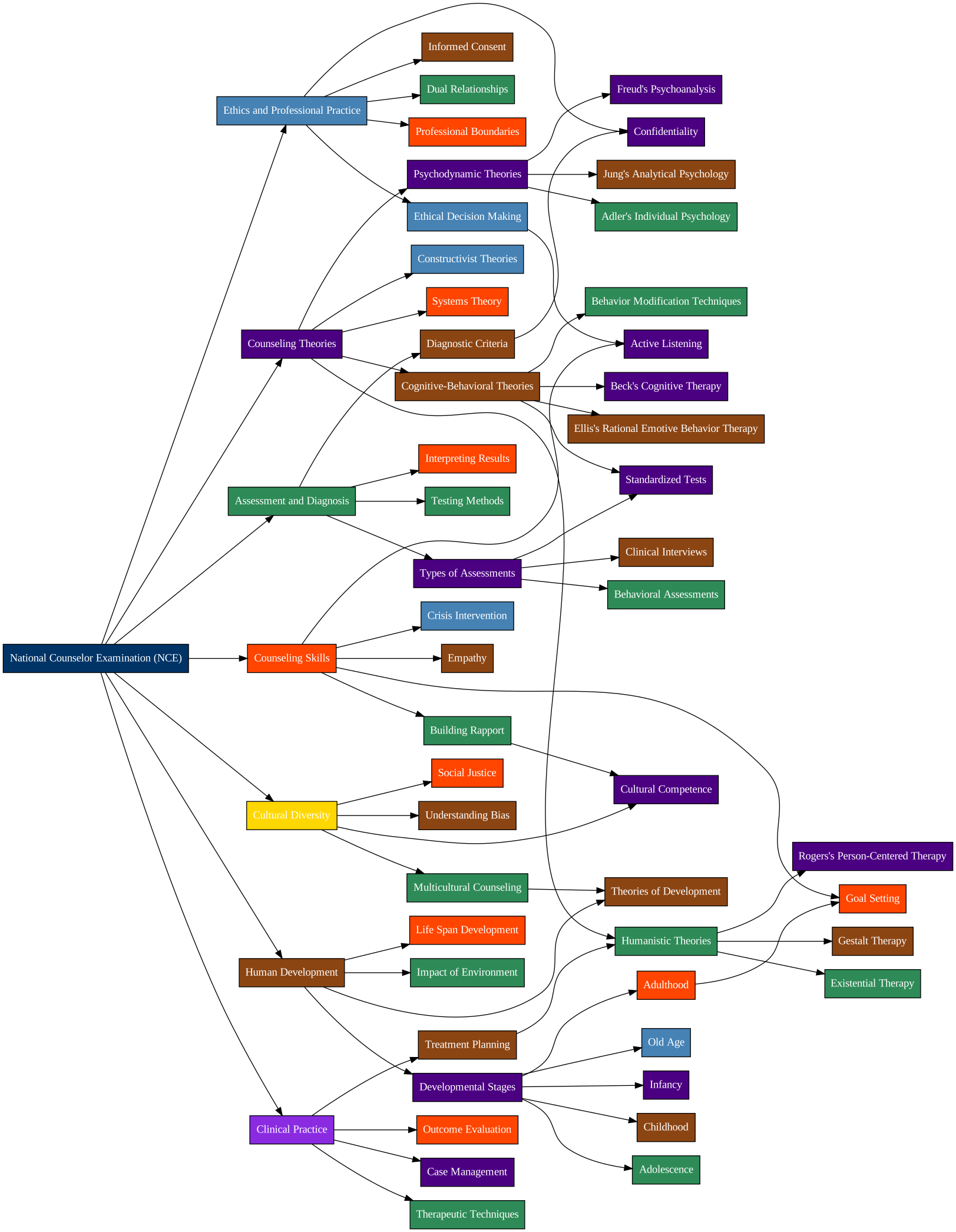
Quiz-summary
0 of 30 questions completed
Questions:
- 1
- 2
- 3
- 4
- 5
- 6
- 7
- 8
- 9
- 10
- 11
- 12
- 13
- 14
- 15
- 16
- 17
- 18
- 19
- 20
- 21
- 22
- 23
- 24
- 25
- 26
- 27
- 28
- 29
- 30
Information
Premium Practice Questions
You have already completed the quiz before. Hence you can not start it again.
Quiz is loading...
You must sign in or sign up to start the quiz.
You have to finish following quiz, to start this quiz:
Results
0 of 30 questions answered correctly
Your time:
Time has elapsed
You have reached 0 of 0 points, (0)
Categories
- Not categorized 0%
- 1
- 2
- 3
- 4
- 5
- 6
- 7
- 8
- 9
- 10
- 11
- 12
- 13
- 14
- 15
- 16
- 17
- 18
- 19
- 20
- 21
- 22
- 23
- 24
- 25
- 26
- 27
- 28
- 29
- 30
- Answered
- Review
-
Question 1 of 30
1. Question
A biochemist at San Sebastian College Manila, Dr. Aris Reyes, has made a groundbreaking discovery regarding a novel compound that shows significant promise in combating a prevalent disease. However, the experimental results, while highly encouraging, are based on a limited sample size and require further replication and peer review. Dr. Reyes is under immense pressure from funding bodies and the public to release the findings immediately, as the potential impact is enormous. Which ethical principle should primarily guide Dr. Reyes’ decision regarding the public announcement of his research findings?
Correct
The question assesses understanding of the philosophical underpinnings of ethical decision-making, particularly as it relates to the pursuit of knowledge and societal contribution, core tenets often emphasized in higher education institutions like San Sebastian College Manila. The scenario presents a researcher facing a conflict between the immediate, potentially sensationalized discovery and the rigorous, verifiable process of scientific inquiry. The core of the dilemma lies in the ethical responsibility of a scholar. A utilitarian approach would weigh the greatest good for the greatest number. While a premature announcement might generate public excitement, it could also lead to widespread misinformation or premature policy decisions based on unverified data, ultimately causing harm. A deontological perspective would focus on the inherent duty of the researcher to uphold scientific integrity and truthfulness, regardless of potential immediate outcomes. This emphasizes the process and adherence to established ethical guidelines for research dissemination. Virtue ethics would consider what a virtuous scholar would do, which typically involves honesty, diligence, and a commitment to the long-term advancement of knowledge. The most ethically sound approach, aligning with the principles of academic integrity and responsible scholarship fostered at institutions like San Sebastian College Manila, is to prioritize the verification and peer-review process. This ensures that any findings are robust, accurate, and can be reliably built upon by the scientific community and society. Therefore, delaying public announcement until the research is thoroughly validated is the most appropriate course of action. The calculation here is not numerical but conceptual: the value of verified truth in advancing knowledge outweighs the potential, albeit uncertain, benefits of immediate, unverified disclosure. The ethical framework prioritizes the integrity of the scientific process and the long-term benefit of reliable knowledge dissemination.
Incorrect
The question assesses understanding of the philosophical underpinnings of ethical decision-making, particularly as it relates to the pursuit of knowledge and societal contribution, core tenets often emphasized in higher education institutions like San Sebastian College Manila. The scenario presents a researcher facing a conflict between the immediate, potentially sensationalized discovery and the rigorous, verifiable process of scientific inquiry. The core of the dilemma lies in the ethical responsibility of a scholar. A utilitarian approach would weigh the greatest good for the greatest number. While a premature announcement might generate public excitement, it could also lead to widespread misinformation or premature policy decisions based on unverified data, ultimately causing harm. A deontological perspective would focus on the inherent duty of the researcher to uphold scientific integrity and truthfulness, regardless of potential immediate outcomes. This emphasizes the process and adherence to established ethical guidelines for research dissemination. Virtue ethics would consider what a virtuous scholar would do, which typically involves honesty, diligence, and a commitment to the long-term advancement of knowledge. The most ethically sound approach, aligning with the principles of academic integrity and responsible scholarship fostered at institutions like San Sebastian College Manila, is to prioritize the verification and peer-review process. This ensures that any findings are robust, accurate, and can be reliably built upon by the scientific community and society. Therefore, delaying public announcement until the research is thoroughly validated is the most appropriate course of action. The calculation here is not numerical but conceptual: the value of verified truth in advancing knowledge outweighs the potential, albeit uncertain, benefits of immediate, unverified disclosure. The ethical framework prioritizes the integrity of the scientific process and the long-term benefit of reliable knowledge dissemination.
-
Question 2 of 30
2. Question
A research team at San Sebastian College Manila is conducting a series of in-depth interviews with community members to understand their perspectives on local heritage preservation initiatives. The interviews are designed to be open-ended to encourage detailed responses. Given the sensitive nature of community dynamics and the potential for even seemingly innocuous details to inadvertently reveal identities when aggregated, what is the most ethically rigorous approach to obtaining informed consent from participants?
Correct
The question assesses understanding of the foundational principles of ethical research conduct, particularly as they apply to academic institutions like San Sebastian College Manila, which emphasizes scholarly integrity and community responsibility. The scenario presents a common dilemma in data collection: balancing the need for comprehensive information with the imperative to protect participant privacy and autonomy. The core ethical principle at play here is informed consent, which requires that participants understand the nature of the research, its potential risks and benefits, and their right to withdraw at any time, without coercion. When a researcher collects data that could inadvertently identify individuals, even if anonymized later, the initial consent process must be robust enough to cover this possibility. In the given scenario, the researcher is collecting qualitative data through open-ended interviews. While the intent is to gather rich insights, the very nature of open-ended questions increases the likelihood of participants revealing personal details that, when combined, could lead to identification, especially in a specific community context. The ethical obligation is to mitigate this risk. Option (a) directly addresses this by proposing a multi-stage consent process. First, participants are informed about the general nature of the research and the types of information being sought. Crucially, they are also made aware of the *potential* for incidental disclosure of identifying information due to the qualitative nature of the data, even with anonymization efforts. This transparency allows them to make a truly informed decision about participation. Second, after the interview, if sensitive information has been shared, a follow-up confirmation can be sought to ensure continued willingness to have their data used, especially if the researcher anticipates a higher risk of identification. This approach respects participant autonomy and upholds the principle of beneficence by minimizing potential harm. Option (b) is insufficient because simply stating that data will be anonymized *after* collection does not adequately address the potential for identification during the collection phase itself, nor does it fully inform participants of the inherent risks of qualitative inquiry. Option (c) is problematic because it shifts the burden of data protection entirely to the participants by asking them to self-censor, which is not the researcher’s primary ethical responsibility. The researcher must proactively design methods to protect participants. Option (d) is also inadequate as it focuses only on the technical aspect of anonymization without addressing the crucial upfront communication and consent regarding the *possibility* of incidental disclosure, which is a key component of ethical qualitative research. Therefore, the most ethically sound approach, aligning with the rigorous standards expected at San Sebastian College Manila, involves a comprehensive and transparent informed consent process that acknowledges and mitigates the inherent risks of qualitative data collection.
Incorrect
The question assesses understanding of the foundational principles of ethical research conduct, particularly as they apply to academic institutions like San Sebastian College Manila, which emphasizes scholarly integrity and community responsibility. The scenario presents a common dilemma in data collection: balancing the need for comprehensive information with the imperative to protect participant privacy and autonomy. The core ethical principle at play here is informed consent, which requires that participants understand the nature of the research, its potential risks and benefits, and their right to withdraw at any time, without coercion. When a researcher collects data that could inadvertently identify individuals, even if anonymized later, the initial consent process must be robust enough to cover this possibility. In the given scenario, the researcher is collecting qualitative data through open-ended interviews. While the intent is to gather rich insights, the very nature of open-ended questions increases the likelihood of participants revealing personal details that, when combined, could lead to identification, especially in a specific community context. The ethical obligation is to mitigate this risk. Option (a) directly addresses this by proposing a multi-stage consent process. First, participants are informed about the general nature of the research and the types of information being sought. Crucially, they are also made aware of the *potential* for incidental disclosure of identifying information due to the qualitative nature of the data, even with anonymization efforts. This transparency allows them to make a truly informed decision about participation. Second, after the interview, if sensitive information has been shared, a follow-up confirmation can be sought to ensure continued willingness to have their data used, especially if the researcher anticipates a higher risk of identification. This approach respects participant autonomy and upholds the principle of beneficence by minimizing potential harm. Option (b) is insufficient because simply stating that data will be anonymized *after* collection does not adequately address the potential for identification during the collection phase itself, nor does it fully inform participants of the inherent risks of qualitative inquiry. Option (c) is problematic because it shifts the burden of data protection entirely to the participants by asking them to self-censor, which is not the researcher’s primary ethical responsibility. The researcher must proactively design methods to protect participants. Option (d) is also inadequate as it focuses only on the technical aspect of anonymization without addressing the crucial upfront communication and consent regarding the *possibility* of incidental disclosure, which is a key component of ethical qualitative research. Therefore, the most ethically sound approach, aligning with the rigorous standards expected at San Sebastian College Manila, involves a comprehensive and transparent informed consent process that acknowledges and mitigates the inherent risks of qualitative data collection.
-
Question 3 of 30
3. Question
Miguel, a prospective student preparing for his studies at San Sebastian College Manila, is reviewing existing academic literature for his intended thesis topic. He discovers a research paper that meticulously details a methodology and presents findings remarkably similar to what he had envisioned for his own project. He is contemplating how to best incorporate this discovery into his academic work while upholding the scholarly standards expected at San Sebastian College Manila. What course of action would most appropriately demonstrate academic integrity and contribute meaningfully to his research endeavor?
Correct
The question assesses understanding of the foundational principles of ethical research conduct, particularly as they apply to the academic environment of San Sebastian College Manila. The scenario presents a common dilemma in academic integrity: the appropriate use of existing research. The core concept here is plagiarism and academic honesty. San Sebastian College Manila, like any reputable institution, emphasizes the importance of original work and proper attribution. When a student or researcher utilizes the ideas, data, or words of another without acknowledging the source, it constitutes plagiarism. This undermines the scholarly process, devalues the original author’s contribution, and misrepresents the student’s own learning and effort. The scenario describes a student, Miguel, who has found a research paper that closely aligns with his intended project at San Sebastian College Manila. He is considering using the paper’s methodology and findings directly in his own work. Option A correctly identifies that Miguel must cite the original source meticulously and build upon it, rather than simply adopting it. This aligns with the principles of scholarly citation and the expectation that students at San Sebastian College Manila will engage critically with existing literature, synthesizing and extending it, not merely replicating it. Proper citation ensures that the original authors are credited, and it allows readers to trace the lineage of ideas. This approach fosters intellectual honesty and contributes to the cumulative nature of knowledge. Option B suggests presenting the work as his own, which is outright plagiarism and a severe breach of academic integrity. This would have serious consequences at San Sebastian College Manila, including potential failure of the course or expulsion. Option C proposes contacting the original author for permission to use the work. While good practice in some professional contexts, for academic research, proper citation is the standard mechanism for acknowledging and utilizing existing work. Seeking permission is generally not required for using published academic research in a way that involves citation and building upon it, unless specific licensing terms dictate otherwise or the use is exceptionally extensive or deviates significantly from standard academic practice. This option is less direct and less universally applicable than proper citation. Option D suggests paraphrasing without citation. This is still a form of plagiarism, as it involves using another’s ideas without attribution, even if the exact wording is changed. The intellectual property of the original author is still being appropriated. Therefore, the most appropriate and ethically sound approach, reflecting the standards expected at San Sebastian College Manila, is to cite the source and use it as a foundation for his own research.
Incorrect
The question assesses understanding of the foundational principles of ethical research conduct, particularly as they apply to the academic environment of San Sebastian College Manila. The scenario presents a common dilemma in academic integrity: the appropriate use of existing research. The core concept here is plagiarism and academic honesty. San Sebastian College Manila, like any reputable institution, emphasizes the importance of original work and proper attribution. When a student or researcher utilizes the ideas, data, or words of another without acknowledging the source, it constitutes plagiarism. This undermines the scholarly process, devalues the original author’s contribution, and misrepresents the student’s own learning and effort. The scenario describes a student, Miguel, who has found a research paper that closely aligns with his intended project at San Sebastian College Manila. He is considering using the paper’s methodology and findings directly in his own work. Option A correctly identifies that Miguel must cite the original source meticulously and build upon it, rather than simply adopting it. This aligns with the principles of scholarly citation and the expectation that students at San Sebastian College Manila will engage critically with existing literature, synthesizing and extending it, not merely replicating it. Proper citation ensures that the original authors are credited, and it allows readers to trace the lineage of ideas. This approach fosters intellectual honesty and contributes to the cumulative nature of knowledge. Option B suggests presenting the work as his own, which is outright plagiarism and a severe breach of academic integrity. This would have serious consequences at San Sebastian College Manila, including potential failure of the course or expulsion. Option C proposes contacting the original author for permission to use the work. While good practice in some professional contexts, for academic research, proper citation is the standard mechanism for acknowledging and utilizing existing work. Seeking permission is generally not required for using published academic research in a way that involves citation and building upon it, unless specific licensing terms dictate otherwise or the use is exceptionally extensive or deviates significantly from standard academic practice. This option is less direct and less universally applicable than proper citation. Option D suggests paraphrasing without citation. This is still a form of plagiarism, as it involves using another’s ideas without attribution, even if the exact wording is changed. The intellectual property of the original author is still being appropriated. Therefore, the most appropriate and ethically sound approach, reflecting the standards expected at San Sebastian College Manila, is to cite the source and use it as a foundation for his own research.
-
Question 4 of 30
4. Question
Maria, a diligent undergraduate student at San Sebastian College Manila, is conducting research for her thesis on the socio-economic impacts of local volunteer initiatives. While interviewing residents in a community known for its economic challenges, she offers a small cash stipend to each participant for their time. What is the primary ethical consideration Maria must carefully navigate to ensure her research adheres to the principles of responsible inquiry and respects the autonomy of her participants?
Correct
The question assesses understanding of the ethical considerations in research, particularly concerning informed consent and the potential for coercion. In the context of San Sebastian College Manila’s commitment to academic integrity and responsible scholarship, understanding these nuances is paramount. The scenario involves a student researcher, Maria, who is collecting data for her thesis on the impact of community engagement programs. She approaches individuals in a low-income neighborhood, offering a small monetary incentive for their participation in a survey. While the incentive is intended to compensate for time, its presence in a context of economic vulnerability raises concerns about whether participants can truly provide voluntary consent, free from undue influence. The core ethical principle at play is voluntariness, a cornerstone of informed consent. Undue influence or coercion occurs when an offer or pressure is so significant that it compromises an individual’s ability to freely choose whether or not to participate. In this case, the monetary incentive, while seemingly modest, could be perceived as substantial by individuals facing financial hardship, potentially leading them to participate not out of genuine willingness but out of perceived necessity. This undermines the principle of autonomy, which requires that participants have the right to make an uncoerced decision. Therefore, the most ethically sound approach for Maria to mitigate this risk is to clearly articulate the voluntary nature of participation and to ensure that the incentive is presented as a token of appreciation for their time, rather than a condition for participation. She should also explicitly state that participants can decline to answer any question or withdraw at any time without penalty. This approach prioritizes the participant’s autonomy and aligns with the ethical standards expected of researchers at San Sebastian College Manila, where the well-being and rights of research subjects are held in high regard. The other options, while seemingly practical, do not adequately address the potential for coercion inherent in offering financial incentives in vulnerable populations.
Incorrect
The question assesses understanding of the ethical considerations in research, particularly concerning informed consent and the potential for coercion. In the context of San Sebastian College Manila’s commitment to academic integrity and responsible scholarship, understanding these nuances is paramount. The scenario involves a student researcher, Maria, who is collecting data for her thesis on the impact of community engagement programs. She approaches individuals in a low-income neighborhood, offering a small monetary incentive for their participation in a survey. While the incentive is intended to compensate for time, its presence in a context of economic vulnerability raises concerns about whether participants can truly provide voluntary consent, free from undue influence. The core ethical principle at play is voluntariness, a cornerstone of informed consent. Undue influence or coercion occurs when an offer or pressure is so significant that it compromises an individual’s ability to freely choose whether or not to participate. In this case, the monetary incentive, while seemingly modest, could be perceived as substantial by individuals facing financial hardship, potentially leading them to participate not out of genuine willingness but out of perceived necessity. This undermines the principle of autonomy, which requires that participants have the right to make an uncoerced decision. Therefore, the most ethically sound approach for Maria to mitigate this risk is to clearly articulate the voluntary nature of participation and to ensure that the incentive is presented as a token of appreciation for their time, rather than a condition for participation. She should also explicitly state that participants can decline to answer any question or withdraw at any time without penalty. This approach prioritizes the participant’s autonomy and aligns with the ethical standards expected of researchers at San Sebastian College Manila, where the well-being and rights of research subjects are held in high regard. The other options, while seemingly practical, do not adequately address the potential for coercion inherent in offering financial incentives in vulnerable populations.
-
Question 5 of 30
5. Question
A team of researchers at San Sebastian College Manila is planning a study to investigate the impact of a new pedagogical approach on student engagement in undergraduate history courses. The study involves observing classroom interactions and administering pre- and post-study surveys to students. To ensure the integrity and ethical standing of their work, what fundamental procedural step must the researchers prioritize before commencing data collection from any student?
Correct
The question assesses understanding of the foundational principles of ethical research conduct, particularly as they apply to academic institutions like San Sebastian College Manila. The scenario presents a common dilemma in academic settings: balancing the pursuit of knowledge with the protection of human subjects. The core ethical principle at play here is informed consent, which requires that participants understand the nature of the research, its potential risks and benefits, and their right to withdraw without penalty. Option (a) directly addresses this by emphasizing the necessity of obtaining explicit, voluntary agreement from all participants after they have been fully apprised of the study’s details. This aligns with the rigorous ethical standards expected in academic research, promoting transparency and respect for individual autonomy. Option (b) is incorrect because while confidentiality is important, it is secondary to obtaining consent in the first place. A study cannot proceed ethically without consent, regardless of how well confidentiality is maintained. Option (c) is flawed because the potential for “valuable insights” does not override the ethical obligation to obtain informed consent. Ethical considerations are paramount and cannot be bypassed for the sake of research outcomes. Option (d) is also incorrect; while institutional review boards (IRBs) play a crucial role in approving research, their approval is contingent upon the researcher demonstrating that informed consent procedures will be properly implemented. The IRB’s role is oversight, not a substitute for the researcher’s direct ethical responsibility to the participants. Therefore, the most critical step in ensuring ethical research practice in this scenario is securing informed consent.
Incorrect
The question assesses understanding of the foundational principles of ethical research conduct, particularly as they apply to academic institutions like San Sebastian College Manila. The scenario presents a common dilemma in academic settings: balancing the pursuit of knowledge with the protection of human subjects. The core ethical principle at play here is informed consent, which requires that participants understand the nature of the research, its potential risks and benefits, and their right to withdraw without penalty. Option (a) directly addresses this by emphasizing the necessity of obtaining explicit, voluntary agreement from all participants after they have been fully apprised of the study’s details. This aligns with the rigorous ethical standards expected in academic research, promoting transparency and respect for individual autonomy. Option (b) is incorrect because while confidentiality is important, it is secondary to obtaining consent in the first place. A study cannot proceed ethically without consent, regardless of how well confidentiality is maintained. Option (c) is flawed because the potential for “valuable insights” does not override the ethical obligation to obtain informed consent. Ethical considerations are paramount and cannot be bypassed for the sake of research outcomes. Option (d) is also incorrect; while institutional review boards (IRBs) play a crucial role in approving research, their approval is contingent upon the researcher demonstrating that informed consent procedures will be properly implemented. The IRB’s role is oversight, not a substitute for the researcher’s direct ethical responsibility to the participants. Therefore, the most critical step in ensuring ethical research practice in this scenario is securing informed consent.
-
Question 6 of 30
6. Question
Consider a research team at San Sebastian College Manila, composed of a principal investigator, two senior researchers, and a junior research assistant. The junior assistant, under the guidance of the senior researchers, played a pivotal role in developing the novel analytical framework and was instrumental in the interpretation of the key findings for a groundbreaking study. However, upon manuscript submission, the junior assistant was listed only in the acknowledgments section, not as a co-author, citing a departmental policy that prioritizes lead investigators for authorship on initial publications. Which ethical principle is most directly challenged by this decision, and what action best upholds academic integrity within the San Sebastian College Manila context?
Correct
The question probes the understanding of ethical considerations in academic research, specifically concerning data integrity and authorship, which are foundational principles at San Sebastian College Manila. The scenario presents a common dilemma where a junior researcher contributes significantly to a project but is not formally acknowledged as a co-author due to institutional policies or oversight. The core issue is the ethical obligation to recognize substantial intellectual contribution. In academic research, authorship is typically granted to individuals who have made significant contributions to the conception, design, data acquisition, analysis, or interpretation of the work, and who have participated in drafting or revising the manuscript. Merely providing technical assistance or funding does not usually warrant authorship. The principle of fairness and academic integrity dictates that all individuals who meet the criteria for authorship should be included. Excluding a researcher who has demonstrably contributed to the core intellectual work, even if they are a junior member, violates ethical standards and can undermine the collaborative spirit essential for scientific advancement, a value emphasized in San Sebastian College Manila’s commitment to scholarly excellence. Therefore, advocating for the inclusion of the junior researcher as a co-author, based on their documented contributions to the project’s conceptualization and data analysis, aligns with the ethical imperative of accurate representation of intellectual property and fair credit.
Incorrect
The question probes the understanding of ethical considerations in academic research, specifically concerning data integrity and authorship, which are foundational principles at San Sebastian College Manila. The scenario presents a common dilemma where a junior researcher contributes significantly to a project but is not formally acknowledged as a co-author due to institutional policies or oversight. The core issue is the ethical obligation to recognize substantial intellectual contribution. In academic research, authorship is typically granted to individuals who have made significant contributions to the conception, design, data acquisition, analysis, or interpretation of the work, and who have participated in drafting or revising the manuscript. Merely providing technical assistance or funding does not usually warrant authorship. The principle of fairness and academic integrity dictates that all individuals who meet the criteria for authorship should be included. Excluding a researcher who has demonstrably contributed to the core intellectual work, even if they are a junior member, violates ethical standards and can undermine the collaborative spirit essential for scientific advancement, a value emphasized in San Sebastian College Manila’s commitment to scholarly excellence. Therefore, advocating for the inclusion of the junior researcher as a co-author, based on their documented contributions to the project’s conceptualization and data analysis, aligns with the ethical imperative of accurate representation of intellectual property and fair credit.
-
Question 7 of 30
7. Question
Maria, a diligent undergraduate student at San Sebastian College Manila, is nearing the completion of her research project on the socio-economic impact of local community initiatives. During her data analysis, she uncovers a correlation that, if true, could significantly alter the understanding of community development strategies, but it also raises potential privacy concerns for some individuals whose anonymized data contributed to the finding. What is the most appropriate initial step Maria should take to navigate this ethically complex situation and ensure responsible dissemination of her work?
Correct
The question probes the understanding of the foundational principles of ethical research conduct, particularly as they apply to academic institutions like San Sebastian College Manila. The scenario involves a student researcher, Maria, who has discovered a potentially groundbreaking but ethically sensitive finding. The core of the question lies in identifying the most appropriate initial step for Maria to take, adhering to academic integrity and institutional protocols. The correct course of action is to consult with her thesis adviser and the institutional review board (IRB) or ethics committee. This ensures that the discovery is handled responsibly, with due consideration for potential ethical implications, participant welfare (if applicable), and the integrity of the research process. The adviser provides guidance on the research methodology and ethical considerations, while the IRB/ethics committee offers formal oversight and approval for research involving human subjects or sensitive data. Option b) is incorrect because immediately publishing or presenting the findings without proper ethical review or consultation could lead to premature conclusions, misinterpretation, or even harm, violating academic standards. Option c) is incorrect as withholding the information entirely from her adviser and the institution undermines the collaborative and supervised nature of academic research and could prevent necessary ethical safeguards from being implemented. Option d) is incorrect because seeking external validation from a commercial entity before internal review and consultation is inappropriate and bypasses the established academic and ethical channels designed to protect both the researcher and the institution. Therefore, the most prudent and ethically sound first step is to engage with the established academic support and oversight structures.
Incorrect
The question probes the understanding of the foundational principles of ethical research conduct, particularly as they apply to academic institutions like San Sebastian College Manila. The scenario involves a student researcher, Maria, who has discovered a potentially groundbreaking but ethically sensitive finding. The core of the question lies in identifying the most appropriate initial step for Maria to take, adhering to academic integrity and institutional protocols. The correct course of action is to consult with her thesis adviser and the institutional review board (IRB) or ethics committee. This ensures that the discovery is handled responsibly, with due consideration for potential ethical implications, participant welfare (if applicable), and the integrity of the research process. The adviser provides guidance on the research methodology and ethical considerations, while the IRB/ethics committee offers formal oversight and approval for research involving human subjects or sensitive data. Option b) is incorrect because immediately publishing or presenting the findings without proper ethical review or consultation could lead to premature conclusions, misinterpretation, or even harm, violating academic standards. Option c) is incorrect as withholding the information entirely from her adviser and the institution undermines the collaborative and supervised nature of academic research and could prevent necessary ethical safeguards from being implemented. Option d) is incorrect because seeking external validation from a commercial entity before internal review and consultation is inappropriate and bypasses the established academic and ethical channels designed to protect both the researcher and the institution. Therefore, the most prudent and ethically sound first step is to engage with the established academic support and oversight structures.
-
Question 8 of 30
8. Question
Mateo, a diligent undergraduate student at San Sebastian College Manila, is reviewing a seminal research paper by his esteemed professor for an upcoming seminar. While meticulously cross-referencing data points, Mateo uncovers a subtle but significant methodological error that, if unaddressed, could cast doubt on the paper’s primary conclusions. Considering the academic rigor and ethical standards upheld at San Sebastian College Manila, what would be the most appropriate and principled course of action for Mateo to take?
Correct
The question probes the understanding of ethical considerations in academic research, a core tenet at San Sebastian College Manila. The scenario involves a student, Mateo, who discovers a significant flaw in his professor’s published research. The ethical dilemma lies in how Mateo should proceed. Option (a) represents the most academically sound and ethically responsible approach: privately informing the professor and offering to help correct the error. This respects the professor’s position, avoids public embarrassment, and fosters a collaborative learning environment, aligning with San Sebastian College Manila’s emphasis on integrity and mentorship. Option (b) is problematic because it involves circumventing the professor and going directly to the journal, which could be seen as disrespectful and undermining. Option (c) is unethical as it suggests exploiting the error for personal gain, a direct violation of academic integrity. Option (d) is also ethically questionable; while it involves informing the professor, it adds a layer of public pressure by copying a department head without first attempting direct, private communication, which can be perceived as confrontational rather than collaborative. Therefore, the most appropriate action, reflecting the values of scholarly conduct and respect for academic hierarchy, is to engage directly and constructively with the professor.
Incorrect
The question probes the understanding of ethical considerations in academic research, a core tenet at San Sebastian College Manila. The scenario involves a student, Mateo, who discovers a significant flaw in his professor’s published research. The ethical dilemma lies in how Mateo should proceed. Option (a) represents the most academically sound and ethically responsible approach: privately informing the professor and offering to help correct the error. This respects the professor’s position, avoids public embarrassment, and fosters a collaborative learning environment, aligning with San Sebastian College Manila’s emphasis on integrity and mentorship. Option (b) is problematic because it involves circumventing the professor and going directly to the journal, which could be seen as disrespectful and undermining. Option (c) is unethical as it suggests exploiting the error for personal gain, a direct violation of academic integrity. Option (d) is also ethically questionable; while it involves informing the professor, it adds a layer of public pressure by copying a department head without first attempting direct, private communication, which can be perceived as confrontational rather than collaborative. Therefore, the most appropriate action, reflecting the values of scholarly conduct and respect for academic hierarchy, is to engage directly and constructively with the professor.
-
Question 9 of 30
9. Question
A diligent student researcher at San Sebastian College Manila, after the successful publication of their findings on sustainable urban planning in a peer-reviewed journal, discovers a critical flaw in their data analysis methodology that significantly alters the interpretation of their primary conclusions. What is the most ethically imperative and academically responsible course of action to address this discovery?
Correct
The core of this question lies in understanding the principles of ethical research conduct, particularly as applied in academic settings like San Sebastian College Manila. When a student discovers a significant error in their published research that could mislead others, the most ethically sound and academically responsible action is to formally retract or issue a correction. This involves notifying the journal or publisher and clearly stating the nature of the error and its implications. Simply correcting the error in future publications without acknowledging the original flawed work is insufficient, as it doesn’t address the existing dissemination of misinformation. Discussing the error with a mentor is a good step, but it’s not the primary action to rectify the published record. Ignoring the error is a clear violation of academic integrity. Therefore, the most appropriate response is to initiate a formal correction or retraction process to ensure the scientific record is accurate and to uphold the trust placed in published research, a cornerstone of academic pursuits at San Sebastian College Manila.
Incorrect
The core of this question lies in understanding the principles of ethical research conduct, particularly as applied in academic settings like San Sebastian College Manila. When a student discovers a significant error in their published research that could mislead others, the most ethically sound and academically responsible action is to formally retract or issue a correction. This involves notifying the journal or publisher and clearly stating the nature of the error and its implications. Simply correcting the error in future publications without acknowledging the original flawed work is insufficient, as it doesn’t address the existing dissemination of misinformation. Discussing the error with a mentor is a good step, but it’s not the primary action to rectify the published record. Ignoring the error is a clear violation of academic integrity. Therefore, the most appropriate response is to initiate a formal correction or retraction process to ensure the scientific record is accurate and to uphold the trust placed in published research, a cornerstone of academic pursuits at San Sebastian College Manila.
-
Question 10 of 30
10. Question
A faculty member at San Sebastian College Manila, while reviewing submissions for a senior thesis seminar, discovers that a student’s research paper extensively incorporates material from an online academic journal without any form of citation or acknowledgment. This practice, if left unaddressed, undermines the foundational principles of scholarly inquiry and intellectual property that are integral to the academic environment of San Sebastian College Manila. What is the most appropriate initial course of action for the faculty member to take in accordance with the college’s commitment to academic integrity?
Correct
The question probes the understanding of ethical considerations in academic research, a core tenet at San Sebastian College Manila. Specifically, it addresses the principle of intellectual honesty and the avoidance of plagiarism. When a student submits work that is not their own, or improperly attributes sources, they are violating academic integrity. This can manifest in various ways, such as direct copying without citation, paraphrasing too closely without acknowledgment, or even presenting ideas from others as original thoughts. San Sebastian College Manila, like any reputable institution, emphasizes the importance of original thought and proper scholarly practice. The scenario presented involves a student submitting a research paper that, upon review, contains significant portions of text and ideas lifted from an online journal without any attribution. This constitutes a clear breach of academic honesty. The most appropriate response from the institution, aligning with its commitment to scholarly ethics, is to address the plagiarism directly and implement corrective measures. This typically involves educating the student on proper citation methods and potentially assigning a penalty, such as a failing grade for the assignment or course, depending on the severity and institutional policy. The other options, while potentially part of a broader disciplinary process, do not directly address the core academic offense of plagiarism as the primary corrective action. For instance, immediate expulsion might be too severe for a first offense without prior warning or educational intervention. Focusing solely on improving writing skills without addressing the underlying ethical lapse of plagiarism would be insufficient. Similarly, simply requiring a revised submission without acknowledging the ethical breach undermines the principle of accountability. Therefore, the most fitting initial response is to address the plagiarism through education and appropriate academic sanctions.
Incorrect
The question probes the understanding of ethical considerations in academic research, a core tenet at San Sebastian College Manila. Specifically, it addresses the principle of intellectual honesty and the avoidance of plagiarism. When a student submits work that is not their own, or improperly attributes sources, they are violating academic integrity. This can manifest in various ways, such as direct copying without citation, paraphrasing too closely without acknowledgment, or even presenting ideas from others as original thoughts. San Sebastian College Manila, like any reputable institution, emphasizes the importance of original thought and proper scholarly practice. The scenario presented involves a student submitting a research paper that, upon review, contains significant portions of text and ideas lifted from an online journal without any attribution. This constitutes a clear breach of academic honesty. The most appropriate response from the institution, aligning with its commitment to scholarly ethics, is to address the plagiarism directly and implement corrective measures. This typically involves educating the student on proper citation methods and potentially assigning a penalty, such as a failing grade for the assignment or course, depending on the severity and institutional policy. The other options, while potentially part of a broader disciplinary process, do not directly address the core academic offense of plagiarism as the primary corrective action. For instance, immediate expulsion might be too severe for a first offense without prior warning or educational intervention. Focusing solely on improving writing skills without addressing the underlying ethical lapse of plagiarism would be insufficient. Similarly, simply requiring a revised submission without acknowledging the ethical breach undermines the principle of accountability. Therefore, the most fitting initial response is to address the plagiarism through education and appropriate academic sanctions.
-
Question 11 of 30
11. Question
Consider a scenario where a promising student at San Sebastian College Manila, Maria, has developed a unique algorithm for analyzing historical linguistic patterns, building upon established computational linguistics theories. She is preparing to present her findings at a departmental colloquium. While her application of the theories is innovative, she is contemplating whether to explicitly acknowledge the specific foundational researchers and their seminal papers that guided her conceptualization, or to present the algorithm as a direct product of her own independent thought process, given its novel implementation. What is the most ethically sound and academically responsible approach for Maria to take in presenting her research?
Correct
The question probes the understanding of the ethical considerations in academic research, specifically as it pertains to the foundational principles of scholarly integrity often emphasized at institutions like San Sebastian College Manila. The scenario involves a student, Maria, who has discovered a novel approach to data analysis. The core ethical dilemma lies in how she attributes her findings and acknowledges the intellectual contributions of others. The principle of proper citation and avoiding plagiarism is paramount. Maria’s initial thought to present the method as solely her own, without referencing the foundational theories that informed her innovation, directly violates the ethical standard of acknowledging prior work. The most ethically sound approach, aligning with scholarly best practices and the academic ethos of San Sebastian College Manila, is to clearly cite the existing theoretical frameworks and researchers whose work laid the groundwork for her novel application. This demonstrates intellectual honesty and respect for the academic community. Therefore, the correct course of action is to meticulously document the lineage of her idea, crediting the sources that inspired and enabled her breakthrough, while still highlighting her unique contribution in applying and extending those concepts. This approach fosters transparency and contributes to the cumulative nature of knowledge advancement, a key tenet in higher education.
Incorrect
The question probes the understanding of the ethical considerations in academic research, specifically as it pertains to the foundational principles of scholarly integrity often emphasized at institutions like San Sebastian College Manila. The scenario involves a student, Maria, who has discovered a novel approach to data analysis. The core ethical dilemma lies in how she attributes her findings and acknowledges the intellectual contributions of others. The principle of proper citation and avoiding plagiarism is paramount. Maria’s initial thought to present the method as solely her own, without referencing the foundational theories that informed her innovation, directly violates the ethical standard of acknowledging prior work. The most ethically sound approach, aligning with scholarly best practices and the academic ethos of San Sebastian College Manila, is to clearly cite the existing theoretical frameworks and researchers whose work laid the groundwork for her novel application. This demonstrates intellectual honesty and respect for the academic community. Therefore, the correct course of action is to meticulously document the lineage of her idea, crediting the sources that inspired and enabled her breakthrough, while still highlighting her unique contribution in applying and extending those concepts. This approach fosters transparency and contributes to the cumulative nature of knowledge advancement, a key tenet in higher education.
-
Question 12 of 30
12. Question
A faculty member at San Sebastian College Manila is developing a novel curriculum module intended to enhance critical thinking skills among first-year students. Before widespread implementation, a rigorous evaluation of its effectiveness is commissioned. The faculty member who designed the module is assigned to lead this evaluation. Considering the principles of academic integrity and unbiased research that San Sebastian College Manila upholds, what is the most appropriate course of action for this faculty member to ensure the credibility and objectivity of the evaluation findings?
Correct
The question probes the understanding of the foundational principles of ethical research conduct, particularly as they apply to academic institutions like San Sebastian College Manila. The scenario presents a common dilemma in academic settings: the potential for bias in research due to personal or institutional affiliations. The core concept being tested is the importance of transparency and objectivity in scholarly work. A researcher at San Sebastian College Manila, tasked with evaluating the efficacy of a new pedagogical approach developed by their own department, faces a conflict of interest. To maintain academic integrity and ensure the validity of their findings, the researcher must proactively address this potential bias. The most ethically sound and methodologically rigorous approach is to disclose the affiliation and seek external validation. This involves informing the relevant academic bodies or ethics committees about the relationship and potentially collaborating with researchers from outside the department or even the institution to conduct an independent review. This ensures that the research is perceived as impartial and that the results are more likely to be accepted by the wider academic community. The other options, while seemingly addressing the issue, fall short of the rigorous standards expected in academic research. Simply acknowledging the affiliation without seeking independent verification might not be sufficient to overcome perceived bias. Conducting the research without any mention of the affiliation would be a clear breach of ethical guidelines. Relying solely on internal peer review, especially within the same department, does not provide the necessary level of objectivity. Therefore, the most robust approach is to ensure transparency and involve an independent perspective.
Incorrect
The question probes the understanding of the foundational principles of ethical research conduct, particularly as they apply to academic institutions like San Sebastian College Manila. The scenario presents a common dilemma in academic settings: the potential for bias in research due to personal or institutional affiliations. The core concept being tested is the importance of transparency and objectivity in scholarly work. A researcher at San Sebastian College Manila, tasked with evaluating the efficacy of a new pedagogical approach developed by their own department, faces a conflict of interest. To maintain academic integrity and ensure the validity of their findings, the researcher must proactively address this potential bias. The most ethically sound and methodologically rigorous approach is to disclose the affiliation and seek external validation. This involves informing the relevant academic bodies or ethics committees about the relationship and potentially collaborating with researchers from outside the department or even the institution to conduct an independent review. This ensures that the research is perceived as impartial and that the results are more likely to be accepted by the wider academic community. The other options, while seemingly addressing the issue, fall short of the rigorous standards expected in academic research. Simply acknowledging the affiliation without seeking independent verification might not be sufficient to overcome perceived bias. Conducting the research without any mention of the affiliation would be a clear breach of ethical guidelines. Relying solely on internal peer review, especially within the same department, does not provide the necessary level of objectivity. Therefore, the most robust approach is to ensure transparency and involve an independent perspective.
-
Question 13 of 30
13. Question
A promising Psychology student at San Sebastian College Manila, while analyzing survey responses for her thesis on cognitive biases, encounters a dataset where a small but statistically significant portion of participants provided responses that deviate sharply from the expected pattern, potentially invalidating her primary hypothesis. The student is concerned that including these outliers will undermine her research’s perceived validity. Which of the following actions best upholds the principles of academic integrity and responsible research conduct expected at San Sebastian College Manila?
Correct
The question assesses understanding of the foundational principles of ethical research conduct, particularly as applied in academic settings like San Sebastian College Manila. The scenario presents a common dilemma involving data integrity and potential bias. To determine the most appropriate course of action, one must consider the core tenets of academic honesty and responsible scholarship. The scenario involves a student, Maria, working on a research project for her Psychology program at San Sebastian College Manila. She discovers that a particular dataset, crucial for her hypothesis, exhibits a statistically significant anomaly that, if excluded, would strongly support her initial prediction. However, including it, even with a valid statistical justification for its potential outlier status, would weaken her findings considerably. The ethical imperative in research is to present findings accurately and transparently, regardless of whether they align with the researcher’s expectations. Excluding data simply because it contradicts a hypothesis, without a robust, pre-defined methodological reason for its exclusion (e.g., a clear data entry error that can be verified, or a pre-specified outlier detection protocol), constitutes data manipulation. This violates the principle of scientific integrity. Therefore, the most ethical and academically sound approach is to acknowledge the anomaly, investigate its potential causes thoroughly, and report the findings with and without the anomalous data point, clearly explaining the rationale for any exclusion or inclusion. This demonstrates intellectual honesty and a commitment to rigorous scientific inquiry, which are paramount values at San Sebastian College Manila. Maria should document her process meticulously, including the statistical tests used to identify the anomaly and her reasoning for any decision regarding its inclusion or exclusion in the final analysis. Presenting the data in its entirety, along with a discussion of the anomaly’s impact, ensures transparency and allows for a more complete and honest interpretation of the results. This approach upholds the scholarly standards expected of students at San Sebastian College Manila, fostering a culture of trust and integrity in research.
Incorrect
The question assesses understanding of the foundational principles of ethical research conduct, particularly as applied in academic settings like San Sebastian College Manila. The scenario presents a common dilemma involving data integrity and potential bias. To determine the most appropriate course of action, one must consider the core tenets of academic honesty and responsible scholarship. The scenario involves a student, Maria, working on a research project for her Psychology program at San Sebastian College Manila. She discovers that a particular dataset, crucial for her hypothesis, exhibits a statistically significant anomaly that, if excluded, would strongly support her initial prediction. However, including it, even with a valid statistical justification for its potential outlier status, would weaken her findings considerably. The ethical imperative in research is to present findings accurately and transparently, regardless of whether they align with the researcher’s expectations. Excluding data simply because it contradicts a hypothesis, without a robust, pre-defined methodological reason for its exclusion (e.g., a clear data entry error that can be verified, or a pre-specified outlier detection protocol), constitutes data manipulation. This violates the principle of scientific integrity. Therefore, the most ethical and academically sound approach is to acknowledge the anomaly, investigate its potential causes thoroughly, and report the findings with and without the anomalous data point, clearly explaining the rationale for any exclusion or inclusion. This demonstrates intellectual honesty and a commitment to rigorous scientific inquiry, which are paramount values at San Sebastian College Manila. Maria should document her process meticulously, including the statistical tests used to identify the anomaly and her reasoning for any decision regarding its inclusion or exclusion in the final analysis. Presenting the data in its entirety, along with a discussion of the anomaly’s impact, ensures transparency and allows for a more complete and honest interpretation of the results. This approach upholds the scholarly standards expected of students at San Sebastian College Manila, fostering a culture of trust and integrity in research.
-
Question 14 of 30
14. Question
Consider a scenario where Dr. Aris Reyes, a researcher affiliated with San Sebastian College Manila’s Faculty of Science, has developed a promising new pharmaceutical compound intended to treat a debilitating chronic illness. During the initial phase of clinical trials, the compound demonstrates remarkable efficacy. However, a small percentage of trial participants experienced a statistically significant, albeit clinically minor, adverse reaction. This reaction, while not posing a serious health threat, is a documented outcome of the compound’s interaction within the human body. What is the most ethically imperative course of action for Dr. Reyes regarding this finding, in adherence to the scholarly principles upheld by San Sebastian College Manila?
Correct
The question probes the understanding of ethical considerations in academic research, a cornerstone of scholarly integrity at institutions like San Sebastian College Manila. The scenario presents a researcher, Dr. Aris Reyes, who has discovered a novel therapeutic compound. However, the compound exhibits a statistically significant but clinically negligible side effect in a small subset of participants during preliminary trials. The core ethical dilemma lies in balancing the potential societal benefit of the drug against the duty to fully disclose all known risks, even minor ones, to participants and regulatory bodies. The principle of *beneficence* suggests acting in the best interest of others, which would favor the drug’s development due to its potential benefits. However, *non-maleficence* dictates avoiding harm, which might lead one to withhold information about the side effect to prevent undue alarm. The principle of *autonomy* requires informed consent, meaning participants must have all relevant information to make a voluntary decision. Withholding even a minor side effect, if it is a known risk, violates this principle. Furthermore, *justice* demands fair distribution of benefits and burdens, and transparency in research is crucial for maintaining public trust. In this context, the most ethically sound approach, aligning with the rigorous standards expected at San Sebastian College Manila, is to disclose the side effect. While the effect is minor, its existence is a fact derived from the research. Transparency is paramount. The researcher’s obligation is to report findings accurately and completely. The decision of whether this minor side effect warrants halting development or requires specific participant warnings is a subsequent step for regulatory review and informed consent processes, but the initial ethical imperative is full disclosure of the data. Therefore, the most appropriate action is to report the side effect to the ethics review board and the relevant regulatory agencies, along with the full data, allowing for an informed assessment of its significance and necessary actions.
Incorrect
The question probes the understanding of ethical considerations in academic research, a cornerstone of scholarly integrity at institutions like San Sebastian College Manila. The scenario presents a researcher, Dr. Aris Reyes, who has discovered a novel therapeutic compound. However, the compound exhibits a statistically significant but clinically negligible side effect in a small subset of participants during preliminary trials. The core ethical dilemma lies in balancing the potential societal benefit of the drug against the duty to fully disclose all known risks, even minor ones, to participants and regulatory bodies. The principle of *beneficence* suggests acting in the best interest of others, which would favor the drug’s development due to its potential benefits. However, *non-maleficence* dictates avoiding harm, which might lead one to withhold information about the side effect to prevent undue alarm. The principle of *autonomy* requires informed consent, meaning participants must have all relevant information to make a voluntary decision. Withholding even a minor side effect, if it is a known risk, violates this principle. Furthermore, *justice* demands fair distribution of benefits and burdens, and transparency in research is crucial for maintaining public trust. In this context, the most ethically sound approach, aligning with the rigorous standards expected at San Sebastian College Manila, is to disclose the side effect. While the effect is minor, its existence is a fact derived from the research. Transparency is paramount. The researcher’s obligation is to report findings accurately and completely. The decision of whether this minor side effect warrants halting development or requires specific participant warnings is a subsequent step for regulatory review and informed consent processes, but the initial ethical imperative is full disclosure of the data. Therefore, the most appropriate action is to report the side effect to the ethics review board and the relevant regulatory agencies, along with the full data, allowing for an informed assessment of its significance and necessary actions.
-
Question 15 of 30
15. Question
Dr. Alcantara, a faculty member at San Sebastian College Manila, is conducting a study on the effectiveness of a novel pedagogical approach in undergraduate courses. To gather data, Dr. Alcantara plans to survey students enrolled in the courses where the new methodology is being implemented. While the survey is designed to be anonymous, the students are aware that Dr. Alcantara is their instructor. What critical ethical consideration must Dr. Alcantara prioritize to ensure the integrity of the research and the well-being of the participants within the academic context of San Sebastian College Manila?
Correct
The question assesses understanding of ethical considerations in research, particularly concerning informed consent and potential biases in data collection, relevant to disciplines like psychology, sociology, and health sciences at San Sebastian College Manila. The scenario involves a researcher, Dr. Alcantara, studying the impact of a new teaching methodology at San Sebastian College Manila. The core ethical dilemma arises from the potential for subtle coercion or undue influence on student participants. While the students are informed about the study’s purpose, the fact that their grades might be indirectly linked to their participation (even if not explicitly stated as a condition for passing) creates a power imbalance. Students might feel pressured to participate or provide favorable responses to please the instructor or researcher, who is also in a position of authority. The principle of voluntary participation is paramount in ethical research. This means participants must be free to decline participation without any negative consequences. In this case, the implicit connection between the study and their academic standing, however indirect, could compromise this voluntariness. Furthermore, the researcher has a responsibility to minimize any potential for bias in the data. If students feel compelled to participate or respond in a certain way, the data collected will not accurately reflect their genuine experiences or opinions, thus undermining the study’s validity. Therefore, the most ethically sound approach, aligning with the rigorous academic and ethical standards expected at San Sebastian College Manila, is to ensure that participation is entirely voluntary and demonstrably separate from academic evaluation. This involves clearly communicating that participation or non-participation will have no bearing on their grades or academic standing. Additionally, the researcher should consider alternative methods of recruitment or data collection that further distance the study from the students’ academic performance, such as having a neutral third party administer consent forms or collect data, or conducting the study outside of regular class time with clear assurances of anonymity and no impact on grades. The goal is to create an environment where students feel genuinely free to contribute or abstain, ensuring the integrity of both the research process and the participants’ rights.
Incorrect
The question assesses understanding of ethical considerations in research, particularly concerning informed consent and potential biases in data collection, relevant to disciplines like psychology, sociology, and health sciences at San Sebastian College Manila. The scenario involves a researcher, Dr. Alcantara, studying the impact of a new teaching methodology at San Sebastian College Manila. The core ethical dilemma arises from the potential for subtle coercion or undue influence on student participants. While the students are informed about the study’s purpose, the fact that their grades might be indirectly linked to their participation (even if not explicitly stated as a condition for passing) creates a power imbalance. Students might feel pressured to participate or provide favorable responses to please the instructor or researcher, who is also in a position of authority. The principle of voluntary participation is paramount in ethical research. This means participants must be free to decline participation without any negative consequences. In this case, the implicit connection between the study and their academic standing, however indirect, could compromise this voluntariness. Furthermore, the researcher has a responsibility to minimize any potential for bias in the data. If students feel compelled to participate or respond in a certain way, the data collected will not accurately reflect their genuine experiences or opinions, thus undermining the study’s validity. Therefore, the most ethically sound approach, aligning with the rigorous academic and ethical standards expected at San Sebastian College Manila, is to ensure that participation is entirely voluntary and demonstrably separate from academic evaluation. This involves clearly communicating that participation or non-participation will have no bearing on their grades or academic standing. Additionally, the researcher should consider alternative methods of recruitment or data collection that further distance the study from the students’ academic performance, such as having a neutral third party administer consent forms or collect data, or conducting the study outside of regular class time with clear assurances of anonymity and no impact on grades. The goal is to create an environment where students feel genuinely free to contribute or abstain, ensuring the integrity of both the research process and the participants’ rights.
-
Question 16 of 30
16. Question
A diligent student at San Sebastian College Manila, Maria, has invested considerable effort into her undergraduate thesis. Midway through the final data analysis phase, she uncovers a subtle but critical flaw in the experimental design that was implemented at the project’s inception. This oversight, if unaddressed, could significantly skew the results. Considering the academic rigor and commitment to ethical scholarship fostered at San Sebastian College Manila, what is the most appropriate immediate course of action for Maria to take?
Correct
The question probes the understanding of ethical considerations in academic research, a core tenet at San Sebastian College Manila, particularly within its programs that emphasize responsible scholarship. The scenario involves a student, Maria, who discovers a significant flaw in her research methodology after a substantial portion of her thesis has been completed. The ethical dilemma lies in how to proceed without compromising academic integrity or unfairly disadvantaging others. The core principle at play is the commitment to truthfulness and transparency in research. While redoing the methodology would be time-consuming and potentially delay graduation, failing to acknowledge and correct a fundamental flaw would be a violation of research ethics. This could lead to the dissemination of inaccurate findings, undermining the credibility of both the student and the institution. The most ethically sound approach, aligning with the scholarly principles valued at San Sebastian College Manila, is to openly discuss the issue with her thesis adviser. This allows for a collaborative decision on the best course of action, which might involve a revised methodology, a re-analysis of existing data with caveats, or even a partial retraction if the flaw is insurmountable. This process upholds the values of honesty and accountability. Option (a) represents this direct, transparent, and collaborative approach. Option (b) suggests continuing without disclosure, which is unethical due to the inherent dishonesty. Option (c) proposes a partial disclosure that still omits the full extent of the problem, which is also a form of deception. Option (d) suggests abandoning the research without proper consultation, which, while avoiding further ethical breaches, fails to address the situation responsibly and misses an opportunity for learning and correction. Therefore, the most appropriate action is to consult with the adviser to navigate the ethical complexities and ensure the integrity of the academic process.
Incorrect
The question probes the understanding of ethical considerations in academic research, a core tenet at San Sebastian College Manila, particularly within its programs that emphasize responsible scholarship. The scenario involves a student, Maria, who discovers a significant flaw in her research methodology after a substantial portion of her thesis has been completed. The ethical dilemma lies in how to proceed without compromising academic integrity or unfairly disadvantaging others. The core principle at play is the commitment to truthfulness and transparency in research. While redoing the methodology would be time-consuming and potentially delay graduation, failing to acknowledge and correct a fundamental flaw would be a violation of research ethics. This could lead to the dissemination of inaccurate findings, undermining the credibility of both the student and the institution. The most ethically sound approach, aligning with the scholarly principles valued at San Sebastian College Manila, is to openly discuss the issue with her thesis adviser. This allows for a collaborative decision on the best course of action, which might involve a revised methodology, a re-analysis of existing data with caveats, or even a partial retraction if the flaw is insurmountable. This process upholds the values of honesty and accountability. Option (a) represents this direct, transparent, and collaborative approach. Option (b) suggests continuing without disclosure, which is unethical due to the inherent dishonesty. Option (c) proposes a partial disclosure that still omits the full extent of the problem, which is also a form of deception. Option (d) suggests abandoning the research without proper consultation, which, while avoiding further ethical breaches, fails to address the situation responsibly and misses an opportunity for learning and correction. Therefore, the most appropriate action is to consult with the adviser to navigate the ethical complexities and ensure the integrity of the academic process.
-
Question 17 of 30
17. Question
Consider a scenario at San Sebastian College Manila where a diligent undergraduate student, Miguel, working under the guidance of Dr. Reyes, has independently uncovered a significant new application for a chemical compound that Dr. Reyes has been researching for a separate, albeit related, project. Miguel’s discovery, if validated, could substantially alter the direction of Dr. Reyes’ current research and potentially lead to groundbreaking advancements. What is the most ethically imperative immediate action Miguel should take upon realizing the full implications of his discovery?
Correct
The core of this question lies in understanding the foundational principles of ethical research conduct, particularly as they apply to academic institutions like San Sebastian College Manila. The scenario presents a student, Miguel, who has discovered a novel application for a previously studied chemical compound. His mentor, Dr. Reyes, has been working on a related but distinct project involving the same compound. The ethical dilemma arises from the potential for conflict of interest and the proper attribution of intellectual property. Miguel’s discovery, while stemming from his independent research, directly impacts Dr. Reyes’ ongoing work. In academic research, transparency and proper acknowledgment are paramount. When a student’s work significantly intersects with or builds upon a faculty member’s ongoing research, especially if that faculty member provided guidance or resources, it necessitates open communication and a clear agreement regarding intellectual property and publication rights. The principle of “informed consent” in research ethics extends beyond human subjects to encompass the acknowledgment of all contributors and the clear delineation of research ownership. In this context, Dr. Reyes, as Miguel’s mentor and a researcher in a related field, has a vested interest and a right to be informed about Miguel’s findings before they are disseminated. This is not about stifling innovation but about maintaining academic integrity and ensuring that all parties are aware of the implications of the research. Miguel’s obligation is to disclose his findings to Dr. Reyes promptly and discuss how the discovery will be integrated into their respective research trajectories. This discussion should address authorship on any potential publications, the timing of disclosures, and how the intellectual property will be managed. Failing to do so could be construed as a breach of trust and academic misconduct, potentially undermining the collaborative spirit that San Sebastian College Manila strives to foster. Therefore, the most ethically sound immediate step is for Miguel to communicate his discovery to his mentor.
Incorrect
The core of this question lies in understanding the foundational principles of ethical research conduct, particularly as they apply to academic institutions like San Sebastian College Manila. The scenario presents a student, Miguel, who has discovered a novel application for a previously studied chemical compound. His mentor, Dr. Reyes, has been working on a related but distinct project involving the same compound. The ethical dilemma arises from the potential for conflict of interest and the proper attribution of intellectual property. Miguel’s discovery, while stemming from his independent research, directly impacts Dr. Reyes’ ongoing work. In academic research, transparency and proper acknowledgment are paramount. When a student’s work significantly intersects with or builds upon a faculty member’s ongoing research, especially if that faculty member provided guidance or resources, it necessitates open communication and a clear agreement regarding intellectual property and publication rights. The principle of “informed consent” in research ethics extends beyond human subjects to encompass the acknowledgment of all contributors and the clear delineation of research ownership. In this context, Dr. Reyes, as Miguel’s mentor and a researcher in a related field, has a vested interest and a right to be informed about Miguel’s findings before they are disseminated. This is not about stifling innovation but about maintaining academic integrity and ensuring that all parties are aware of the implications of the research. Miguel’s obligation is to disclose his findings to Dr. Reyes promptly and discuss how the discovery will be integrated into their respective research trajectories. This discussion should address authorship on any potential publications, the timing of disclosures, and how the intellectual property will be managed. Failing to do so could be construed as a breach of trust and academic misconduct, potentially undermining the collaborative spirit that San Sebastian College Manila strives to foster. Therefore, the most ethically sound immediate step is for Miguel to communicate his discovery to his mentor.
-
Question 18 of 30
18. Question
Miguel, a diligent undergraduate student at San Sebastian College Manila, is nearing the completion of his thesis on early Philippine literature. He has developed a unique analytical framework for identifying subtle thematic shifts in historical documents, a breakthrough he believes will significantly contribute to the field. Excited by his progress, he discusses his methodology and some preliminary results with a classmate, Clara, who is working on a separate project concerning colonial-era cartography. Weeks later, Miguel discovers that Clara has published a journal article detailing a methodology strikingly similar to his own, without any acknowledgment of his contribution or prior discussion. This published work has already garnered attention within academic circles. What is the most ethically sound and procedurally appropriate course of action for Miguel to take in this situation, considering the academic standards and scholarly principles upheld at San Sebastian College Manila?
Correct
The core of this question lies in understanding the principles of ethical research conduct, particularly as it pertains to academic integrity within a university setting like San Sebastian College Manila. The scenario presents a student, Miguel, who has discovered a novel approach to analyzing historical texts that could significantly impact his thesis. He has shared preliminary findings with a peer, Clara, who, without attribution, incorporates a similar methodology into her own, unrelated research project, leading to a publication. This action constitutes academic misconduct. The most appropriate response for Miguel, aligning with the ethical standards expected at San Sebastian College Manila, is to formally report the incident to the appropriate academic authority, such as his thesis advisor or the university’s academic integrity office. This ensures that the university can investigate the matter, uphold its policies, and address the plagiarism. Simply confronting Clara might not lead to a formal resolution or prevent future occurrences. Ignoring the issue would be a dereliction of his responsibility to academic honesty. While Miguel could seek legal advice, the primary recourse within the academic framework is through the university’s established procedures for handling academic misconduct. The university’s commitment to scholarly principles and ethical requirements necessitates such a reporting mechanism to maintain the integrity of research and education. This scenario tests a candidate’s understanding of how to navigate complex ethical dilemmas in an academic environment, a crucial skill for success at San Sebastian College Manila.
Incorrect
The core of this question lies in understanding the principles of ethical research conduct, particularly as it pertains to academic integrity within a university setting like San Sebastian College Manila. The scenario presents a student, Miguel, who has discovered a novel approach to analyzing historical texts that could significantly impact his thesis. He has shared preliminary findings with a peer, Clara, who, without attribution, incorporates a similar methodology into her own, unrelated research project, leading to a publication. This action constitutes academic misconduct. The most appropriate response for Miguel, aligning with the ethical standards expected at San Sebastian College Manila, is to formally report the incident to the appropriate academic authority, such as his thesis advisor or the university’s academic integrity office. This ensures that the university can investigate the matter, uphold its policies, and address the plagiarism. Simply confronting Clara might not lead to a formal resolution or prevent future occurrences. Ignoring the issue would be a dereliction of his responsibility to academic honesty. While Miguel could seek legal advice, the primary recourse within the academic framework is through the university’s established procedures for handling academic misconduct. The university’s commitment to scholarly principles and ethical requirements necessitates such a reporting mechanism to maintain the integrity of research and education. This scenario tests a candidate’s understanding of how to navigate complex ethical dilemmas in an academic environment, a crucial skill for success at San Sebastian College Manila.
-
Question 19 of 30
19. Question
A research team at San Sebastian College Manila, investigating the impact of localized urban green spaces on community well-being, encounters a participant who, midway through a structured interview, expresses significant distress and states, “I don’t think I can continue with this; it’s bringing up too many difficult memories.” What is the immediate and most ethically imperative course of action for the research team?
Correct
The question assesses understanding of the foundational principles of ethical research conduct, particularly as they apply to academic institutions like San Sebastian College Manila, which emphasizes scholarly integrity. The scenario presents a common dilemma in academic settings: balancing the pursuit of knowledge with the protection of human subjects. The core ethical principle at play here is informed consent, which requires that participants understand the nature of the research, its potential risks and benefits, and their right to withdraw without penalty. When a participant expresses discomfort and a desire to withdraw, the researcher has an immediate ethical obligation to honor that request. Continuing the study without explicit re-consent, or attempting to persuade the participant to stay against their expressed wishes, violates this fundamental right. Therefore, the most ethically sound immediate action is to cease data collection from that individual and to respect their decision to withdraw. This aligns with the principles of autonomy and non-maleficence, which are cornerstones of research ethics taught and upheld at institutions like San Sebastian College Manila. The other options represent either a misunderstanding of the immediacy of the ethical obligation or an attempt to rationalize continuing the research in a way that compromises participant welfare.
Incorrect
The question assesses understanding of the foundational principles of ethical research conduct, particularly as they apply to academic institutions like San Sebastian College Manila, which emphasizes scholarly integrity. The scenario presents a common dilemma in academic settings: balancing the pursuit of knowledge with the protection of human subjects. The core ethical principle at play here is informed consent, which requires that participants understand the nature of the research, its potential risks and benefits, and their right to withdraw without penalty. When a participant expresses discomfort and a desire to withdraw, the researcher has an immediate ethical obligation to honor that request. Continuing the study without explicit re-consent, or attempting to persuade the participant to stay against their expressed wishes, violates this fundamental right. Therefore, the most ethically sound immediate action is to cease data collection from that individual and to respect their decision to withdraw. This aligns with the principles of autonomy and non-maleficence, which are cornerstones of research ethics taught and upheld at institutions like San Sebastian College Manila. The other options represent either a misunderstanding of the immediacy of the ethical obligation or an attempt to rationalize continuing the research in a way that compromises participant welfare.
-
Question 20 of 30
20. Question
Maria, a diligent student at San Sebastian College Manila, has developed a groundbreaking analytical technique that significantly enhances the efficiency of processing qualitative data for social science research. She is eager to share her discovery with the academic community. Which course of action best exemplifies adherence to scholarly ethics and promotes the responsible advancement of knowledge within the San Sebastian College Manila framework?
Correct
The question assesses understanding of the foundational principles of ethical research conduct, particularly as applied in academic settings like San Sebastian College Manila. The scenario presents a student, Maria, who has discovered a novel method for data analysis. The core ethical consideration is how Maria should disseminate her findings. Option A, presenting her work at a San Sebastian College Manila research symposium and subsequently publishing in a peer-reviewed journal, aligns with academic integrity. This process involves rigorous review, allowing for critique and validation by the broader scholarly community, which is a cornerstone of academic advancement and responsible knowledge creation. This approach upholds principles of transparency, accountability, and the collaborative nature of scientific progress, all vital to the academic environment at San Sebastian College Manila. Option B, while involving dissemination, bypasses the crucial peer-review process, potentially leading to the acceptance of flawed or incomplete findings. Option C, sharing only with a select group, limits the potential for broader scientific contribution and scrutiny. Option D, withholding the findings, directly contradicts the purpose of academic research, which is to contribute to the collective body of knowledge. Therefore, the most ethically sound and academically appropriate action is to follow a structured dissemination path that includes peer review.
Incorrect
The question assesses understanding of the foundational principles of ethical research conduct, particularly as applied in academic settings like San Sebastian College Manila. The scenario presents a student, Maria, who has discovered a novel method for data analysis. The core ethical consideration is how Maria should disseminate her findings. Option A, presenting her work at a San Sebastian College Manila research symposium and subsequently publishing in a peer-reviewed journal, aligns with academic integrity. This process involves rigorous review, allowing for critique and validation by the broader scholarly community, which is a cornerstone of academic advancement and responsible knowledge creation. This approach upholds principles of transparency, accountability, and the collaborative nature of scientific progress, all vital to the academic environment at San Sebastian College Manila. Option B, while involving dissemination, bypasses the crucial peer-review process, potentially leading to the acceptance of flawed or incomplete findings. Option C, sharing only with a select group, limits the potential for broader scientific contribution and scrutiny. Option D, withholding the findings, directly contradicts the purpose of academic research, which is to contribute to the collective body of knowledge. Therefore, the most ethically sound and academically appropriate action is to follow a structured dissemination path that includes peer review.
-
Question 21 of 30
21. Question
Miguel, a diligent student pursuing his degree at San Sebastian College Manila, has developed an innovative analytical framework for his thesis research on historical urban development patterns in the Philippines. He believes his preliminary results, derived from this new method, are groundbreaking and could significantly influence ongoing academic discourse. Eager to establish his academic reputation and potentially secure early recognition, Miguel contemplates sharing his initial, yet unverified, findings through a widely accessible online platform before completing the full validation and formal peer-review process. What is the most ethically responsible course of action for Miguel to uphold the scholarly integrity expected at San Sebastian College Manila?
Correct
The question probes understanding of the foundational principles of ethical research conduct, particularly as applied in academic settings like San Sebastian College Manila. The scenario presents a student, Miguel, who has discovered a novel approach to data analysis for his thesis. He is considering publishing his preliminary findings without full peer review to gain an advantage. The core ethical dilemma revolves around the responsibility to the scientific community and the integrity of the research process. The principle of **timely and transparent dissemination of research findings, balanced with rigorous validation**, is paramount. While Miguel’s desire for recognition is understandable, prematurely releasing unverified results can lead to the dissemination of potentially flawed information, which could mislead other researchers and the public. This undermines the collaborative and self-correcting nature of scientific progress. San Sebastian College Manila, like any reputable institution, emphasizes the importance of adhering to established scholarly practices that ensure the reliability and validity of research. Publishing preliminary, unvetted data without acknowledging its tentative status or the ongoing validation process is considered a breach of academic integrity. It prioritizes individual gain over collective scientific advancement and can damage the credibility of the researcher and the institution. Therefore, the most ethically sound approach involves completing the validation process, seeking peer review, and then publishing the findings. This ensures that the information shared is robust and contributes meaningfully to the body of knowledge, aligning with the scholarly standards expected at San Sebastian College Manila.
Incorrect
The question probes understanding of the foundational principles of ethical research conduct, particularly as applied in academic settings like San Sebastian College Manila. The scenario presents a student, Miguel, who has discovered a novel approach to data analysis for his thesis. He is considering publishing his preliminary findings without full peer review to gain an advantage. The core ethical dilemma revolves around the responsibility to the scientific community and the integrity of the research process. The principle of **timely and transparent dissemination of research findings, balanced with rigorous validation**, is paramount. While Miguel’s desire for recognition is understandable, prematurely releasing unverified results can lead to the dissemination of potentially flawed information, which could mislead other researchers and the public. This undermines the collaborative and self-correcting nature of scientific progress. San Sebastian College Manila, like any reputable institution, emphasizes the importance of adhering to established scholarly practices that ensure the reliability and validity of research. Publishing preliminary, unvetted data without acknowledging its tentative status or the ongoing validation process is considered a breach of academic integrity. It prioritizes individual gain over collective scientific advancement and can damage the credibility of the researcher and the institution. Therefore, the most ethically sound approach involves completing the validation process, seeking peer review, and then publishing the findings. This ensures that the information shared is robust and contributes meaningfully to the body of knowledge, aligning with the scholarly standards expected at San Sebastian College Manila.
-
Question 22 of 30
22. Question
Mateo, a diligent student at San Sebastian College Manila, has developed a groundbreaking analytical framework for deciphering the nuanced socio-political contexts embedded within ancient Filipino epics. He is confident that his methodology will revolutionize the field of Philippine literary studies. Before presenting his work to his thesis advisor, Mateo is contemplating the most responsible and ethically sound method to share his discovery with the wider academic world, ensuring proper attribution and fostering future scholarly inquiry. Which of the following actions would best uphold the principles of academic integrity and responsible knowledge dissemination as emphasized by San Sebastian College Manila’s commitment to scholarly excellence?
Correct
The question probes the understanding of ethical considerations in academic research, a core tenet at San Sebastian College Manila. The scenario presents a student, Mateo, who has discovered a novel method for analyzing historical texts. He is eager to publish his findings but is aware of the potential for his methodology to be replicated and potentially misused if not properly attributed or if the underlying principles are not clearly articulated. The ethical principle of intellectual property and responsible dissemination of knowledge is paramount here. Mateo’s obligation is to ensure that his contribution is acknowledged and that the broader academic community can build upon his work without compromising its integrity or his own scholarly credit. This involves careful consideration of publication venues, the clarity of his methodology’s description, and the potential for future research to be built upon his foundation. The most ethically sound approach, aligning with scholarly integrity and the values of San Sebastian College Manila, is to publish his findings in a peer-reviewed journal. This process ensures that his work is vetted by experts, properly documented, and made accessible to the academic community, thereby fostering further research and upholding academic standards. Publishing in a peer-reviewed journal allows for rigorous scrutiny, proper citation, and the establishment of his intellectual contribution, which is crucial for academic advancement and the responsible growth of knowledge. This aligns with the college’s commitment to scholarly excellence and ethical research practices.
Incorrect
The question probes the understanding of ethical considerations in academic research, a core tenet at San Sebastian College Manila. The scenario presents a student, Mateo, who has discovered a novel method for analyzing historical texts. He is eager to publish his findings but is aware of the potential for his methodology to be replicated and potentially misused if not properly attributed or if the underlying principles are not clearly articulated. The ethical principle of intellectual property and responsible dissemination of knowledge is paramount here. Mateo’s obligation is to ensure that his contribution is acknowledged and that the broader academic community can build upon his work without compromising its integrity or his own scholarly credit. This involves careful consideration of publication venues, the clarity of his methodology’s description, and the potential for future research to be built upon his foundation. The most ethically sound approach, aligning with scholarly integrity and the values of San Sebastian College Manila, is to publish his findings in a peer-reviewed journal. This process ensures that his work is vetted by experts, properly documented, and made accessible to the academic community, thereby fostering further research and upholding academic standards. Publishing in a peer-reviewed journal allows for rigorous scrutiny, proper citation, and the establishment of his intellectual contribution, which is crucial for academic advancement and the responsible growth of knowledge. This aligns with the college’s commitment to scholarly excellence and ethical research practices.
-
Question 23 of 30
23. Question
Mateo, a promising undergraduate student at San Sebastian College Manila, has developed an innovative computational method for identifying subtle thematic shifts in classical Filipino literature. His preliminary results are compelling, suggesting a reinterpretation of several canonical works. However, a faculty advisor, eager to showcase the department’s cutting-edge research, is urging Mateo to present these findings at an upcoming international conference and submit a manuscript for rapid publication, even though Mateo feels his validation process is incomplete and he hasn’t yet explored all potential confounding variables or alternative analytical frameworks. What is the most ethically responsible course of action for Mateo to uphold the principles of academic integrity valued at San Sebastian College Manila?
Correct
The question probes understanding of the foundational principles of ethical research conduct, particularly as they relate to the academic environment of San Sebastian College Manila. The scenario presents a student, Mateo, who has discovered a novel approach to analyzing historical texts, a field relevant to many humanities programs at San Sebastian College Manila. Mateo’s initial findings are promising, but he is facing pressure to publish quickly. The core ethical dilemma revolves around the integrity of his research process and the responsible dissemination of findings. The principle of scientific integrity dictates that research must be conducted with honesty, accuracy, and transparency. This includes acknowledging limitations, avoiding fabrication or falsification of data, and giving proper credit to sources. In Mateo’s case, rushing to publish without thoroughly validating his methodology or exploring alternative interpretations could lead to the dissemination of potentially flawed conclusions. This would not only undermine his own academic credibility but also mislead the scholarly community, including peers and faculty at San Sebastian College Manila. The concept of peer review is central to academic publishing. It is a process designed to ensure the quality and validity of research before it is made public. Mateo’s inclination to bypass this crucial step, driven by external pressure, directly contravenes this principle. While innovation is encouraged, it must be balanced with rigorous validation. The pursuit of knowledge at San Sebastian College Manila emphasizes not just discovery but also the responsible and ethical advancement of understanding. Therefore, the most ethically sound course of action for Mateo is to complete his validation and submit his work for peer review, even if it means delaying publication. This upholds the standards of academic rigor and contributes to the collective body of knowledge in a trustworthy manner.
Incorrect
The question probes understanding of the foundational principles of ethical research conduct, particularly as they relate to the academic environment of San Sebastian College Manila. The scenario presents a student, Mateo, who has discovered a novel approach to analyzing historical texts, a field relevant to many humanities programs at San Sebastian College Manila. Mateo’s initial findings are promising, but he is facing pressure to publish quickly. The core ethical dilemma revolves around the integrity of his research process and the responsible dissemination of findings. The principle of scientific integrity dictates that research must be conducted with honesty, accuracy, and transparency. This includes acknowledging limitations, avoiding fabrication or falsification of data, and giving proper credit to sources. In Mateo’s case, rushing to publish without thoroughly validating his methodology or exploring alternative interpretations could lead to the dissemination of potentially flawed conclusions. This would not only undermine his own academic credibility but also mislead the scholarly community, including peers and faculty at San Sebastian College Manila. The concept of peer review is central to academic publishing. It is a process designed to ensure the quality and validity of research before it is made public. Mateo’s inclination to bypass this crucial step, driven by external pressure, directly contravenes this principle. While innovation is encouraged, it must be balanced with rigorous validation. The pursuit of knowledge at San Sebastian College Manila emphasizes not just discovery but also the responsible and ethical advancement of understanding. Therefore, the most ethically sound course of action for Mateo is to complete his validation and submit his work for peer review, even if it means delaying publication. This upholds the standards of academic rigor and contributes to the collective body of knowledge in a trustworthy manner.
-
Question 24 of 30
24. Question
Maria, an undergraduate student at San Sebastian College Manila, is conducting research for her thesis on a novel agricultural technique. During her experiments, she stumbles upon data that suggests a significant, albeit unexpected, side effect of the technique, which could have profound implications for public health if not handled with extreme care. The data is compelling but requires further rigorous validation and has not yet undergone peer review. Considering the academic rigor and ethical commitments upheld by San Sebastian College Manila, what is the most appropriate initial step Maria should take?
Correct
The question tests the understanding of the foundational principles of ethical research conduct, particularly as they apply to academic institutions like San Sebastian College Manila. The scenario involves a student researcher, Maria, who discovers potentially groundbreaking but ethically ambiguous data. The core ethical dilemma revolves around the responsible handling of such information. Ethical research mandates that findings, even if preliminary or controversial, must be reported accurately and transparently. This includes acknowledging limitations and potential biases. However, the principle of “do no harm” is also paramount. Prematurely releasing unverified or potentially harmful information without proper context or peer review can have detrimental consequences for individuals, communities, or even scientific progress itself. Maria’s situation requires balancing the pursuit of knowledge with the ethical obligation to prevent harm. The most ethically sound approach, aligning with the rigorous standards expected at San Sebastian College Manila, involves consulting with her faculty advisor and the institutional review board (IRB). These bodies are established to guide researchers through complex ethical considerations, ensuring that research is conducted responsibly and in accordance with established guidelines and legal frameworks. They can help assess the potential risks and benefits, determine the appropriate level of disclosure, and guide the process of validation and dissemination. Option A, “Consulting with her faculty advisor and the Institutional Review Board (IRB) to determine the most responsible course of action, including potential validation steps and ethical review before any public disclosure,” represents the most comprehensive and ethically defensible strategy. This approach prioritizes careful deliberation, expert guidance, and adherence to institutional protocols, which are crucial for maintaining academic integrity and public trust. Option B, “Immediately publishing the findings in a prominent scientific journal to ensure rapid dissemination and gain recognition,” neglects the ethical imperative to validate and review potentially sensitive information, risking misinterpretation and harm. Option C, “Sharing the data exclusively with a select group of senior researchers for their private review, without informing her advisor,” bypasses established ethical oversight mechanisms and lacks transparency, potentially leading to unmonitored use or dissemination of the data. Option D, “Delaying any form of disclosure until she has absolute certainty of the findings’ validity, even if it means a significant delay in potentially beneficial discoveries,” while prioritizing certainty, might unduly hinder the progress of science and the potential benefits of the discovery, and does not fully address the need for ethical guidance during the process. Therefore, the most appropriate and ethically sound action for Maria, reflecting the values of responsible scholarship at San Sebastian College Manila, is to seek guidance from her advisor and the IRB.
Incorrect
The question tests the understanding of the foundational principles of ethical research conduct, particularly as they apply to academic institutions like San Sebastian College Manila. The scenario involves a student researcher, Maria, who discovers potentially groundbreaking but ethically ambiguous data. The core ethical dilemma revolves around the responsible handling of such information. Ethical research mandates that findings, even if preliminary or controversial, must be reported accurately and transparently. This includes acknowledging limitations and potential biases. However, the principle of “do no harm” is also paramount. Prematurely releasing unverified or potentially harmful information without proper context or peer review can have detrimental consequences for individuals, communities, or even scientific progress itself. Maria’s situation requires balancing the pursuit of knowledge with the ethical obligation to prevent harm. The most ethically sound approach, aligning with the rigorous standards expected at San Sebastian College Manila, involves consulting with her faculty advisor and the institutional review board (IRB). These bodies are established to guide researchers through complex ethical considerations, ensuring that research is conducted responsibly and in accordance with established guidelines and legal frameworks. They can help assess the potential risks and benefits, determine the appropriate level of disclosure, and guide the process of validation and dissemination. Option A, “Consulting with her faculty advisor and the Institutional Review Board (IRB) to determine the most responsible course of action, including potential validation steps and ethical review before any public disclosure,” represents the most comprehensive and ethically defensible strategy. This approach prioritizes careful deliberation, expert guidance, and adherence to institutional protocols, which are crucial for maintaining academic integrity and public trust. Option B, “Immediately publishing the findings in a prominent scientific journal to ensure rapid dissemination and gain recognition,” neglects the ethical imperative to validate and review potentially sensitive information, risking misinterpretation and harm. Option C, “Sharing the data exclusively with a select group of senior researchers for their private review, without informing her advisor,” bypasses established ethical oversight mechanisms and lacks transparency, potentially leading to unmonitored use or dissemination of the data. Option D, “Delaying any form of disclosure until she has absolute certainty of the findings’ validity, even if it means a significant delay in potentially beneficial discoveries,” while prioritizing certainty, might unduly hinder the progress of science and the potential benefits of the discovery, and does not fully address the need for ethical guidance during the process. Therefore, the most appropriate and ethically sound action for Maria, reflecting the values of responsible scholarship at San Sebastian College Manila, is to seek guidance from her advisor and the IRB.
-
Question 25 of 30
25. Question
Consider a scenario where a Bachelor of Arts in Communication student at San Sebastian College Manila, preparing a research paper on media ethics, inadvertently copies several paragraphs from an online journal article without proper citation, believing the content to be publicly accessible and thus permissible. The professor, upon reviewing the paper, identifies the unacknowledged borrowing. What is the most appropriate immediate academic consequence for this student, aligning with San Sebastian College Manila’s commitment to scholarly integrity and ethical research practices?
Correct
The question probes the understanding of ethical considerations in academic research, a core tenet at San Sebastian College Manila. Specifically, it addresses the principle of intellectual honesty and the consequences of academic misconduct. When a student submits work that is not their own, they are engaging in plagiarism, which is a form of academic dishonesty. This undermines the integrity of the educational process and devalues the efforts of genuine scholars. San Sebastian College Manila, with its emphasis on character formation and scholarly excellence, expects its students to uphold the highest standards of academic integrity. The university’s policies, like those in many reputable institutions, outline severe penalties for such infractions, which can range from failing the assignment or course to suspension or expulsion. The scenario presented, where a student copies a significant portion of an essay from an online source without attribution, directly violates these principles. The most appropriate and direct consequence, reflecting the severity of the offense and the university’s commitment to academic honesty, is a failing grade for the assignment and a formal reprimand, which serves as a disciplinary record. This approach balances the need for accountability with an opportunity for the student to learn from their mistake and recommit to ethical academic practices. Other options, while potentially related to academic consequences, do not capture the immediate and direct disciplinary action for plagiarism as accurately as a failing grade and a reprimand. For instance, a mandatory workshop, while beneficial, might be a secondary or alternative consequence, not the primary disciplinary action. A simple warning might be insufficient for a substantial act of copying, and a suspension, while possible in severe or repeated cases, might be an escalation beyond the initial response for a first offense of this nature. Therefore, the combination of a failing grade and a formal reprimand is the most fitting consequence.
Incorrect
The question probes the understanding of ethical considerations in academic research, a core tenet at San Sebastian College Manila. Specifically, it addresses the principle of intellectual honesty and the consequences of academic misconduct. When a student submits work that is not their own, they are engaging in plagiarism, which is a form of academic dishonesty. This undermines the integrity of the educational process and devalues the efforts of genuine scholars. San Sebastian College Manila, with its emphasis on character formation and scholarly excellence, expects its students to uphold the highest standards of academic integrity. The university’s policies, like those in many reputable institutions, outline severe penalties for such infractions, which can range from failing the assignment or course to suspension or expulsion. The scenario presented, where a student copies a significant portion of an essay from an online source without attribution, directly violates these principles. The most appropriate and direct consequence, reflecting the severity of the offense and the university’s commitment to academic honesty, is a failing grade for the assignment and a formal reprimand, which serves as a disciplinary record. This approach balances the need for accountability with an opportunity for the student to learn from their mistake and recommit to ethical academic practices. Other options, while potentially related to academic consequences, do not capture the immediate and direct disciplinary action for plagiarism as accurately as a failing grade and a reprimand. For instance, a mandatory workshop, while beneficial, might be a secondary or alternative consequence, not the primary disciplinary action. A simple warning might be insufficient for a substantial act of copying, and a suspension, while possible in severe or repeated cases, might be an escalation beyond the initial response for a first offense of this nature. Therefore, the combination of a failing grade and a formal reprimand is the most fitting consequence.
-
Question 26 of 30
26. Question
Maria, an undergraduate student at San Sebastian College Manila, is conducting a qualitative study on the impact of community outreach programs on local youth engagement. During her data collection, she realizes that her aunt is a key administrator in one of the primary organizations being studied, a fact she had not initially considered a significant conflict. Upon this realization, what is the most ethically sound and procedurally appropriate course of action for Maria to ensure the integrity of her research within the academic standards of San Sebastian College Manila?
Correct
The question tests an understanding of the foundational principles of ethical research conduct, particularly as it relates to the academic environment of San Sebastian College Manila, which emphasizes scholarly integrity and social responsibility. The scenario involves a student researcher, Maria, who discovers a potential conflict of interest in her project. The core ethical dilemma is how to proceed when her personal involvement might bias her findings. Ethical research requires transparency and the mitigation of bias. When a researcher identifies a conflict of interest, the most responsible action is to disclose it to the relevant authorities, such as her academic advisor or the institutional review board. This disclosure allows for an informed decision on how to proceed, which might include modifying the research design, having an independent party review the data, or even recusing oneself from certain aspects of the study. Option (a) directly addresses this by proposing disclosure to the advisor. This aligns with the principle of accountability and the collaborative nature of academic research. It allows the institution to uphold its standards of integrity. Option (b) is incorrect because continuing the research without any acknowledgment of the conflict, while potentially yielding results, violates the principle of transparency and could lead to compromised data or interpretations. This undermines the trust placed in academic research. Option (c) is also incorrect. While seeking external advice is a good step, it is insufficient without also informing the primary academic supervisor who is responsible for overseeing the student’s work and ensuring adherence to institutional guidelines. The advisor is the first point of contact for such matters within the academic structure. Option (d) is problematic because it suggests a unilateral decision to alter the methodology without consultation. While a researcher might eventually propose methodological changes, the initial and most crucial step is to report the conflict of interest to those responsible for guiding and approving the research. This ensures that any subsequent changes are ethically sound and academically appropriate. Therefore, the most ethically sound and procedurally correct action for Maria is to inform her advisor.
Incorrect
The question tests an understanding of the foundational principles of ethical research conduct, particularly as it relates to the academic environment of San Sebastian College Manila, which emphasizes scholarly integrity and social responsibility. The scenario involves a student researcher, Maria, who discovers a potential conflict of interest in her project. The core ethical dilemma is how to proceed when her personal involvement might bias her findings. Ethical research requires transparency and the mitigation of bias. When a researcher identifies a conflict of interest, the most responsible action is to disclose it to the relevant authorities, such as her academic advisor or the institutional review board. This disclosure allows for an informed decision on how to proceed, which might include modifying the research design, having an independent party review the data, or even recusing oneself from certain aspects of the study. Option (a) directly addresses this by proposing disclosure to the advisor. This aligns with the principle of accountability and the collaborative nature of academic research. It allows the institution to uphold its standards of integrity. Option (b) is incorrect because continuing the research without any acknowledgment of the conflict, while potentially yielding results, violates the principle of transparency and could lead to compromised data or interpretations. This undermines the trust placed in academic research. Option (c) is also incorrect. While seeking external advice is a good step, it is insufficient without also informing the primary academic supervisor who is responsible for overseeing the student’s work and ensuring adherence to institutional guidelines. The advisor is the first point of contact for such matters within the academic structure. Option (d) is problematic because it suggests a unilateral decision to alter the methodology without consultation. While a researcher might eventually propose methodological changes, the initial and most crucial step is to report the conflict of interest to those responsible for guiding and approving the research. This ensures that any subsequent changes are ethically sound and academically appropriate. Therefore, the most ethically sound and procedurally correct action for Maria is to inform her advisor.
-
Question 27 of 30
27. Question
Consider a scenario where a San Sebastian College Manila student is presenting their undergraduate thesis proposal to a panel of faculty members. The student has meticulously prepared their research question, methodology, and expected outcomes. Which of the following approaches would best exemplify the communication standards expected for a successful proposal defense at San Sebastian College Manila, demonstrating both academic rigor and professional presentation?
Correct
The question probes the understanding of the foundational principles of effective communication within an academic setting, specifically relating to the ethos of San Sebastian College Manila. The scenario involves a student presenting a research proposal. The core of effective academic communication lies in clarity, conciseness, logical structure, and audience awareness. A well-structured proposal demonstrates a thorough understanding of the research topic and the ability to articulate it coherently. This includes a clear problem statement, well-defined objectives, a sound methodology, and a realistic timeline. The ability to anticipate and address potential questions from the faculty panel is also crucial, showcasing preparedness and a deep engagement with the subject matter. Therefore, the most effective approach would involve a comprehensive yet succinct presentation that anticipates faculty inquiries, reflecting the rigorous academic standards expected at San Sebastian College Manila. This demonstrates not only mastery of the research but also the communication skills vital for academic success and contribution to scholarly discourse.
Incorrect
The question probes the understanding of the foundational principles of effective communication within an academic setting, specifically relating to the ethos of San Sebastian College Manila. The scenario involves a student presenting a research proposal. The core of effective academic communication lies in clarity, conciseness, logical structure, and audience awareness. A well-structured proposal demonstrates a thorough understanding of the research topic and the ability to articulate it coherently. This includes a clear problem statement, well-defined objectives, a sound methodology, and a realistic timeline. The ability to anticipate and address potential questions from the faculty panel is also crucial, showcasing preparedness and a deep engagement with the subject matter. Therefore, the most effective approach would involve a comprehensive yet succinct presentation that anticipates faculty inquiries, reflecting the rigorous academic standards expected at San Sebastian College Manila. This demonstrates not only mastery of the research but also the communication skills vital for academic success and contribution to scholarly discourse.
-
Question 28 of 30
28. Question
Consider a scenario where a San Sebastian College Manila student, deeply convinced of the efficacy of a particular historical interpretation regarding the Philippine Revolution, designs a research project to investigate its validity. Throughout the research process, from selecting primary sources to analyzing secondary literature, the student consistently prioritizes evidence that supports their pre-existing belief, while downplaying or dismissing information that contradicts it. Which fundamental ethical principle of academic research is most significantly compromised in this situation?
Correct
The question probes the understanding of the foundational principles of ethical research conduct, particularly as they relate to the academic environment of San Sebastian College Manila. The scenario presents a common dilemma in academic settings: the potential for bias in research design and data interpretation. To arrive at the correct answer, one must analyze the described situation through the lens of established ethical guidelines for scholarly inquiry. The core issue is the researcher’s pre-existing belief influencing the methodology and analysis, which compromises objectivity. The principle of **objectivity and impartiality** is paramount in academic research. This involves designing studies in a way that minimizes personal bias and interpreting findings without undue influence from preconceived notions. When a researcher harbors a strong conviction about the outcome of their study, they may unconsciously (or consciously) steer the research process to confirm their hypothesis. This can manifest in various ways, such as selecting specific data points that support their view while disregarding contradictory evidence, or framing the research questions in a way that predisposes a particular answer. In the context of San Sebastian College Manila, with its emphasis on scholarly integrity and the pursuit of truth, upholding these ethical standards is crucial. A researcher’s commitment to **rigor and transparency** means acknowledging potential biases and taking steps to mitigate them. This might involve employing blind or double-blind methodologies, seeking peer review of the research design and analysis, or clearly stating any limitations that could affect the interpretation of results. The scenario highlights a failure in this regard, as the researcher’s personal belief directly impacts the integrity of the study. Therefore, the most appropriate ethical consideration being violated is the researcher’s obligation to maintain objectivity and avoid allowing personal convictions to skew the research process and its outcomes. This ensures that the findings are a genuine reflection of the data, rather than a product of the researcher’s agenda, thereby upholding the credibility of the research and the institution.
Incorrect
The question probes the understanding of the foundational principles of ethical research conduct, particularly as they relate to the academic environment of San Sebastian College Manila. The scenario presents a common dilemma in academic settings: the potential for bias in research design and data interpretation. To arrive at the correct answer, one must analyze the described situation through the lens of established ethical guidelines for scholarly inquiry. The core issue is the researcher’s pre-existing belief influencing the methodology and analysis, which compromises objectivity. The principle of **objectivity and impartiality** is paramount in academic research. This involves designing studies in a way that minimizes personal bias and interpreting findings without undue influence from preconceived notions. When a researcher harbors a strong conviction about the outcome of their study, they may unconsciously (or consciously) steer the research process to confirm their hypothesis. This can manifest in various ways, such as selecting specific data points that support their view while disregarding contradictory evidence, or framing the research questions in a way that predisposes a particular answer. In the context of San Sebastian College Manila, with its emphasis on scholarly integrity and the pursuit of truth, upholding these ethical standards is crucial. A researcher’s commitment to **rigor and transparency** means acknowledging potential biases and taking steps to mitigate them. This might involve employing blind or double-blind methodologies, seeking peer review of the research design and analysis, or clearly stating any limitations that could affect the interpretation of results. The scenario highlights a failure in this regard, as the researcher’s personal belief directly impacts the integrity of the study. Therefore, the most appropriate ethical consideration being violated is the researcher’s obligation to maintain objectivity and avoid allowing personal convictions to skew the research process and its outcomes. This ensures that the findings are a genuine reflection of the data, rather than a product of the researcher’s agenda, thereby upholding the credibility of the research and the institution.
-
Question 29 of 30
29. Question
A research team at San Sebastian College Manila, after publishing a study on the socio-economic impact of local community initiatives, discovers a critical methodological oversight in their data analysis. This oversight, if unaddressed, could significantly alter the interpretation of their key findings and potentially mislead policymakers and the public. Considering the college’s emphasis on truthfulness and the responsible advancement of knowledge, what is the most ethically imperative course of action for the research team?
Correct
The question probes the understanding of the ethical considerations in academic research, specifically concerning the responsible dissemination of findings. San Sebastian College Manila, with its commitment to scholarly integrity and the formation of virtuous professionals, emphasizes the importance of ethical conduct in all academic endeavors. When a researcher discovers a significant flaw in their published work that could mislead others, the most ethically sound and academically responsible action is to promptly issue a correction or retraction. This demonstrates accountability, upholds the integrity of the scientific record, and prevents the perpetuation of misinformation. A retraction formally withdraws the publication, acknowledging the errors and their potential impact. A correction, often termed an erratum or corrigendum, addresses specific errors while the core findings may still be valid. In this scenario, the flaw is described as “significant” and potentially “misleading,” necessitating a clear and public acknowledgment of the error. Failing to do so, or attempting to downplay the issue, would violate principles of transparency and honesty fundamental to academic discourse and the values instilled at San Sebastian College Manila. The other options represent less responsible or incomplete actions. Waiting for external validation might delay crucial information. Privately informing colleagues, while a step, does not rectify the public record. Simply noting the error in future work is insufficient as it does not address the existing, potentially misleading publication. Therefore, issuing a formal correction or retraction is the paramount ethical imperative.
Incorrect
The question probes the understanding of the ethical considerations in academic research, specifically concerning the responsible dissemination of findings. San Sebastian College Manila, with its commitment to scholarly integrity and the formation of virtuous professionals, emphasizes the importance of ethical conduct in all academic endeavors. When a researcher discovers a significant flaw in their published work that could mislead others, the most ethically sound and academically responsible action is to promptly issue a correction or retraction. This demonstrates accountability, upholds the integrity of the scientific record, and prevents the perpetuation of misinformation. A retraction formally withdraws the publication, acknowledging the errors and their potential impact. A correction, often termed an erratum or corrigendum, addresses specific errors while the core findings may still be valid. In this scenario, the flaw is described as “significant” and potentially “misleading,” necessitating a clear and public acknowledgment of the error. Failing to do so, or attempting to downplay the issue, would violate principles of transparency and honesty fundamental to academic discourse and the values instilled at San Sebastian College Manila. The other options represent less responsible or incomplete actions. Waiting for external validation might delay crucial information. Privately informing colleagues, while a step, does not rectify the public record. Simply noting the error in future work is insufficient as it does not address the existing, potentially misleading publication. Therefore, issuing a formal correction or retraction is the paramount ethical imperative.
-
Question 30 of 30
30. Question
When a San Sebastian College Manila undergraduate student presents a research proposal to a faculty review committee, and the proposal itself is well-researched and factually sound, what element is most critical for securing the committee’s approval?
Correct
The question probes the understanding of the foundational principles of rhetoric and argumentation, particularly as they relate to persuasive discourse within an academic setting like San Sebastian College Manila. The scenario involves a student presenting a research proposal. The core of effective persuasion in such a context lies not just in the factual accuracy of the proposal but also in its logical structure and the ethical appeal it makes to the audience (the faculty review board). The concept of *ethos* (credibility and character), *pathos* (emotional appeal), and *logos* (logic and reason) are central to classical rhetoric. While *logos* is crucial for the factual basis of the research, a compelling proposal also requires establishing the presenter’s credibility (*ethos*) and, to a lesser extent, appealing to the audience’s shared values or intellectual curiosity (*pathos*). In this specific scenario, the student’s proposal is described as “well-researched and factually sound.” This directly addresses the *logos* component. However, the question asks about the *most* critical element for gaining approval. A proposal, even with strong *logos*, can fail if the presenter lacks credibility or if the presentation itself is flawed. Consider the options: 1. **Establishing strong *ethos* through a clear demonstration of expertise and integrity:** This is paramount. A faculty review board needs to trust the researcher’s ability to conduct the proposed study. This involves not just the content but also the presenter’s demeanor, prior work (if any), and the professional presentation of the proposal. A well-researched proposal is a component of *logos*, but the *ethos* of the presenter and the proposal’s overall presentation are what convince the evaluators of the project’s viability and the student’s capability. 2. **Appealing to the faculty’s emotional investment in the research topic:** While a degree of shared enthusiasm can be beneficial, relying primarily on *pathos* is generally considered less rigorous in academic settings and can be perceived as manipulative if not handled with extreme care. 3. **Focusing solely on the novelty of the research findings:** Novelty is important, but a proposal’s approval hinges more on its feasibility, methodology, and the researcher’s capacity than solely on the groundbreaking nature of the expected results. A novel idea poorly executed or presented by an unconvincing researcher is unlikely to be approved. 4. **Prioritizing the extensive use of complex statistical models:** While appropriate statistical methods are part of *logos*, their “extensive use” is not the primary driver of approval. The *appropriateness* and *correct application* of statistical models are key, but this is a subset of the overall logical argument and methodological soundness, not the overarching critical factor for approval. Therefore, establishing strong *ethos* by demonstrating expertise and integrity is the most critical element for a research proposal’s approval in an academic context like San Sebastian College Manila, as it underpins the trust and confidence the faculty must have in the student and their project.
Incorrect
The question probes the understanding of the foundational principles of rhetoric and argumentation, particularly as they relate to persuasive discourse within an academic setting like San Sebastian College Manila. The scenario involves a student presenting a research proposal. The core of effective persuasion in such a context lies not just in the factual accuracy of the proposal but also in its logical structure and the ethical appeal it makes to the audience (the faculty review board). The concept of *ethos* (credibility and character), *pathos* (emotional appeal), and *logos* (logic and reason) are central to classical rhetoric. While *logos* is crucial for the factual basis of the research, a compelling proposal also requires establishing the presenter’s credibility (*ethos*) and, to a lesser extent, appealing to the audience’s shared values or intellectual curiosity (*pathos*). In this specific scenario, the student’s proposal is described as “well-researched and factually sound.” This directly addresses the *logos* component. However, the question asks about the *most* critical element for gaining approval. A proposal, even with strong *logos*, can fail if the presenter lacks credibility or if the presentation itself is flawed. Consider the options: 1. **Establishing strong *ethos* through a clear demonstration of expertise and integrity:** This is paramount. A faculty review board needs to trust the researcher’s ability to conduct the proposed study. This involves not just the content but also the presenter’s demeanor, prior work (if any), and the professional presentation of the proposal. A well-researched proposal is a component of *logos*, but the *ethos* of the presenter and the proposal’s overall presentation are what convince the evaluators of the project’s viability and the student’s capability. 2. **Appealing to the faculty’s emotional investment in the research topic:** While a degree of shared enthusiasm can be beneficial, relying primarily on *pathos* is generally considered less rigorous in academic settings and can be perceived as manipulative if not handled with extreme care. 3. **Focusing solely on the novelty of the research findings:** Novelty is important, but a proposal’s approval hinges more on its feasibility, methodology, and the researcher’s capacity than solely on the groundbreaking nature of the expected results. A novel idea poorly executed or presented by an unconvincing researcher is unlikely to be approved. 4. **Prioritizing the extensive use of complex statistical models:** While appropriate statistical methods are part of *logos*, their “extensive use” is not the primary driver of approval. The *appropriateness* and *correct application* of statistical models are key, but this is a subset of the overall logical argument and methodological soundness, not the overarching critical factor for approval. Therefore, establishing strong *ethos* by demonstrating expertise and integrity is the most critical element for a research proposal’s approval in an academic context like San Sebastian College Manila, as it underpins the trust and confidence the faculty must have in the student and their project.